
What an LPG Emergency Response Plan Really Means for Pakistani Industrial Sites
Industrial accidents involving LPG rarely start with explosions. They begin quietly — a pressure fluctuation at a regulator, a burner flame behaving unpredictably, a vaporizer running beyond safe thermal limits, or a faint gas smell dismissed during a busy shift. In Pakistan’s factories and workshops, these early warning signs are often overlooked until a controllable incident becomes a full-scale emergency.
An LPG emergency response plan exists for exactly this reason. It is not a compliance document to be filed away, nor a theoretical safety exercise. It is a practical framework that determines how quickly a facility can prevent injury, equipment loss, production shutdowns, and regulatory consequences when LPG behaviour becomes unstable.
Across industrial environments in Pakistan — from textile units and food processing plants to metal workshops and boiler rooms — LPG systems operate under high load, variable demand, and inconsistent maintenance conditions. Burners cycle rapidly. Vaporizers are pushed during peak production. Regulators face pressure stress from fluctuating supply. Each of these conditions increases the probability of leaks, flashbacks, or uncontrolled gas release if not managed within a structured emergency framework.
Unlike residential LPG use, industrial systems magnify risk through scale and complexity. A minor fault at a single connection point can propagate across manifolds, pipelines, and downstream equipment. When vaporizers overheat or safety valves fail to relieve pressure correctly, escalation can be measured in seconds rather than minutes. In these environments, response timing is not a safety preference — it is the difference between containment and catastrophe.
Why LPG Incidents Escalate in Factories and Workshops
One of the most critical challenges in Pakistani industrial settings is the gap between operational reality and emergency preparedness. LPG installations are often expanded incrementally as production grows. Additional burners are added. Larger vaporizers are installed. Temporary piping becomes permanent. Yet emergency planning frequently remains unchanged.
Workshops and factories also operate with mixed equipment quality. Imported components, locally sourced fittings, and ageing systems often coexist within the same gas line. This increases the likelihood of pressure mismatch, seal degradation, and thermal stress, especially in high-duty cycles such as furnaces, kilns, and industrial heaters.
Human factors further compound the risk. Operators may recognise abnormal behaviour but lack clarity on escalation thresholds. Supervisors may prioritise production continuity over precautionary shutdowns. Without a clearly defined LPG emergency response plan, hesitation replaces decisive action — and hesitation is dangerous when dealing with pressurised gas systems.
Regulatory Expectations vs Ground Reality in Pakistan
Pakistan does not lack regulatory oversight in principle. Bodies such as OGRA (Oil and Gas Regulatory Authority) and Civil Defence Pakistan outline safety expectations for LPG storage, handling, and industrial usage. However, enforcement consistency varies, and many facilities rely on internal judgement rather than documented emergency procedures aligned with these standards.
This disconnect places operational responsibility squarely on factory owners, engineers, and safety managers. In the absence of enforced response protocols, liability shifts rapidly during incidents — from technical failure to organisational negligence. Investigations following LPG accidents routinely examine whether an emergency response plan existed, was understood, and was actionable under real conditions.
Industrial operators who engage with industrial LPG safety solutions in Pakistan offered by suppliers such as Indus 3 are often better positioned because system design, equipment selection, and emergency readiness are approached holistically rather than reactively. Working with experienced industrial gas equipment suppliers ensures that emergency planning is informed by real-world system behaviour, not theoretical risk models.
This opening section sets the foundation for understanding why LPG emergencies escalate in industrial environments. The sections that follow will break down how incidents unfold, how response timing matters, and how structured planning aligns safety, compliance, and operational resilience — without compromising industrial productivity.
Identifying LPG Emergency Scenarios Before They Escalate
Most serious LPG incidents in factories do not begin with fire or explosion. They begin with subtle, early-stage failures that are easy to miss during routine operations. In a LPG gas leakage factory environment, these early signals are often present hours or days before an emergency is declared.
Early identification is the weakest link in industrial LPG safety across Pakistan. Facilities tend to react once conditions become visible or disruptive. By that stage, pressure imbalance, gas accumulation, or thermal stress has already crossed safe thresholds. Understanding how and where failures begin is essential to reducing industrial LPG hazards Pakistan continues to face.
Common Early Warning Signs in Industrial LPG Systems
LPG emergencies often start with changes in system behaviour rather than dramatic events. Operators may notice inconsistent burner flames, pressure gauge instability, or unexplained odours near equipment zones. These signs indicate system imbalance, not normal variation.
In many workshops, LPG piping runs close to heat sources and moving equipment. Small vibrations, temperature cycling, and mechanical stress weaken joints over time. When left unchecked, these conditions increase LPG safety risks, particularly during peak production hours when system load is highest.
Another overlooked indicator is frequent manual adjustment of regulators. When operators compensate repeatedly for pressure drops or surges, it often masks an underlying fault. These adjustments delay failure detection rather than resolve it.
How Poor Maintenance Triggers Equipment Failure
Industrial LPG equipment is designed to operate safely within defined tolerances. Poor maintenance pushes components beyond those limits. Regulators are especially vulnerable. Dust ingress, internal spring fatigue, and seal degradation lead to pressure drift. This drift may appear manageable initially but creates unstable downstream flow.
Ball valves are often assumed to be fail-safe. In reality, lack of periodic operation and lubrication causes internal seizure or partial closure. During an emergency, a stiff or stuck valve delays isolation and worsens gas release. This is a common factor in workshop-level LPG incidents.
Vaporizers face a different risk profile. Scale buildup, faulty thermostats, and sensor failure reduce heat transfer efficiency. As vaporizers struggle to meet demand, operators increase load, pushing units into unsafe thermal zones. This increases the risk of overheating, pressure spikes, and safety valve activation.
Industrial LPG heaters and immersion elements also fail silently. Insulation breakdown, uneven heating, or electrical faults alter vaporisation rates. These failures are rarely visible until downstream burners behave erratically.
Gas filters are among the most neglected components. Blocked or saturated filters restrict flow and increase upstream pressure. This places additional stress on regulators and valves, accelerating system-wide degradation.
Why Early Failures Go Unreported
In many factories and workshops, early-stage LPG issues are normalised. Minor leaks are treated as routine maintenance. Temporary fixes become permanent. This cultural acceptance of deviation increases overall system fragility.
Another challenge is fragmented responsibility. Maintenance teams focus on mechanical reliability. Operators focus on production output. Safety oversight is often reactive. Without structured monitoring, early warnings fall between roles.
Facilities that proactively source industrial LPG safety equipment from reliable suppliers tend to identify risks earlier because system design, component compatibility, and maintenance guidance are aligned. Access to certified components through platforms like the Indus 3 shop page (https://indus3.pk/shop-page/) reduces mismatch-related failures.
Similarly, using purpose-built components from the LPG Accessories category (https://indus3.pk/product-category/lpg-accessories/) improves detection and containment by ensuring consistent performance across the system.
Regulatory Context in Pakistan
Local authorities recognise these risks. OGRA and Civil Defence Pakistan both highlight leak detection, equipment integrity, and preventive maintenance as critical safety pillars. According to Oil and Gas Regulatory Authority guidelines, many LPG incidents stem from avoidable mechanical failure rather than unforeseeable events.
However, compliance on paper does not guarantee safety on the ground. Without practical understanding of how early-stage failures develop, even compliant facilities remain exposed.
Identifying LPG emergency scenarios early is not about alarmism. It is about recognising system signals before escalation becomes inevitable. The next section will examine what happens when those early warnings are missed and how response timing defines outcomes.
Immediate Actions: What to Do in the First 5 Minutes of an LPG Emergency
When an LPG incident escalates, the first few minutes determine the outcome. Equipment can be replaced. Buildings can be repaired. Lives cannot. A well-defined response sequence ensures that panic does not override judgement and that actions taken under pressure reduce risk rather than amplify it.
An effective response is not improvised. It follows a clear order, prioritising isolation, atmosphere control, and human safety. Every LPG emergency response plan used in factories and workshops should train staff to act decisively but methodically.
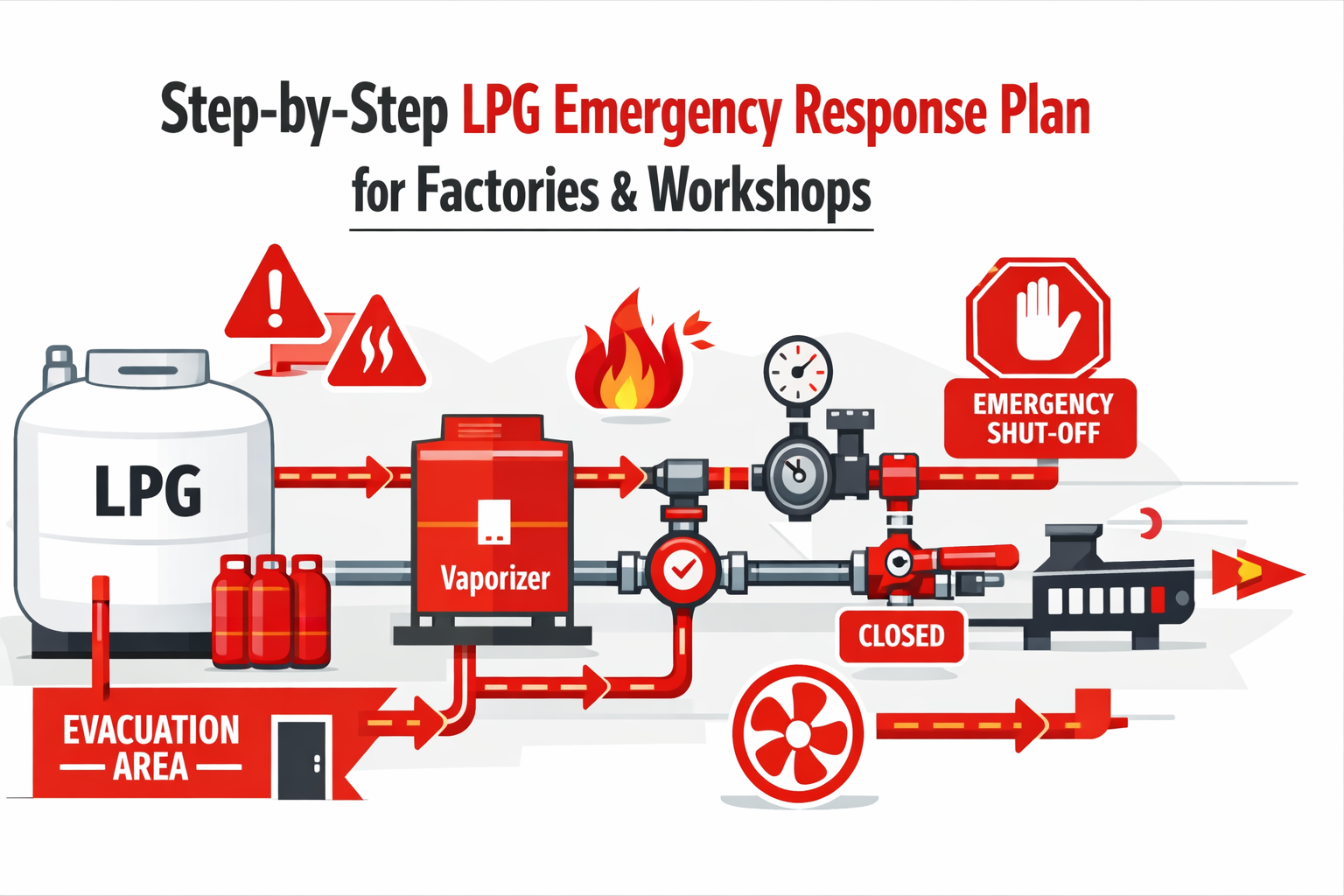
Step-by-Step First Response in an LPG Emergency Response Plan
1. Isolate the Gas Supply Immediately
The first priority is stopping gas flow at the source. Trained personnel must close the nearest manual shut-off points without delay. This typically includes cylinder valves, tank outlet valves, and downstream isolation points.
Ball valves are critical here. If these valves are poorly located, seized, or unfamiliar to staff, isolation time increases dramatically. Facilities should rely on clearly marked, easily accessible components such as those found in the LPG Ball Valves category:
https://indus3.pk/product-category/lpg-accessories/lpg-ball-wall/
Isolation should always be attempted from upwind positions where possible to reduce exposure.
2. Activate Emergency Shut-Off Systems
Where installed, automatic or semi-automatic shut-off devices must be triggered immediately. These systems are designed to stop flow faster than manual intervention, especially in high-capacity installations.
Emergency shut-off mechanisms are part of broader safety assemblies, including excess flow valves and pressure relief devices. Their correct operation depends on regular testing and compatible system design, supported by components from the LPG Safety Devices category:
https://indus3.pk/product-category/lpg-accessories/lpg-safety/
3. Control the Atmosphere Through Ventilation
Once isolation begins, attention shifts to gas dispersion. Accumulated LPG vapour is heavier than air and settles at floor level, pits, and enclosed spaces. Ventilation must be initiated immediately to dilute gas concentration.
Mechanical exhaust fans should be used only if they are explosion-proof. If not, natural ventilation through doors, shutters, and roof vents is safer. Airflow should push gas outward, not deeper into the facility.
4. Eliminate All Ignition Sources
Ignition control is often underestimated. Electrical switches, mobile phones, welding equipment, forklifts, and even static discharge can ignite LPG-air mixtures.
During an emergency, do not operate electrical controls unless they are intrinsically safe. Engines must be shut down. Hot work must cease instantly. This step is as important as gas isolation because ignition turns a leak into an explosion.
5. Initiate Controlled Evacuation
Evacuation is not a last resort. It is a parallel action. Non-essential personnel must leave the affected area immediately using predefined routes. Assembly points should be upwind and away from drainage channels where gas may accumulate.
Evacuation must be calm and controlled. Running, shouting, or crowding increases confusion and delays accountability. Supervisors should conduct rapid headcounts once safe zones are reached.
Why Sequence Matters in the First Minutes
Each step above supports the next. Isolation without ventilation leaves trapped gas. Ventilation without ignition control introduces sparks. Evacuation without isolation exposes responders to expanding risk zones. A structured sequence prevents these overlaps.
International safety authorities reinforce this approach. Guidance from National Fire Protection Association emphasises rapid isolation, ignition control, and evacuation as the core pillars of LPG emergency handling in industrial environments.
In Pakistan, where workshops and factories often operate in dense industrial clusters, disciplined first response protects not only one facility but surrounding operations as well. The next section will examine how engineering controls and equipment selection reduce the likelihood that these emergency steps are ever needed at full scale.
Equipment-Based Controls That Reduce LPG Emergency Impact
Emergency response does not begin when an alarm is raised. In industrial LPG systems, it begins much earlier — at the level of equipment selection, configuration, and condition. Engineering controls are the silent safeguards that limit how far an incident can escalate once abnormal conditions appear.
In many industrial LPG hazards Pakistan faces, investigations later show that the emergency itself was intensified by equipment that failed to perform as intended. Not because it was poorly designed, but because it was mismatched, degraded, or incorrectly integrated into the system.
The Role of Regulators, Valves, and Safety Devices
Pressure regulators sit at the heart of every industrial LPG installation. When functioning correctly, they stabilise downstream flow even when upstream pressure fluctuates. Under poor maintenance, regulators begin to drift. Springs weaken. Diaphragms stiffen. This causes slow pressure creep that operators often compensate for manually, increasing LPG safety risks without realising it.
Isolation components are equally critical. Ball valves are expected to close instantly during abnormal conditions. In reality, valves exposed to dust, corrosion, or infrequent operation may only partially close or seize completely. During an emergency, this delay allows gas to continue feeding the fault point.
Dedicated safety devices are designed to intervene when human reaction time is insufficient. Excess flow valves, pressure relief valves, and slam-shut devices respond automatically to abnormal flow or pressure. These components do not prevent incidents, but they dramatically reduce release volume and escalation potential when failures occur. Systems that rely solely on manual intervention expose operators to unnecessary danger.
Vaporizers and Thermal Protection Systems
Vaporizers represent one of the highest-risk points in industrial LPG systems. They operate at the intersection of pressure, temperature, and demand. When vaporizers are undersized, scaled internally, or controlled by faulty thermostats, they struggle to maintain stable vaporisation.
As load increases, vaporizers may overheat in an attempt to meet demand. This stresses pressure relief systems and increases the likelihood of uncontrolled discharge. Properly specified units, combined with accurate thermal cut-outs and safety valves, ensure that vaporisation remains within safe limits even during peak operation.
Facilities that source vaporizers through specialised categories such as LPG Vaporizers
https://indus3.pk/product-category/lpg-vaporizer/
benefit from equipment matched to industrial duty cycles rather than adapted from smaller applications.
Filters, Flow Stability, and System Balance
Gas filters rarely receive attention until a problem appears. Over time, debris, oil residue, and particulate matter accumulate inside filters. This restricts flow and increases upstream pressure, placing additional strain on regulators and valves.
Blocked filters are a common hidden contributor to pressure instability. They do not cause emergencies directly, but they weaken the system’s ability to respond predictably under stress. When combined with worn regulators, this imbalance accelerates failure across multiple components.
Consistent system performance depends on compatibility. Mixing components of varying pressure ratings, response times, and material quality increases failure probability during abnormal conditions.
Why Equipment Choice Shapes Emergency Outcomes
Equipment-based controls do not eliminate the need for an LPG emergency response plan. They reduce the severity of incidents when plans are activated. Facilities equipped with certified, purpose-built components experience slower escalation, clearer fault isolation, and safer intervention windows.
This relationship between equipment integrity and emergency containment is reinforced by international guidance. According to Health and Safety Executive LPG safety guidance, well-maintained regulators, isolation valves, and protective devices significantly limit the consequences of gas releases in industrial settings.
In Pakistan’s factories and workshops, where space constraints and production pressure are common, engineering controls act as the first line of defence. The next section will shift focus from equipment to people — examining how training, roles, and responsibility determine whether these controls are used effectively when incidents occur.
Training, Roles & Responsibilities During LPG Emergencies
Even the most robust LPG system can fail if people do not respond correctly under pressure. In factories and workshops, emergency outcomes are shaped as much by human behaviour as by equipment performance. A clear structure of roles, responsibilities, and training ensures that an LPG emergency response plan functions as intended rather than collapsing into confusion.
In Pakistan’s industrial environments, LPG systems are often operated by mixed-skill teams. Operators, maintenance staff, supervisors, and contractors may all interact with the same installation. Without defined responsibilities, critical actions are delayed or duplicated, increasing exposure to LPG safety risks during emergencies.
Defining Clear Roles During an LPG Incident
An effective response begins with role clarity. Every facility using LPG should formally assign emergency responsibilities before an incident occurs.
Operators are typically the first to notice abnormal conditions. Their role is observation and immediate reporting, not diagnosis. When operators attempt to “fix” problems during early escalation, they often worsen leaks or delay isolation.
Maintenance staff hold technical authority. They are responsible for isolating systems, verifying shut-down status, and assessing equipment condition once conditions are stabilised. However, maintenance teams must act within predefined limits. Improvised repairs during active gas release are a major contributor to injury in industrial LPG hazards Pakistan continues to face.
Supervisors act as coordinators. They initiate evacuation, ensure headcounts, and communicate with external responders. Without a designated supervisor role, evacuation becomes fragmented and accountability is lost.
Facilities that work with experienced industrial gas equipment suppliers often receive guidance that aligns system layout with human response paths, reducing hesitation during emergencies. This operational clarity is as important as component quality.
Training That Matches Real-World Conditions
Training is only effective when it reflects actual working conditions. Classroom instruction alone does not prepare staff for the stress of an LPG emergency.
Practical drills should simulate realistic scenarios such as regulator failure, vaporizer overheating, or valve seizure. Staff must practice identifying isolation points, understanding gas flow direction, and recognising when evacuation takes priority over intervention.
Training frequency matters. High staff turnover in workshops means knowledge degrades quickly. Refresher sessions ensure that emergency response remains instinctive rather than theoretical.
Facilities seeking structured guidance often consult through channels such as the Indus 3 Contact page (https://indus3.pk/contact), where system-specific training considerations can be aligned with equipment configuration rather than generic checklists.
Communication Under Emergency Conditions
Communication breakdown is a silent hazard. During LPG incidents, noise, stress, and environmental conditions distort verbal instructions. Clear communication protocols reduce reliance on improvisation.
Emergency signals should be standardised and understood across shifts. Visual indicators, hand signals, and pre-agreed commands prevent misunderstanding when audible communication fails.
External communication is equally important. Supervisors must know when and how to contact Civil Defence Pakistan and local emergency services. Delayed notification often results from uncertainty rather than negligence.
Facilities that document communication flows as part of their LPG emergency response plan reduce confusion and accelerate coordinated action.
Accountability and Post-Training Oversight
Assigning roles is ineffective without accountability. Emergency responsibilities must be reflected in job descriptions and reinforced through audits and drills. When roles exist only on paper, response quality deteriorates under real conditions.
Leadership commitment reinforces training effectiveness. When management participates in drills and reviews, safety culture strengthens across the organisation.
Facilities supported by suppliers listed on the Indus 3 About page (https://indus3.pk/about-us/) often benefit from long-term engagement rather than transactional equipment purchases. This continuity supports consistent training, clearer responsibility mapping, and improved emergency readiness.
Human response does not replace engineering controls. It activates them. The next section will examine what happens after an LPG incident is contained, focusing on inspection, reporting, and system recovery to prevent recurrence.
Post-Incident Actions: Reporting, Inspection & System Recovery
Once an LPG incident is contained, risk does not disappear. In many factories and workshops, secondary incidents occur during restart, not during the initial emergency. A disciplined post-incident process ensures the system is safe to return to service and that the root causes are not carried forward into daily operations.
Post-incident actions are a formal phase of an LPG emergency response plan. They protect people, equipment, and compliance standing. Skipping this phase or rushing recovery is one of the most common causes of repeat LPG failures in Pakistan’s industrial sector.
Incident Reporting and Documentation
Every LPG incident, regardless of scale, must be documented. This includes minor leaks, pressure irregularities, and safety valve activations. These events indicate system stress even if no damage occurred.
Reports should capture the timeline of events, equipment involved, isolation points used, and environmental conditions. Witness observations are valuable and should be recorded while details are fresh. Photographs of affected components help identify degradation patterns during later analysis.
Accurate documentation is not only an internal requirement. Regulatory bodies and insurers often review incident records to assess whether risks were foreseeable and preventable. Inadequate reporting weakens both safety and legal standing.
Inspection of LPG Equipment After an Incident
No LPG system should be restarted until a structured inspection is completed. Visual checks alone are insufficient. Components exposed to abnormal pressure or temperature may appear intact but be internally compromised.
Regulators must be checked for pressure stability and diaphragm integrity. Any sign of drift, sluggish response, or contamination warrants replacement rather than adjustment. Ball valves should be fully exercised to confirm smooth operation and complete sealing.
Gas filters require particular attention. After an incident, filters may contain debris dislodged by pressure surges. A partially blocked filter increases upstream stress and destabilises the entire system. Replacing or cleaning units from the Gas Filters category
https://indus3.pk/product-category/lpg-accessories/gas-filter/
restores predictable flow and reduces recurrence risk.
Vaporizers and heaters should undergo thermal assessment. Overheating during an incident can damage heating elements and insulation. Thermostats must be verified for accuracy and response speed. Faulty temperature control is a frequent contributor to repeat incidents. Certified replacements from the LPG Thermostats category
https://indus3.pk/product-category/lpg-accessories/lpg-thermostate/
help restore safe operating margins.
Re-Commissioning and Controlled Restart
Re-commissioning should be gradual. Pressurising systems slowly allows early detection of leaks or instability before full load is applied. Leak testing must be performed at all joints, valves, and regulator interfaces.
Control settings should not be returned automatically to pre-incident levels. Demand conditions may have changed, and equipment may have been downgraded following inspection. Restart parameters should reflect the system’s verified condition, not production pressure.
Supervisors should observe initial operation closely. Any abnormal flame behaviour, pressure fluctuation, or temperature variance must halt restart immediately.
Learning From the Incident to Prevent Recurrence
Post-incident review transforms emergencies into preventive lessons. Patterns often emerge when reports are reviewed collectively: repeated regulator failures, frequent filter blockage, or recurring vaporizer stress during peak shifts.
International safety guidance supports this approach. According to Health and Safety Executive LPG incident guidance, structured investigation and corrective action significantly reduce the likelihood of repeat events in industrial gas systems.
Facilities that integrate post-incident findings into maintenance schedules and equipment upgrades strengthen their overall LPG emergency response plan. Recovery is not about returning to normal quickly. It is about returning safely, with reduced risk and improved system resilience.
The next section will focus on building a site-specific LPG emergency response plan that reflects actual operating conditions in Pakistani factories and workshops, rather than generic safety templates.
Building a Site-Specific LPG Emergency Response Plan for Pakistan
No two industrial LPG installations are truly alike. Layout, load profile, equipment age, workforce skill level, and surrounding environment all influence how an emergency unfolds. A site-specific LPG emergency response plan recognises these differences and translates generic safety principles into practical, location-aware procedures.
In Pakistan, many factories rely on copied templates or supplier manuals that do not reflect real operating conditions. These documents may satisfy audits, but they fail when an incident occurs. A functional plan must be built around how LPG is actually used on site, not how it is assumed to be used.
Assessing Site-Specific LPG Risks
The foundation of a site-specific plan is a realistic risk assessment. This begins with mapping LPG flow from storage to end use. Tanks, vaporizers, regulators, manifolds, burners, and isolation points should be reviewed as a single system, not as isolated components.
High-risk zones must be identified clearly. These often include vaporizer rooms, boiler houses, enclosed workshops, and areas where LPG piping runs close to heat sources or moving machinery. Ventilation quality, drainage paths, and ignition sources should be assessed together, as LPG behaviour is influenced by all three.
Operating patterns matter. Facilities with seasonal peaks, night shifts, or batch production experience different stress cycles than continuous operations. These variations must be reflected in the emergency response plan, especially in staffing levels and supervision during high-risk periods.
Documentation and Visual Safety Mapping
An effective LPG emergency response plan is not just text. Visual clarity is critical during high-stress situations. Site maps should clearly show gas flow direction, isolation valves, emergency shut-off points, evacuation routes, and assembly areas.
These maps must be displayed where LPG is used, not stored in offices. Operators should be able to identify their nearest isolation point instinctively. Colour coding, symbols, and consistent labelling reduce decision time during emergencies.
Documentation should also define escalation thresholds. For example, when a pressure fluctuation becomes an emergency, or when evacuation overrides continued isolation attempts. Ambiguity at this stage leads to hesitation, which increases LPG safety risks.
Facilities that align documentation with system layout often find that plan reviews expose design weaknesses early. This reinforces the value of integrating planning with system design, supported by suppliers offering comprehensive industrial LPG safety solutions in Pakistan through the Indus 3 home page (https://indus3.pk/).
Alignment With Pakistani Safety Authorities
A site-specific plan must also reflect local regulatory expectations. In Pakistan, coordination with Civil Defence departments and adherence to OGRA guidance are essential. Emergency contact details, reporting protocols, and access routes for responders should be included explicitly.
Local authorities often expect facilities to demonstrate not only that a plan exists, but that it is understood and practised. Drills, records, and equipment compatibility all contribute to this assessment. Plans that ignore local enforcement practices may appear compliant on paper but fail during inspections or investigations.
Industry-focused guidance can also strengthen local relevance. Technical resources such as the Indus 3 blog on Industrial Gas Regulator Pakistan
https://indus3.pk/industrial-gas-regulator-pakistan/
provide context on how equipment behaviour influences emergency planning in local operating conditions.
From Generic Templates to Operational Readiness
The goal of a site-specific LPG emergency response plan is operational readiness. It should guide real people, using real equipment, in real spaces. When plans are tailored to the site, staff confidence increases, response time decreases, and incident severity is reduced.
This section establishes how planning must reflect reality. The final section will bring these elements together, summarising why structured emergency planning and the right industrial LPG equipment are essential for long-term safety and operational continuity.
Turning LPG Emergency Planning Into Long-Term Industrial Safety
LPG incidents in factories and workshops are rarely the result of a single failure. They emerge from a chain of conditions — equipment under stress, early warnings ignored, roles unclear, and response actions delayed. Throughout this guide, one message remains consistent: safety is not created at the moment of crisis. It is built into systems, people, and planning long before an emergency occurs.
A structured LPG emergency response plan brings these elements together. It defines how risks are recognised early, how first-response actions are executed under pressure, how equipment limits escalation, how people act with clarity, and how systems recover safely after an incident. When these pieces align, emergencies become manageable events rather than catastrophic failures.
Why Proactive LPG Emergency Planning Protects Lives and Operations
In Pakistan’s industrial landscape, LPG is a critical energy source. It powers boilers, burners, furnaces, and production lines across sectors. This dependence makes preparedness non-negotiable. Facilities without a tailored emergency response plan operate on borrowed time, relying on luck rather than control.
Proactive planning reduces uncertainty. Operators know when to escalate. Maintenance teams know when to isolate. Supervisors know when to evacuate. This shared understanding removes hesitation at the most critical moments. It also reduces damage, downtime, and regulatory exposure when incidents do occur.
Equally important, emergency planning strengthens everyday operations. Systems that are designed with isolation, ventilation, and safety devices in mind tend to operate more stably under normal conditions. Preventive maintenance improves. Equipment life extends. Safety culture becomes embedded rather than enforced.
The Role of the Right Equipment in Emergency Readiness
No response plan can compensate for unsuitable or degraded equipment. Regulators that drift, valves that seize, vaporizers that overheat, and filters that clog undermine even the best procedures. Emergency readiness depends on components that perform predictably when conditions deteriorate.
This is why industrial facilities increasingly work with suppliers who understand not just products, but system behaviour under stress. Access to certified regulators, vaporizers, safety valves, thermostats, and accessories ensures that emergency controls activate as designed, buying critical time during incidents.
Facilities looking to strengthen this foundation can explore purpose-built solutions through the Indus 3 shop page
https://indus3.pk/shop-page/
where industrial-grade LPG equipment is matched to real operating demands rather than generic specifications.
Partnering With Indus 3 for Safer LPG Operations
Effective LPG emergency planning is not a one-time exercise. It evolves as production scales, layouts change, and equipment ages. Having a long-term partner with industrial LPG expertise allows facilities to adapt safely without compromising compliance or productivity.
Indus 3 supports factories and workshops across Pakistan by combining equipment supply with system-level understanding. From vaporizers and regulators to safety devices and accessories, solutions are selected with emergency response, maintenance realities, and local operating conditions in mind.
For organisations reviewing or developing their LPG emergency response plan, engaging early with a specialist can prevent costly redesigns and reactive fixes later. To discuss system upgrades, equipment selection, or safety alignment for your facility, connect directly via the Indus 3 Contact page
https://indus3.pk/contact
A well-executed LPG emergency response plan does more than meet regulatory expectations. It protects people, preserves assets, and ensures that industrial operations in Pakistan remain resilient, responsible, and ready — even when conditions are at their most challenging.
One Reply to “LPG Emergency Response Plan for Factories & Workshops | Indus 3”