
Understanding Industrial LPG Vaporizers and Why Type Selection Matters
Industrial LPG vaporizers sit quietly at the centre of many energy systems, yet their role is critical. Any comparison of LPG vaporizer types must start with a clear understanding of what these systems do and why their design choices matter. In industrial environments, LPG is stored as a liquid under pressure. Before it can be burned efficiently, it must be converted into a stable gaseous form at the right pressure and flow rate. This is where vaporizers come in.
Choosing the wrong vaporizer type can lead to pressure fluctuations, inefficient combustion, safety risks, and avoidable downtime. For engineers and plant operators, a well-matched vaporizer is not a luxury. It is a core reliability component.
How LPG vaporizers work in industrial systems
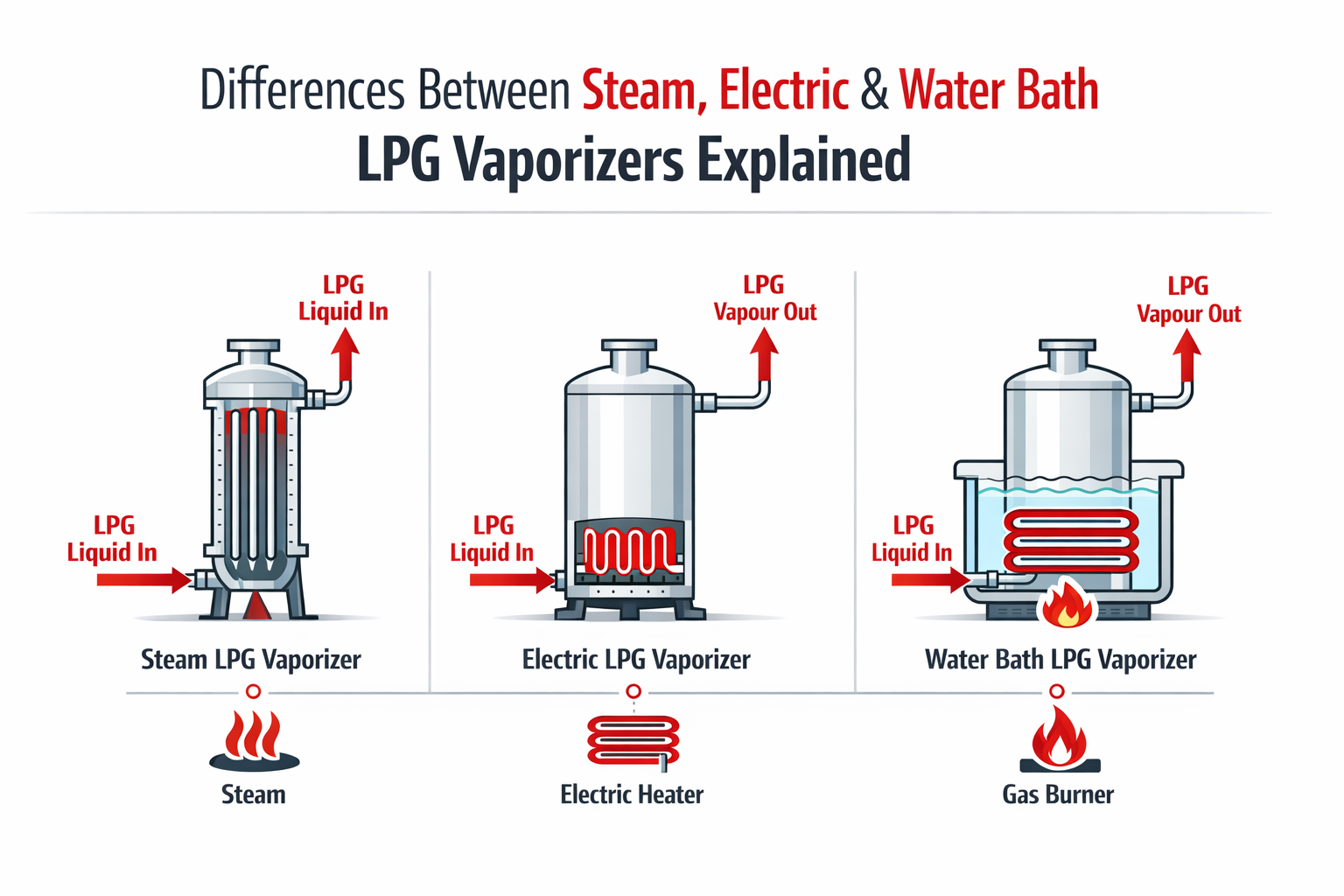
At a basic level, LPG vaporizers apply heat to liquid LPG, causing it to change phase into gas. The heat source may be steam, electricity, combustion, or heated water. Each method affects how quickly and consistently vaporisation occurs.
In industrial settings, vaporizers must handle continuous demand, sudden load changes, and varying ambient conditions. Unlike small commercial units, industrial LPG vaporizers are designed around capacity ratings, redundancy, and integration with pressure control systems. This is why an informed LPG vaporizer types comparison is essential before system design or upgrades.
Companies specialising in industrial LPG systems, such as Indus 3, typically evaluate vaporizer selection as part of the overall gas handling strategy rather than as a standalone component. This systems-first approach reduces long-term operational risks. Learn more about their role as industrial LPG system specialists at https://indus3.pk/.
Why vaporization method impacts safety and efficiency
The vaporization method directly influences both safety and energy efficiency. Insufficient heat input can cause LPG to flash unevenly, leading to pressure drops and unstable flame characteristics. Excessive or poorly controlled heat can create overheating risks and accelerate equipment wear.
Different heat sources also introduce different failure modes. Electric vaporizers rely on power stability. Steam vaporizers depend on upstream boiler performance. Direct fired systems require strict combustion safety controls. Understanding these differences is central to any industrial LPG vaporizer selection guide.
In Pakistan, industrial LPG installations must also align with national safety requirements. The Oil and Gas Regulatory Authority provides guidance on LPG handling, storage, and system safety. Engineers should always cross-check vaporizer design decisions against OGRA guidelines to ensure compliance and safe operation: https://ogra.org.pk/.
Common industrial applications in Pakistan
Across Pakistan, LPG vaporizers are used in a wide range of industries. Textile processing plants rely on stable gas supply for dryers and boilers. Food and beverage facilities use LPG for process heating and steam generation. Ceramics, glass, and metal treatment industries require consistent high-temperature output, often under continuous operation.
In industrial hubs such as Lahore, where gas demand can fluctuate due to grid constraints, LPG systems act as primary or backup fuel sources. In these cases, vaporizer reliability becomes even more important, particularly during peak production periods.
Rather than treating vaporizers as interchangeable equipment, experienced engineers compare LPG vaporizer technologies based on demand profile, site conditions, and compliance needs. This article supports that decision-making process and links back to a comprehensive industrial LPG vaporizer selection guide designed to help plants choose correctly without risking performance or safety.
By understanding how vaporizers work and why type selection matters, plant decision-makers are better prepared to evaluate steam, electric, and water bath systems in detail.
Steam Operated LPG Vaporizers: Design, Performance, and Use Cases
Steam operated LPG vaporizers are widely used in large industrial plants where steam is already available as a utility. In any serious LPG vaporizer types comparison, steam systems are usually positioned as high-capacity, high-stability solutions designed for continuous demand. Their strength lies in predictable heat transfer and the ability to handle large vaporisation loads without sharp pressure variations.
These vaporizers are commonly selected for process-driven industries where interruptions in gas supply are not acceptable and operational consistency is a priority.
Steam operated LPG vaporizer specifications
A steam operated LPG vaporizer typically uses a shell-and-tube or coil-based heat exchanger. Liquid LPG flows through internal tubes while steam circulates around them. As steam condenses, it releases latent heat, which efficiently converts LPG from liquid to gas.
Key specifications include maximum vaporisation capacity, allowable inlet pressure, steam pressure range, and design temperature limits. Compared to electric or water bath systems, steam vaporizers are well suited for very high flow rates and stable long-duration operation.
Because steam temperature is relatively constant, these vaporizers deliver consistent gas quality even during load fluctuations. This makes them a common choice in plants with boilers, cogeneration units, or central steam networks already in place.
Advantages of steam vaporizers for high demand systems
For high demand systems, steam vaporizers offer several operational advantages. First, they provide excellent thermal efficiency. The heat transfer characteristics of steam allow large quantities of LPG to be vaporised without oversized equipment.
Second, steam systems scale well. As demand increases, capacity can often be expanded by adjusting steam flow or adding parallel vaporizer units. This makes them suitable for refineries, chemical plants, textile processing facilities, and large industrial boilers.
From an LPG vaporizer performance comparison perspective, steam systems excel under continuous load. They are less sensitive to ambient temperature changes, which is particularly valuable in colder regions or during winter operation.
Many engineers comparing steam vs electric vaporizer for LPG also note that steam vaporizers reduce electrical dependency, which can be a strategic advantage in areas with unstable power supply.
Limitations and infrastructure requirements
Despite their strengths, steam operated LPG vaporizers are not universal solutions. Their biggest limitation is infrastructure dependency. A reliable steam source is mandatory. Plants without existing boilers may find the total system cost unjustifiable.
Maintenance is another consideration. Steam traps, condensate return lines, and heat exchanger surfaces require regular inspection. Poor steam quality or untreated condensate can reduce heat transfer efficiency over time.
From a safety and compliance standpoint, steam vaporizers must be designed and installed in line with pressure equipment standards and local LPG regulations. In Pakistan, system designers typically align vaporizer installations with OGRA safety guidance and relevant engineering codes. Manufacturer documentation and recognised engineering standards are often used as technical references when finalising designs.
When steam infrastructure is already present, these limitations are manageable. When it is not, alternative technologies may offer better overall value.
For organisations with in-house steam generation and long operating hours, steam vaporizers often represent the most stable option in a direct fired vs steam LPG vaporizer evaluation.
Where steam vaporizers fit best
Steam operated LPG vaporizers are best suited for industrial environments with predictable, high-volume gas demand. They are commonly integrated into central gas distribution systems supplying multiple burners or processes.
Engineering-led suppliers with long-term field experience, such as Indus 3, typically assess steam vaporizers as part of a complete LPG system rather than a standalone unit. This approach considers upstream steam availability, downstream pressure control, and future capacity expansion. You can learn more about this systems-based design philosophy through their 24+ years of industrial gas engineering experience at https://indus3.pk/about-us/.
For readers evaluating options, this section supports the broader analysis presented in the main pillar resource on how to compare LPG vaporizer technologies for industrial use.
Dry Electric LPG Vaporizers: Efficiency, Control, and Modern Applications
Dry electric LPG vaporizers represent a modern approach to vaporisation where precision, cleanliness, and control are prioritised. In an LPG vaporizer types comparison, electric systems are often favoured for their predictable performance and minimal reliance on auxiliary utilities. Instead of steam or combustion, these vaporizers use electrical heating elements to supply controlled heat directly to the LPG.
Their design makes them particularly attractive for industrial and commercial users who require stable gas output without the complexity of boilers or burners.
How dry electric LPG vaporizers work
A dry electric LPG vaporizer uses resistance heating elements embedded within a heat exchange block. Liquid LPG passes through internal channels, absorbing heat as it flows. Thermostats, sensors, and control panels regulate the temperature precisely, ensuring LPG exits as vapour at a consistent pressure.
Unlike water bath systems, there is no standing liquid medium. This “dry” design reduces thermal lag and allows the vaporizer to respond quickly to changes in demand. From an LPG vaporizer heat source comparison perspective, electric systems provide one of the most controllable heat inputs available.
Because heat delivery is uniform and monitored continuously, these vaporizers perform well under intermittent or variable loads. This makes them suitable where demand changes frequently during production cycles.
Advantages of dry electric LPG vaporizer systems
The advantages of dry electric LPG vaporizer systems are largely tied to efficiency and control. Electrical energy is converted directly into heat with minimal losses, supporting favourable LPG vaporizer efficiency comparison results at moderate capacities.
Another key benefit is cleanliness. There are no combustion by-products, no flue systems, and no condensate handling. This simplifies installation and reduces ongoing maintenance requirements. For facilities operating in clean environments, such as food processing or laboratories, this is a significant advantage.
Electric vaporizers also integrate easily with automation systems. Alarms, remote monitoring, and interlocks can be added to align with plant safety protocols. When comparing electric vs water bath LPG vaporizer options, this level of control is often a deciding factor.
Typical industrial and commercial uses
Dry electric LPG vaporizers are commonly used in medium-demand industrial processes, commercial kitchens, test facilities, and backup fuel systems. They are particularly effective where steam is unavailable and combustion-based systems are undesirable.
However, their suitability depends on electrical infrastructure. High-capacity electric vaporizers require stable power supply and appropriate load planning. In regions where electrical reliability varies, this must be assessed carefully during system design.
From a compliance perspective, electrical safety standards are critical. Installations should align with recognised electrical and hazardous area guidelines. In South Asia, references such as PESO safety frameworks are often used alongside manufacturer documentation to validate safe electrical installation practices: https://peso.gov.in/.
Positioning electric vaporizers in system design
In a broader LPG vaporizer selection guide, dry electric systems are best viewed as precision tools rather than universal solutions. They excel in controlled environments, moderate capacities, and applications where responsiveness matters more than sheer output.
Engineering-led suppliers typically recommend electric vaporizers after evaluating demand profile, duty cycle, and power availability. Indus 3 approaches this by offering industrial LPG vaporizer options that align with real operating conditions rather than catalogue specifications alone. Relevant system configurations can be explored through their industrial LPG vaporizer solutions at https://indus3.pk/shop-page/.
This section supports the wider discussion on selecting the best LPG vaporizer type for industrial use, which is explored in detail within the main pillar resource comparing LPG vaporizer technologies across applications and environments.
Water Bath and Direct Fired LPG Vaporizers: Traditional but Demanding
Water bath and direct fired LPG vaporizers are among the earliest vaporisation technologies still in use today. In an LPG vaporizer types comparison, these systems are often described as robust and self-sufficient, yet operationally demanding. They rely on combustion-based heat rather than electricity or steam, which makes them viable in locations where utilities are limited.
Despite their age, these vaporizers continue to serve specific industrial scenarios where simplicity and independence outweigh efficiency concerns.
Water bath LPG vaporizer pros and cons
A water bath LPG vaporizer uses a burner to heat a tank of water, with LPG coils submerged inside. Heat transfers from the hot water to the LPG, converting it into vapour. One of the main advantages of this design is thermal stability. The water acts as a buffer, smoothing temperature fluctuations during variable demand.
However, water bath LPG vaporizer pros and cons must be evaluated carefully. While they perform reliably in cold climates and remote sites, they require regular water quality management, burner maintenance, and safety checks. Heat losses are also higher, which affects overall LPG vaporizer efficiency comparison results when measured against steam or electric systems.
Direct fired LPG vaporizer features
Direct fired LPG vaporizers apply flame heat directly to the vaporisation chamber or heat exchanger. This design eliminates the water medium, making the system more compact and responsive. Direct fired LPG vaporizer features include faster start-up times and the ability to operate independently of steam or electrical infrastructure.
These vaporizers are commonly used in agriculture, temporary installations, and remote industrial operations. From an LPG vaporizer heat source comparison perspective, they offer high heat output but require strict burner control and flame supervision systems.
Fuel consumption and emissions must also be considered. Compared to electric systems, direct fired units demand closer operator attention and disciplined maintenance routines.
Safety and operational considerations
Safety is the defining factor when evaluating combustion-based vaporizers. Both water bath and direct fired systems involve open flames and high temperatures near LPG equipment. This increases the importance of proper ventilation, flame failure protection, and emergency shutdown systems.
In Pakistan, such installations must align with OGRA safety guidance for LPG handling and combustion equipment. Engineers often reference OGRA documentation alongside manufacturer manuals to validate design and installation practices: https://ogra.org.pk/.
Operationally, these vaporizers require trained personnel. Burner tuning, periodic inspection, and water treatment are not optional. For facilities without in-house technical capability, these demands can outweigh the benefits of utility independence.
Where these vaporizers still make sense
Despite their challenges, water bath and direct fired LPG vaporizers remain relevant. They are often selected for remote locations, seasonal operations, or sites with limited access to electricity or steam. In these contexts, their self-contained nature is a genuine advantage.
Engineering consultants typically recommend these systems only after a careful review of site conditions and safety management capability. Organisations considering such technologies often seek expert input through an industrial LPG system consultation to avoid compliance and reliability issues. Indus 3 supports this evaluation process through its system design experience and encourages clients to discuss requirements directly via https://indus3.pk/contact/.
This section supports the wider pillar discussion on industrial LPG vaporizer types explained, helping readers understand where traditional technologies still fit and where modern alternatives may offer lower long-term risk.
LPG Vaporizer Performance and Efficiency Comparison Across Technologies
When engineers compare LPG vaporizer technologies, performance and efficiency usually outweigh initial cost. A proper LPG vaporizer types comparison looks beyond heat source preference and focuses on how each system behaves under real operating conditions. Capacity stability, energy losses, and response to load changes all influence long-term reliability and operating expense.
Understanding these differences helps decision-makers avoid undersized equipment, excessive energy consumption, or poor combustion performance downstream.
LPG vaporizer capacity ratings explained
LPG vaporizer capacity ratings define how much liquid LPG can be converted into vapour per hour under specified conditions. These ratings are not interchangeable across technologies. Steam vaporizers typically achieve the highest continuous capacities due to efficient latent heat transfer. Electric vaporizers offer precise control but are usually limited to moderate flow rates by electrical load constraints.
Water bath and direct fired systems often advertise high nominal capacities, but actual output can fluctuate based on burner performance, ambient temperature, and maintenance condition. This is why capacity ratings must always be reviewed alongside duty cycle and demand profile.
From an engineering perspective, vaporizers should be selected with headroom rather than operated at maximum rating continuously. This improves stability and equipment life.
Efficiency comparison by heat source
In an LPG vaporizer efficiency comparison, steam and electric systems generally outperform combustion-based technologies. Steam vaporizers benefit from efficient heat exchange and minimal losses when condensate recovery is managed properly. Electric vaporizers convert electrical energy directly into heat, offering high efficiency at smaller scales.
Water bath vaporizers lose heat through the tank surface and require constant burner operation to maintain temperature. Direct fired systems are the least efficient due to radiant and exhaust heat losses, although they compensate with independence from external utilities.
Efficiency must also be considered in context. A slightly less efficient vaporizer may still be the better choice if it aligns with existing site infrastructure.
Performance in continuous vs intermittent demand
Continuous demand environments, such as industrial boilers and process heating systems, favour steam vaporizers. Their thermal stability supports steady gas output without frequent control adjustments. Electric vaporizers perform well under intermittent demand, where fast response and accurate control prevent pressure swings.
Water bath systems handle fluctuating loads reasonably well due to thermal buffering but respond slowly to sudden demand spikes. Direct fired vaporizers respond quickly but require careful burner modulation to maintain safe operation.
From an LPG vaporizer performance comparison standpoint, no single technology dominates all scenarios. Performance depends on how well the vaporizer matches the load profile.
System-level comparison for industrial plants
Rather than viewing vaporizers in isolation, experienced engineers evaluate them as part of a complete LPG system. This includes storage, pressure regulation, control valves, and safety devices. Organisations seeking complete industrial LPG solutions often prioritise system balance over headline efficiency figures. Indus 3 applies this approach across its industrial gas installations, focusing on long-term performance rather than short-term optimisation. More insight into this systems-based methodology can be found at https://indus3.pk/.
This section supports the broader pillar analysis on LPG vaporizer heat source comparison, reinforcing the importance of matching technology to operating reality rather than relying on generic performance claims.
Choosing the Right LPG Vaporizer Type for Industrial Conditions
Selecting the correct vaporizer is not about choosing the most advanced technology. It is about choosing the most appropriate one for the operating environment. A practical guide to choosing LPG vaporizer type focuses on site conditions, demand behaviour, and long-term operating realities. When these factors are aligned, system reliability improves and operating risks decrease.
In Pakistan, where industrial conditions vary widely by region and sector, this evaluation becomes even more important.
LPG vaporizer selection criteria
The first step in LPG vaporizer selection criteria is understanding demand. Engineers must assess peak load, average consumption, and whether demand is continuous or intermittent. Climate, available utilities, and space constraints also play a major role.
For example, facilities with an existing boiler system may naturally favour steam vaporizers. Sites with stable electrical infrastructure and moderate demand may benefit from dry electric systems. Remote locations without reliable utilities often lean towards water bath or direct fired designs.
Maintenance capability should never be overlooked. A technically complex vaporizer may perform well on paper but struggle in environments without skilled maintenance support.
Best LPG vaporizer for cold climates and high demand
Cold climates introduce additional challenges. Low ambient temperatures increase the risk of LPG freezing and pressure drop. In such cases, steam vaporizers and water bath systems perform more reliably due to consistent heat availability. This is why they are often considered the best LPG vaporizer for cold climates and high demand systems.
High-demand applications, such as industrial boilers and continuous process heating, require vaporizers that can operate at stable output for long hours. Steam systems typically dominate this category, particularly where load variation is minimal.
Electric vaporizers can support cold environments but may require higher power ratings, which must be evaluated carefully during design.
Vaporizers for remote or power-limited sites
In power-limited or remote locations, utility independence becomes the priority. Direct fired and water bath vaporizers are often selected for agriculture, seasonal processing plants, or temporary installations. Their ability to operate without electricity or steam makes them practical, despite higher maintenance requirements.
However, safety management is critical in these scenarios. Combustion-based vaporizers demand disciplined operating procedures and regular inspection. This is where engineering-led design and site-specific risk assessment add real value.
Engineering-led decision making
Rather than relying on generic recommendations, experienced engineers assess vaporizer choice within the full LPG system context. Indus 3 follows this engineering-led LPG system design approach, balancing performance, safety, and lifecycle cost. You can learn more about their methodology through their engineering-led LPG system design experience at https://indus3.pk/about-us/.
This section supports the main pillar content on identifying the best LPG vaporizer for industrial plants, helping decision-makers move from theoretical comparison to practical selection grounded in real operating conditions.
Regional Considerations: LPG Vaporizer Types Used in Pakistan, UAE, and India
LPG vaporizer selection is rarely universal. Climate, regulation, energy infrastructure, and industry mix all shape which technologies dominate in a given region. A serious LPG vaporizer types comparison must therefore account for geographic context, especially for operators working across South Asia and the Middle East.
Understanding these regional patterns helps engineers avoid designs that work well on paper but struggle in real-world conditions.
LPG vaporizer types in Pakistan
In Pakistan, LPG vaporizers are widely used in textiles, food processing, ceramics, and industrial boilers. Steam operated vaporizers are common in large plants that already operate boilers, particularly in industrial zones around Lahore, Faisalabad, and Karachi. Their ability to support continuous demand makes them suitable for energy-intensive processes.
Dry electric LPG vaporizers are increasingly adopted in commercial kitchens, medium-scale industries, and backup fuel systems where precision and cleanliness are priorities. Water bath and direct fired systems remain in use in agriculture and remote installations, where access to electricity or steam is limited.
All installations must align with national safety and licensing requirements. The Oil and Gas Regulatory Authority sets the regulatory framework for LPG storage and vaporisation systems in Pakistan, and engineers typically reference OGRA guidance during system design and approval: https://ogra.org.pk/.
Differences in UAE and Indian installations
In the UAE, LPG vaporizer technologies are strongly influenced by strict safety enforcement and environmental controls. Electric and steam vaporizers dominate industrial and commercial sectors due to their cleaner operation and ease of compliance. Direct fired systems are less common and are typically restricted to controlled industrial environments.
India presents a mixed landscape. Steam vaporizers are widely used in large manufacturing plants, while electric vaporizers are popular in urban commercial applications. Water bath systems remain prevalent in rural and agricultural settings, reflecting infrastructure variability across regions.
From a compare LPG vaporizer technologies perspective, India and Pakistan share similar industrial challenges, but regulatory enforcement and utility reliability often differ.
Compliance and environmental factors
Across all three regions, compliance increasingly influences vaporizer choice. Emissions control, electrical safety, and pressure equipment standards shape what technologies are acceptable in different settings. Environmental considerations also push industries towards cleaner heat sources where feasible.
Suppliers with regional experience understand how these factors interact. Indus 3 positions itself as a Pakistan-based industrial gas supplier with regional awareness, supporting clients whose operations span borders or adopt international best practices. More about their industrial focus can be found at https://indus3.pk/.
This regional overview supports the broader pillar discussion on LPG vaporizer options for industrial systems, reinforcing that the “best” vaporizer type is always context-driven rather than universally fixed.
Selecting the Right LPG Vaporizer Technology with Confidence
Selecting the right vaporizer is ultimately an engineering decision, not a catalogue choice. As this LPG vaporizer types comparison shows, steam, dry electric, water bath, and direct fired systems each serve specific industrial realities. Performance, efficiency, safety, and long-term reliability all depend on how well the vaporizer matches the operating environment.
Steam operated vaporizers remain the preferred option for high-demand, continuous industrial processes with existing boiler infrastructure. Dry electric LPG vaporizers excel where precision, cleanliness, and controlled demand are priorities. Water bath and direct fired vaporizers continue to play a role in remote or utility-limited sites, provided safety and maintenance are managed correctly.
What separates reliable LPG systems from problematic ones is not the technology alone, but the quality of system design behind it. Vaporizer sizing, heat source selection, control integration, and compliance planning must all work together. This is where experienced engineering input becomes critical.
Indus 3 approaches LPG vaporizer selection as part of a complete system, balancing technical performance with real operating conditions. If you are evaluating a new installation or upgrading an existing setup, discussing your requirements with an experienced team can prevent costly mistakes. You can discuss your LPG vaporizer requirements directly through https://indus3.pk/contact/ or explore industrial LPG vaporizer solutions suited to your application at https://indus3.pk/shop-page/.
With the right guidance and a clear understanding of how LPG vaporizer types work, industrial operators can move forward with confidence, safety, and long-term operational stability.