
Understanding LPG Transportation Safety in Pakistan
Liquefied Petroleum Gas plays a critical role in Pakistan’s energy mix, supplying fuel to industries, commercial kitchens, hospitals, and millions of households. As consumption grows, LPG transportation safety Pakistan becomes a frontline concern for plant managers, contractors, and safety officers responsible for moving this fuel from import terminals and bottling plants to end users. Transportation is the most exposed stage of the LPG value chain, where technical risk meets public space.
LPG is classified globally as hazardous cargo because of its physical and chemical behaviour. It is stored and transported under pressure, allowing large quantities of energy to be concentrated in relatively small volumes. When released, LPG rapidly expands and forms vapour clouds that are heavier than air. This means leaked gas can travel along the ground, accumulate in low-lying areas, and reach ignition sources some distance away. Combined with its high flammability range, even a small loss of containment during transport can escalate into fires, explosions, or flashback incidents.
Why LPG Transportation Safety Pakistan Is a High-Risk Activity
Unlike many liquid fuels, LPG does not dissipate quickly in open air. In road or port environments, a leak can remain undetected until gas concentrations reach dangerous levels. Tanker rollover, valve damage, poor cylinder handling, or thermal exposure can all trigger release scenarios. These risks are amplified in Pakistan due to dense urban routes, mixed traffic conditions, and limited buffer zones between transport corridors and populated areas.
For safety officers, this makes transportation the phase where engineering controls, operating discipline, and emergency preparedness must work together. Without structured safety frameworks, reliance on experience alone is not enough to manage these hazards consistently.
How LPG Is Transported Across Pakistan
In Pakistan, LPG moves through three primary transport channels. Road tankers are the backbone of domestic distribution, carrying bulk LPG from refineries, import terminals, and storage depots to bottling plants and industrial consumers. These tankers operate under pressure and require robust vessel design, secure valves, and controlled loading and unloading practices to minimise risk during transit.
Cylinder transportation is the most visible form of LPG movement. Filled cylinders are distributed by trucks, pickups, and trolleys to commercial and domestic markets. While individual cylinders contain smaller quantities, the cumulative risk increases when many are transported together without adequate separation, securing, or impact protection.
Sea-based LPG imports add another layer of complexity. LPG transport ships deliver cargo to port terminals, where it is transferred into storage and onward distribution networks. This interface between marine transport and land logistics introduces additional ignition sources, transfer risks, and emergency response challenges, particularly in busy port environments.
The Need for Structured Safety Frameworks
The diversity of transport modes highlights why LPG transportation cannot rely on informal practices. Each stage introduces different failure points, yet all share the same fundamental hazards. This is why the industry increasingly depends on documented procedures, engineered safeguards, and regulatory oversight to create consistency across operators.
National oversight bodies such as Oil and Gas Regulatory Authority provide the regulatory context that shapes how LPG is moved safely across the country. Their role underlines the importance of aligning daily transport operations with recognised safety principles rather than ad-hoc decision-making.
For organisations involved in LPG handling and logistics, partnering with experienced technical suppliers and advisors becomes essential. Companies offering industrial LPG safety solutions such as those highlighted at https://indus3.pk/ help bridge the gap between theory and field reality. Backed by Indus 3’s industry experience (https://indus3.pk/about-us/), structured safety approaches can be embedded into transport systems before incidents occur.
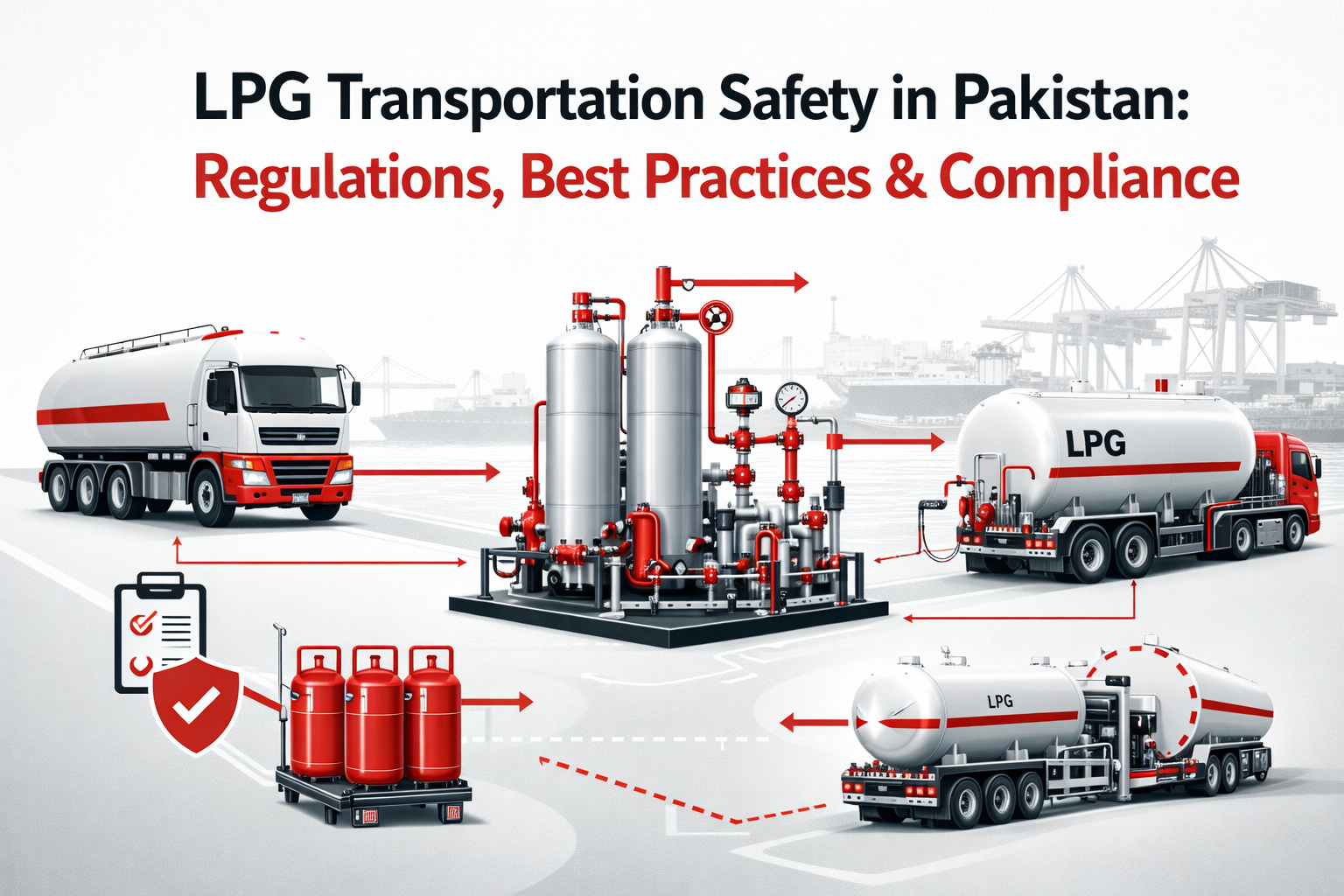
A simple schematic-style illustration comparing road tankers, cylinder distribution, and sea-based LPG transport can be useful here, helping teams visualise where risks concentrate across the transport chain.
How Is LPG Transported? Road, Sea, and Bulk Handling Explained
For engineers and operators entering the LPG sector, one of the first practical questions is straightforward: how is LPG transported from source to point of use? In Pakistan, LPG logistics follow a structured but multi-modal flow, shaped by geography, infrastructure, and demand centres. Understanding this flow is essential before diving into detailed safety or compliance procedures.
How Is LPG Transported by Road in Pakistan
Road transport is the dominant method of LPG movement within Pakistan. Bulk LPG is carried in pressurised road tankers from refineries, import terminals, and storage depots to bottling plants and large industrial consumers. These tankers are not ordinary fuel trucks. They are cylindrical pressure vessels designed to withstand internal pressure, temperature variation, and mechanical stress during long-distance travel.
Key design features include thick steel shells, reinforced end caps, pressure relief valves, and protected liquid and vapour lines. The shape itself is intentional: a cylindrical vessel distributes stress evenly, reducing the likelihood of rupture under pressure. From a logistics perspective, road tankers offer flexibility. They can reach inland cities, industrial zones, and remote markets where pipeline infrastructure does not exist.
Alongside bulk tankers, road transport also handles LPG cylinders. Trucks and smaller vehicles distribute filled cylinders to distributors, commercial kitchens, and retail outlets. While each cylinder contains a limited quantity of gas, risks increase when many cylinders are transported together. Poor stacking, inadequate restraints, or impact during loading and unloading can damage valves, increasing the chance of leakage during transit.
Bulk LPG Transportation Versus Cylinder Movement
Bulk LPG transportation and cylinder movement serve different roles but are closely linked. Bulk tankers feed bottling plants and high-volume users, forming the upstream logistics layer. Cylinder distribution is downstream, closer to consumers and more exposed to traffic congestion, manual handling, and short-distance trips.
In practical terms, this means risk profiles differ. Bulk tankers operate on defined routes with controlled loading points, while cylinder vehicles make frequent stops in crowded urban environments. Understanding these differences helps operators choose suitable LPG transport and storage equipment and design workflows that match actual operating conditions rather than theoretical models.
LPG Transport Ship and Sea-Based Imports
Pakistan also relies heavily on sea-based LPG imports. This answers another common query: what is an LPG transport ship and how does it fit into local supply? LPG carriers deliver cargo to coastal terminals, where it is transferred into onshore storage before entering the domestic distribution network.
Port Qasim, including facilities such as the Pakistan International Bulk Terminal (PIBT), plays a critical role in this flow. At the port level, LPG handling focuses on controlled ship-to-shore transfer, temporary storage, and onward dispatch by road tankers. From a logistics standpoint, this is a transition point between marine transport and inland distribution, not an end destination.
At this stage, coordination matters more than speed. Delays, misalignment between ship schedules and road tanker availability, or inadequate staging areas can disrupt supply chains. A simple transport flow diagram comparing road-only distribution with combined sea-to-road movement is often useful for teams planning capacity and turnaround times.
Transport Classification and Standards Context
Across all these modes, LPG is formally classified as hazardous cargo due to its pressurised and flammable nature. Bodies such as Petroleum and Explosives Safety Organization provide internationally referenced classification frameworks that influence how LPG transport vessels and routes are designed, even when local enforcement varies.
For organisations navigating these complexities, early-stage planning and technical consultation (https://indus3.pk/contact/) can prevent costly redesigns later. Clear understanding of transport modes, equipment roles, and flow logic forms the foundation on which safety systems and compliance measures are built in subsequent stages.
LPG Transport Regulations in Pakistan: OGRA, PESO & Legal Compliance
LPG transportation in Pakistan operates under a tightly regulated framework because the consequences of failure are severe. LPG transport regulations are not administrative formalities; they are risk controls designed to prevent fires, explosions, supply disruptions, and loss of life. For operators, contractors, and fleet owners, non-compliance routinely results in vehicle impoundment, operational shutdowns, heavy fines, and—most critically—serious accidents.
At the centre of this framework is licensing and oversight by Oil and Gas Regulatory Authority (OGRA). Any entity involved in LPG transportation must hold valid authorisation that defines what can be transported, in what quantity, and under which conditions. From an operational perspective, this means transport activity is tied directly to documentation, traceability, and inspection readiness. Unlicensed or conditionally approved operations are among the most common reasons for enforcement action across Pakistan.
OGRA Licensing and Route Control
OGRA does not regulate LPG transport in isolation. Licensing is linked to approved transport routes, especially for bulk road tankers. These routes are selected to reduce exposure to dense populations, sensitive infrastructure, and high-traffic urban corridors where possible. Deviating from approved routes without authorisation is treated as a serious breach, even if no incident occurs.
In practice, route compliance is one of the most visible enforcement realities. Traffic stops, roadside inspections, and coordination with local authorities mean that transporters must assume they can be checked at any point. Operators who treat route approval as flexible often face immediate suspension rather than warnings. This is why structured planning, supported by LPG compliance support from experienced partners such as https://indus3.pk/, becomes a necessity rather than a safeguard.
Vehicle Certification and Fitness Requirements
Another core pillar of LPG transport regulations is vehicle certification. Road tankers and cylinder transport vehicles must meet defined construction and fitness standards. These include pressure vessel integrity, valve protection, emergency shut-off arrangements, and clear hazard identification markings.
From an operational standpoint, certification is not a one-time hurdle. Periodic inspections, pressure testing, and documentation renewal are required to keep vehicles legally active. In Pakistan, enforcement agencies increasingly focus on expired certificates and undocumented modifications. A tanker that appears structurally sound can still be taken off the road if paperwork is incomplete or inspection intervals are missed.
Internationally aligned standards, including those referenced by Petroleum and Explosives Safety Organization (PESO), influence how LPG transport vehicles are classified and assessed. While PESO is not a Pakistani authority, its technical benchmarks are widely recognised and often referenced in engineering and safety audits across the region.
Operator Training and Accountability
Regulations extend beyond equipment to the people operating it. OGRA places clear responsibility on licensed entities to ensure that drivers and handlers are trained specifically for LPG transportation. This goes beyond holding a standard driving licence. Operators must understand pressure behaviour, emergency isolation, leak recognition, and basic incident response.
In enforcement cases, lack of documented training is frequently cited as an aggravating factor. Even when equipment failure is the root cause, untrained response can turn a controllable event into a major incident. This is why companies with strong regulatory advisory experience, such as those outlined at https://indus3.pk/about-us/, emphasise training as part of compliance strategy rather than an afterthought.
Why Non-Compliance Has Immediate Consequences
Unlike many industrial regulations that rely on post-incident review, LPG transport enforcement in Pakistan is proactive. Authorities act on the assumption that prevention is cheaper than response. Shutdowns and fines are therefore applied early, sometimes on technical grounds that operators consider minor.
A regulatory checklist-style visual—covering licensing status, route approval, vehicle certification, and operator training—can be a practical tool for transport managers. It helps convert complex regulatory expectations into actionable, day-to-day controls.
Ultimately, LPG transport regulations exist to protect assets, people, and continuity of supply. Treating them as operational requirements rather than legal hurdles is the only sustainable way to operate in Pakistan’s high-risk, high-scrutiny LPG environment.
LPG Handling and Transport Safety at Ports, PIBT & Urban Areas
LPG handling and transport in Karachi present a distinct risk profile compared to inland routes. As Pakistan’s primary port city and a dense metropolitan area, Karachi concentrates port operations, fuel storage, road logistics, and large populations within a limited geographic footprint. For operators managing lpg handling and transport Karachi, safety is shaped as much by environment as by equipment.
LPG Handling and Transport at PIBT
Port Qasim is a key gateway for imported LPG, with facilities such as the Pakistan International Bulk Terminal (PIBT) forming a critical transition point between sea transport and inland distribution. At PIBT, LPG handling typically follows a clear flow: ship arrival, controlled unloading, temporary storage, and dispatch via road tankers to bottling plants and industrial users.
From a safety perspective, this interface between marine and road transport is where risks concentrate. Multiple ignition sources coexist in close proximity—ship engines, electrical equipment, tanker movements, and port machinery. LPG’s heavier-than-air behaviour means that any release during transfer can accumulate at ground level, especially in calm weather conditions common at port berths.
Operational focus at PIBT is therefore on maintaining controlled movement and separation. Tankers must be staged, loaded, and released in a sequence that avoids congestion within the terminal. An illustrated layout of port-side LPG handling—showing ship berths, transfer arms, storage areas, and tanker exit routes—can be especially effective in helping teams visualise how risk propagates through the system.
Dense Urban Routes and Congestion Risks
Once LPG leaves the port, it enters Karachi’s urban transport network. Congestion is not just a logistical inconvenience; it is a safety variable. Extended idling increases thermal exposure, traffic density raises collision probability, and proximity to informal roadside activities multiplies ignition sources.
Urban routes also amplify population exposure. In many parts of Karachi, LPG transport vehicles pass through mixed-use areas where residential buildings, shops, workshops, and street vendors operate side by side. A minor leak that might disperse harmlessly on an open highway can become critical in a confined street with poor ventilation.
This reality demands route planning that accounts for time of day, traffic patterns, and local activity levels. While approved routes set the baseline, real-world conditions require continuous situational awareness by drivers and dispatch teams.
Ignition Sources and Environmental Factors
Karachi’s port and urban environments introduce a wide range of ignition sources that are difficult to control externally. Open flames from food stalls, welding activities, unprotected electrical connections, and vehicle exhaust systems are common along transport corridors. High ambient temperatures further increase vapour pressure inside LPG containers, stressing valves and seals.
For this reason, LPG handling in Karachi cannot rely solely on compliance documentation. It must be supported by physical safeguards, monitoring, and rapid response capability. Selecting appropriate LPG safety devices (https://indus3.pk/shop-page/)—such as excess flow valves, pressure relief systems, and gas detection equipment—helps mitigate the consequences when environmental controls are limited.
Emergency Preparedness and Response Readiness
In high-density environments, response time is critical. Emergency preparedness for LPG transport around PIBT and urban Karachi focuses on early detection, immediate isolation, and clear communication. Drivers and site personnel must know when to stop operations, secure the area, and escalate incidents without hesitation.
Coordination with port authorities and local emergency services is an essential part of this readiness. Guidance from bodies such as the Port Qasim Authority underlines the importance of defined emergency access routes, muster points, and communication protocols within port limits.
For operators, periodic site safety assessment (https://indus3.pk/contact/) provides an opportunity to evaluate real transport conditions rather than assumed ones. By reviewing congestion patterns, ignition risks, and emergency access in Karachi’s evolving urban landscape, LPG handlers can adapt safety measures before incidents expose weaknesses.
In environments as complex as Karachi and PIBT, LPG transport safety is ultimately about anticipating interaction—between fuel, infrastructure, and people—and managing it deliberately rather than reactively.
LPG Cylinder Transportation Procedures and On-Site Safety
While bulk tankers attract most regulatory attention, a significant share of LPG incidents occur much closer to end users during transporting LPG gas bottles and short-distance cylinder movement. Cylinders are handled more frequently, moved manually, and often transported through congested areas. For this reason, lpg cylinder safety during transportation and on-site handling deserves focused operational discipline rather than informal practice.
Manual Handling Hazards in Cylinder Transport
LPG cylinders are heavy, pressurised containers with a high centre of gravity. Manual handling introduces risks that are not always obvious to untrained personnel. Dropping a cylinder, dragging it across rough surfaces, or allowing it to strike hard edges can damage valves or weaken the neck ring. Even when no visible damage is present, internal valve misalignment can lead to slow leaks during transit.
Repeated manual lifting also increases the likelihood of fatigue-related errors. In commercial distribution, cylinders may be loaded and unloaded dozens of times in a single shift. Without clear procedures, the probability of mishandling rises sharply. This is why cylinder movement should be treated as a controlled operation, not a routine task.
LPG Cylinders Trolley Transportation Procedure
Short-distance movement using trolleys is common at bottling plants, warehouses, and retail distribution points. A proper lpg cylinders trolley transportation procedure starts with using trolleys designed specifically for gas cylinders. These should provide stable support, secure retention points, and smooth-rolling wheels to avoid sudden impacts.
Cylinders must always be transported in an upright position. Laying cylinders horizontally on trolleys increases stress on valves and can compromise pressure relief mechanisms. Trolleys should never be overloaded; exceeding design capacity reduces stability and increases the risk of tipping, especially on uneven surfaces or ramps.
Clear pathways are equally important. Moving cylinders through cluttered areas or across steep inclines introduces unnecessary hazards. Where possible, dedicated cylinder routes should be marked within facilities to separate cylinder movement from pedestrian traffic and other operations.
Stacking Rules and Separation Distances
When cylinders are transported or temporarily staged, stacking rules play a critical role in preventing chain-reaction incidents. Cylinders should not be stacked in a way that places weight on valve assemblies. Interlocking stacks may appear stable, but they increase the risk of multiple cylinders falling if one shifts.
Separation distances are another key control. Cylinders in transit should be kept away from ignition sources, heat-generating equipment, and combustible materials. Even during short stops, cylinders should not be placed near open flames, welding activities, or electrical panels. Maintaining clear separation reduces the chance that a minor leak escalates into a fire.
Selecting appropriate cylinder safety accessories (https://indus3.pk/shop-page/)—such as valve caps, protective collars, and securing straps—adds a practical layer of protection during transport and handling.
Valve Protection and Leak Prevention
The valve is the most vulnerable component of an LPG cylinder. Damage to the valve is responsible for a large proportion of cylinder-related incidents. Protective caps should always be fitted during transport, even for short distances. Caps shield the valve from impact and prevent accidental opening caused by vibration or contact.
Routine visual checks before and after transport help detect early signs of leakage, corrosion, or mechanical damage. These checks are not a substitute for formal inspection, but they act as an immediate safeguard during daily operations.
Standards Context and Visual Aids
Internationally recognised safety bodies such as the Petroleum and Explosives Safety Organization provide widely referenced guidance on cylinder handling, stacking, and valve protection. Although enforcement frameworks vary by country, the technical principles remain consistent and are applicable across industrial settings in Pakistan.
Rather than relying on decorative photography, a simple safety illustration showing correct trolley use, upright positioning, valve protection, and separation distances can be far more effective. Visual clarity helps reinforce procedures on the ground, especially for teams working under time pressure.
Integrated into broader industrial LPG solutions (https://indus3.pk/), disciplined cylinder transportation practices reduce incidents at the most frequent and most human-dependent stage of the LPG supply chain.
Risk Analysis, HAZOP & Fire Safety in LPG Transportation
For engineers and safety auditors, managing LPG transport risk starts with structured analysis rather than reactive controls. Among the most widely applied methodologies is LPG transportation HAZOP (Hazard and Operability Study), which systematically examines how deviations in pressure, flow, temperature, or containment can escalate into incidents during transport. In LPG logistics, HAZOP is less about paperwork and more about anticipating failure modes before they manifest on the road or at transfer points.
LPG Transportation HAZOP Explained
A transport-focused HAZOP typically breaks the LPG movement chain into nodes: loading, transit, unloading, and temporary staging. Each node is analysed using guide words such as more pressure, less flow, leakage, or loss of containment. For example, a deviation like overpressure during transit may be linked to causes such as thermal expansion, blocked relief paths, or valve malfunction.
What makes LPG transport HAZOP particularly critical is mobility. Unlike fixed installations, transport systems are exposed to vibration, impact, traffic incidents, and environmental variation. A well-executed HAZOP therefore considers not only equipment failure but also human factors, route conditions, and external interference. The outcome is a prioritised list of credible scenarios that inform design choices and operational controls.
Fire, Leak, and Explosion Scenarios
Ignition scenarios in LPG transportation generally follow a predictable pattern. A leak occurs, gas accumulates in a low-lying area, and an ignition source is encountered. The source may be obvious, such as an open flame, or indirect, such as static discharge or vehicle exhaust.
From an engineering perspective, the key variable is time. The longer a leak remains undetected, the larger the vapour cloud becomes and the wider the potential impact zone. This is why transport risk assessments focus heavily on early detection and rapid isolation rather than relying solely on passive containment.
Collision-induced valve damage, hose failure during transfer, and thermal exposure during traffic delays are among the most commonly modelled scenarios. Each has a different escalation pathway, but all benefit from layered protection rather than single-point safeguards.
Layered Protection Systems in Practice
Layered protection is a core principle in LPG transport safety. No single device can eliminate risk; instead, multiple independent barriers reduce the likelihood and severity of incidents. At the equipment level, excess flow valves are designed to restrict gas release if downstream lines fail. Their role is preventive, limiting leak rates rather than stopping leaks entirely.
Gas detection systems add another layer by identifying abnormal conditions early. In transport and transfer environments, detection is most effective when paired with clear response protocols. Detection without action capability offers limited risk reduction.
Emergency shutoff systems form the final active barrier. When triggered manually or automatically, they isolate sections of the system to prevent continued release. When integrated correctly into LPG safety systems (https://indus3.pk/shop-page/), these devices work together to buy time—time for operators to respond and for emergency measures to take effect.
Fire Safety Validation and Standards Context
Fire behaviour and escalation modelling for LPG transport are guided by internationally recognised technical standards. Bodies such as the National Fire Protection Association provide validated methodologies for assessing flammable gas release, ignition probability, and thermal radiation impact. While these standards are not transport regulations in themselves, they underpin many engineering decisions related to separation distances, protection levels, and emergency planning.
Auditors often use these benchmarks to test whether transport systems meet accepted fire safety principles, even when local regulations are less explicit.
Visualising Risk Through Hazard Mapping
A hazard-mapping diagram can be particularly effective in transport risk assessments. By visually plotting potential leak points, ignition sources, and population exposure along transport routes or transfer areas, teams can see how individual hazards interact. This approach turns abstract HAZOP findings into actionable insights that support route selection, equipment placement, and emergency planning.
Backed by proven engineering expertise (https://indus3.pk/about-us/), structured risk analysis ensures that LPG transportation safety is engineered into the system rather than enforced after incidents occur.
Training, Certification & Safety Culture in LPG Transport Operations
In LPG transportation, equipment and procedures are only as effective as the people applying them. Strong lpg safety performance is consistently linked to training quality, certification discipline, and an organisational culture that treats incidents as learning opportunities rather than liabilities. For transport operators in Pakistan, this human layer is where many compliance gaps and preventable accidents originate.
Training as the First Line of Risk Control
Formal training for LPG transport personnel must go beyond basic driving or handling skills. Drivers, loaders, and supervisors are expected to understand how LPG behaves under pressure, how leaks develop, and how rapidly situations can escalate. This knowledge directly supports safe decision-making during routine transport and abnormal events.
Toolbox talks are one of the most effective ways to reinforce this understanding. Short, focused discussions conducted before shifts allow teams to review specific risks related to routes, weather, or recent incidents. For example, a toolbox talk before an urban delivery may focus on ignition sources and congestion, while a port-related briefing may emphasise coordination and exclusion zones. These sessions keep lpg safety practical and current rather than theoretical.
Refresher Training and Competency Maintenance
LPG transport conditions evolve over time. Routes change, equipment ages, and regulatory expectations tighten. Refresher training ensures that personnel do not rely on outdated assumptions or informal habits. Periodic re-training reinforces correct responses to leaks, valve damage, or traffic incidents and helps standardise behaviour across shifts and teams.
From a compliance perspective, refresher programmes also support the validity of an lpg gas safety certificate issued to operators or organisations. Certification is not merely proof of past attendance; it reflects ongoing competency. In enforcement reviews, regulators increasingly look for evidence that training is continuous rather than one-off.
Incident Reporting and Safety Culture
A mature safety culture encourages early reporting of near misses, minor leaks, or procedural deviations. In LPG transport, small incidents often precede major ones. A damaged valve guard, an unsecured cylinder, or an unexpected odour may seem insignificant in isolation, but each is a warning signal.
Organisations that penalise reporting tend to suppress these signals until an accident forces attention. In contrast, structured incident reporting systems allow safety teams to analyse trends and intervene early. This approach aligns with guidance from bodies such as Oil and Gas Regulatory Authority, which emphasise operator responsibility for training, documentation, and corrective action.
Certification and Regulatory Expectations
Training and certification are closely linked in LPG transport operations. Regulatory oversight bodies expect licensed operators to maintain verifiable records of training, assessments, and competency checks. These records demonstrate that safety controls extend beyond equipment into workforce capability.
Guidance influenced by organisations such as the Petroleum and Explosives Safety Organization (PESO) reinforces the principle that certified personnel reduce operational risk across the transport chain. While enforcement mechanisms vary, the underlying expectation is consistent: trained people are a core safety barrier.
Practical Tools for Training Effectiveness
Visual tools can significantly enhance training outcomes. Simple safety presentations illustrating correct cylinder handling, emergency isolation steps, or typical leak scenarios are often more effective than dense manuals. These visuals support different learning styles and help translate written procedures into real-world actions.
For companies seeking structured support, LPG safety advisory services such as those available at https://indus3.pk/ help align training programmes with operational realities. Where gaps are identified, targeted training consultation (https://indus3.pk/contact/) allows organisations to strengthen competency without disrupting operations.
In LPG transport, a strong safety culture is built through repetition, clarity, and openness. When training, certification, and reporting work together, they form a living system that protects people, assets, and continuity of supply.
Ensuring Safe and Compliant LPG Transportation in Pakistan
Across Pakistan’s LPG supply chain, transportation remains the most exposed and most scrutinised phase. From port-side transfers and long-haul road tankers to cylinder distribution in dense urban areas, the risks are varied but interconnected. What ties them together is the need for deliberate planning, engineered controls, and disciplined operations. LPG transportation safety Pakistan is not achieved through isolated fixes; it is built through alignment between regulation, equipment, people, and process.
From a regulatory standpoint, clear expectations already exist. Licensing, approved routes, certified vehicles, and trained operators are not optional layers—they define whether an LPG operation is allowed to function at all. Enforcement realities in Pakistan show that authorities act early, often shutting down transport activity before an incident occurs. This makes compliance a business continuity issue as much as a safety one.
Operationally, the way LPG is moved matters. Bulk road tankers, cylinder vehicles, and sea-to-land transfer points each introduce different hazards. Congestion, ignition sources, population exposure, and environmental conditions amplify these hazards, particularly in cities like Karachi and at port interfaces such as PIBT. Understanding transport flow and risk concentration points allows organisations to prioritise controls where they are most effective, rather than applying generic measures everywhere.
On the safety engineering side, structured risk analysis such as HAZOP, combined with layered protection systems, provides a practical framework for prevention. Early detection, controlled isolation, and clear response pathways consistently outperform reactive approaches. Just as importantly, trained personnel and a reporting-driven safety culture ensure that small deviations are addressed before they escalate.
Taken together, these elements point to a simple conclusion: safe LPG transportation is not the result of compliance documents alone, nor of equipment selection in isolation. It is the outcome of systems thinking—where regulation informs design, design supports operation, and operation is reinforced by training and accountability.
This is where the role of an experienced technical partner becomes critical. Indus 3 approaches LPG transportation safety not as a product transaction, but as a long-term engineering and advisory relationship. With 24+ years of industry experience (https://indus3.pk/about-us/), the focus remains on helping operators interpret regulatory intent, select fit-for-purpose equipment, and align real-world transport conditions with accepted safety principles.
Whether the requirement is a transport audit, a review of existing practices, guidance on equipment selection, or support in preparing for regulatory inspections, early consultation reduces uncertainty and cost. Engaging specialists before enforcement action or incidents occur allows organisations to correct gaps methodically rather than under pressure.
For plant managers, contractors, and safety officers seeking clarity and confidence in their LPG transport operations, the next step is conversation, not escalation. You can speak to LPG safety experts (https://indus3.pk/contact/) to discuss audits, compliance guidance, or operational improvements tailored to your transport environment.
In a sector where margins are tight and risks are high, investing in structured LPG transportation safety is not an overhead—it is a safeguard for people, assets, and long-term operational stability.