
The Energy Reality of Pakistan’s Textile Sector and the Role of LPG Systems
Pakistan’s textile sector continues to operate under persistent energy constraints. Gas pressure fluctuations, winter curtailments and uneven regional distribution are not temporary disturbances; they are structural realities of the industrial landscape. For mills running continuous dyeing ranges, stenters, singeing machines and steam boilers, even minor instability can interrupt production flow or compromise fabric quality.
In this context, the discussion around an LPG system for textile mills moves beyond contingency planning. It becomes a question of engineered reliability.
Gas Instability and Process Sensitivity
Textile processes are thermally sensitive and combustion dependent. Singeing requires precise flame characteristics. Dyeing and finishing depend on stable steam pressure. Dryers and stenters must operate within controlled temperature bands to avoid shade variation or fabric distortion.
A sudden drop in pipeline gas pressure does not merely reduce output. It alters combustion behaviour, affects air gas ratios and can destabilise burners across an entire production line.
Industrial zones such as Faisalabad, Lahore and Karachi regularly experience seasonal load management, particularly during winter months. Many mills respond by switching fuels in an unstructured manner, leading to inconsistent flame performance and operational inefficiencies.
A properly engineered LPG backbone provides controlled energy continuity rather than emergency fuel switching. Broader industrial trends and supply considerations are examined in LPG energy dynamics in Pakistan, where increasing industrial uptake reflects reliability concerns.
From a macro perspective, energy diversification is widely recognised as an industrial resilience strategy. The International Energy Agency highlights fuel diversification as a mechanism to reduce systemic production risk in manufacturing economies.
Cost Pressure and Industrial LPG Economics
Engineers often evaluate LPG purely on a per unit price comparison with pipeline natural gas. However, this narrow assessment overlooks hidden operational costs.
Industrial stakeholders closely monitor the industrial LPG price per kg in Pakistan and track the prevailing LPG gas rate for industry. Yet real operational economics must account for:
- Production downtime
- Batch reprocessing
- Quality rejects
- Combustion inefficiencies
In high-output textile environments, a single disruption can outweigh marginal fuel price differences over an extended period.
Accurate assessment of LPG consumption in textile mills is therefore essential before any infrastructure decision is made. Consumption modelling should include:
- Peak thermal load across simultaneous equipment
- Steam generation demand
- Standby redundancy planning
- Winter vaporisation derating
Structured estimation methods similar to those discussed in the LPG consumption calculator guide for Pakistan help prevent undersized vaporizers or inefficiently oversized systems.
Bulk Supply and Infrastructure Planning
The shift towards bulk LPG supply for industries in Pakistan reflects growing recognition that cylinders are inadequate for textile-scale demand. Textile units require bulk storage tanks, vaporizers and regulated distribution networks designed for continuous load.
An LPG system for textile mills is not simply a tank connected to a pipeline. It is an integrated energy framework that typically includes:
- Bulk storage vessels
- Engineered vaporisation units
- Multi-stage pressure regulation
- Air gas mixing is where required
- Flame monitoring and safety controls
When properly designed, such systems provide consistent calorific value, controlled pressure and stable combustion across high-load textile machinery.
Regional Industrial Context
Industrial clusters such as Faisalabad represent dense textile ecosystems where collective gas shortages can disrupt entire supply chains. As a result, demand for engineered industrial LPG solutions in Faisalabad and other hubs continues to increase.
From an engineering standpoint, LPG offers controllable calorific value, reliable availability and scalable infrastructure. In Pakistan’s textile landscape, this resilience is no longer optional.
An LPG system for textile mills is not merely a substitute fuel strategy. It represents a structured response to chronic grid instability, rising industrial demand and the need for predictable combustion performance across energy-intensive processes.
Core Components of an Industrial LPG System for Textile Mills
An effective LPG system for textile mills is more than a single piece of equipment. It is a coordinated energy delivery architecture engineered around process demand, combustion stability and safety compliance. Textile facilities operate multiple thermal loads at the same time. Singeing machines, textile dryers, stenters and steam boilers draw fuel at varying pressures and flow rates. Without proper integration, flame instability and pressure fluctuation become unavoidable. For this reason, understanding each core component is essential before installation begins.
For textile scale consumption, cylinders are neither practical nor safe for sustained operations. Mills require bulk storage tanks sized according to daily consumption, refill cycles and expansion planning. Tank selection should consider peak LPG consumption in textile mills, delivery logistics and scheduling, safety buffer margins and future production scaling. Improper tank sizing can result in vaporisation limitations, particularly during winter when natural evaporation rates decline. Safe storage principles, including separation distances, earthing and pressure relief design, are explained in the LPG storage tank safety guide. In addition, compliance with national standards and coordination with OGRA-approved LPG companies is critical to minimise operational and regulatory risk. Broader compliance considerations are addressed in LPG storage compliance in Pakistan, while regulatory oversight frameworks can be referenced through the Oil and Gas Regulatory Authority of Pakistan.
LPG stored in tanks exists in liquid form. Textile equipment requires a consistent supply of vapour phase gas under controlled pressure. Natural vaporisation from the tank surface area is insufficient for high-demand textile operations, particularly where steam generation and large burners operate simultaneously. An LPG vaporizer for industrial use ensures a continuous gas phase supply, stable outlet pressure, controlled temperature management and prevention of regulator freezing. The thermodynamic process behind vaporization is explained in detail in how LPG vaporizers work. For mills operating multiple production lines, vaporizer capacity must reflect peak hourly demand rather than average daily consumption, as undersized vaporizers can cause pressure drops during simultaneous burner firing and directly affect flame quality.
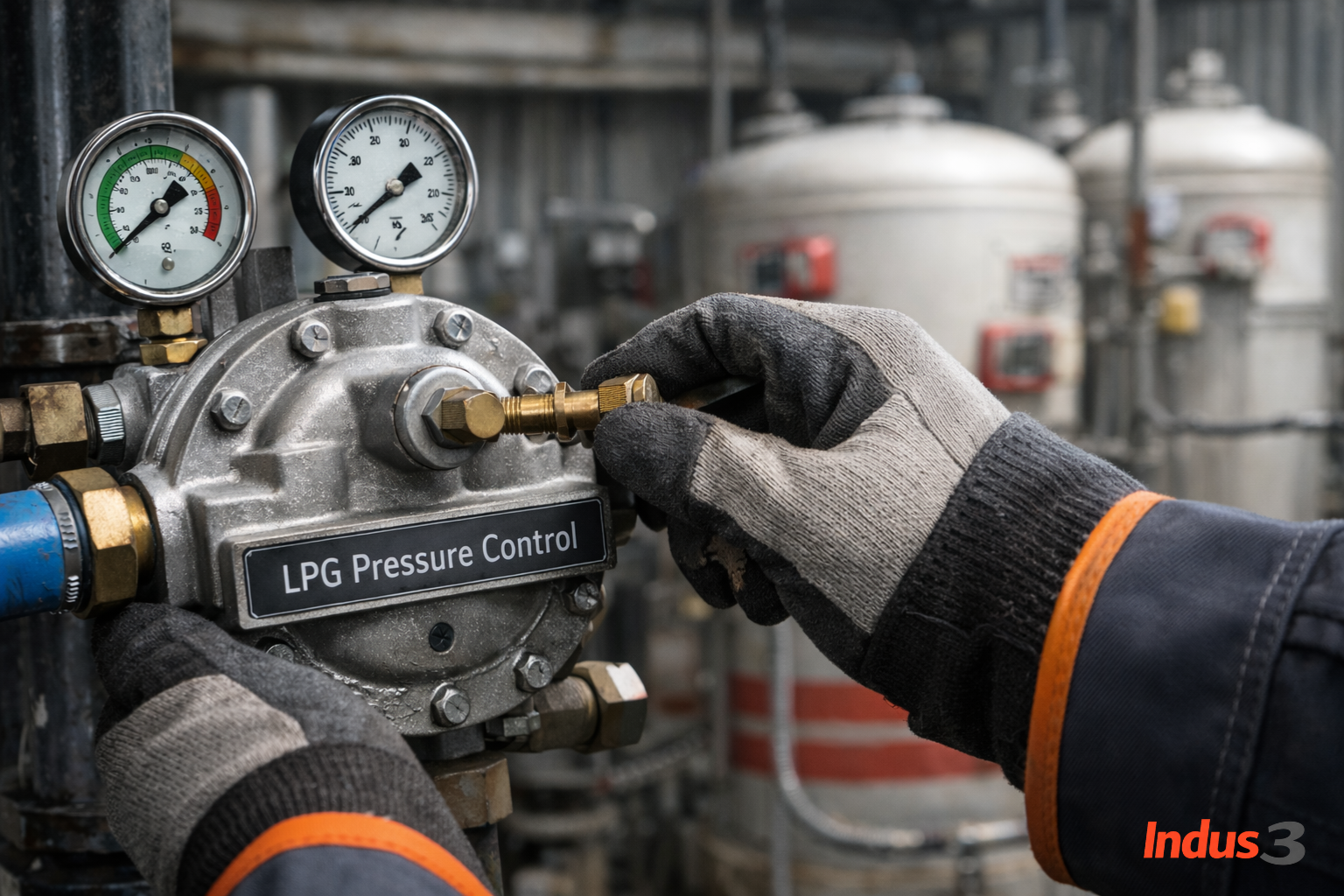
After vaporisation, the gas must pass through multi-stage regulation before reaching process equipment. Textile burners operate within defined pressure bands. Excess pressure can cause flame lifting and overheating, while insufficient pressure may result in incomplete combustion and unstable flame patterns. Industrial-grade regulation strategies are detailed in the industrial LPG regulator guide. A properly engineered LPG system for textile mills typically includes first-stage pressure reduction near the storage tank, second-stage regulation close to process lines, slam shut valves and pressure relief and monitoring instrumentation. These measures ensure controlled and uniform distribution across extended production halls.
Industrial LPG pipeline installation must account for flow velocity, pressure drop and material compatibility. Textile plants often span large areas, and uneven distribution can lead to burner imbalance between machines. Pipelines should incorporate certified fittings, isolation valves and protective safety components. Hardware such as LPG safety valves in Pakistan plays a critical role in preventing overpressure incidents. Proper routing also reduces mechanical stress, simplifies inspection and improves long term maintenance efficiency.
Textile processes vary in combustion sensitivity. Singeing machines require sharp, stable flames. Textile dryers demand uniform heat distribution. Fabric dyeing and finishing rely on consistent steam quality. Compatibility between LPG calorific value and burner design is fundamental. In some installations, air gas mixing systems are introduced to stabilise combustion and maintain consistent flame characteristics, particularly when converting natural gas burners to LPG. Incorrect burner configuration can result in soot formation, fabric scorching or inefficient fuel utilisation. Access to appropriate components and replacements is essential for sustained performance, as discussed in burner spare parts in Pakistan.
When examined collectively, storage tanks, vaporizers, regulators, pipelines and burners form a single engineered network. An LPG system for textile mills must be designed as an integrated framework rather than assembled in isolation. Each component directly influences combustion stability, safety compliance and production continuity. In high-output textile environments, system integration determines whether LPG operates as a reliable industrial backbone or becomes a source of operational vulnerability.
Vaporizer Selection Framework for Textile Operations
Selecting the correct vaporizer is one of the most critical engineering decisions within an LPG system for textile mills. Vaporisation capacity directly affects combustion stability, pressure consistency and overall production reliability. In textile environments where multiple high-load machines operate simultaneously, vaporizer selection must be driven by peak process demand rather than average fuel consumption.
Textile mills typically operate singeing machines, dryers, stenters and steam boilers at overlapping intervals. Each of these systems draws fuel differently. Steam boilers demand sustained thermal input, while singeing lines require sharp, controlled flame characteristics. LPG-powered stenters for textiles often cycle burners depending on temperature feedback. This variation means that vaporizer sizing cannot rely on simplified daily usage calculations alone.
A structured approach begins with calculating peak hourly LPG consumption in textile mills. It requires evaluating total burner ratings across all connected equipment and identifying worst-case simultaneous firing conditions. Guidance on calculating accurate vaporisation loads can be found in the LPG vaporizer sizing guide. Engineers must also account for redundancy margins to prevent pressure drops during unexpected load surges.
One common mistake in industrial installations is sizing vaporizers based on nominal tank withdrawal capacity. Natural vaporisation declines significantly in winter due to reduced ambient temperature. In colder months, inadequate vaporisation leads to regulator freezing, pressure instability and flame inconsistency. The technical principles behind phase conversion and heat transfer are outlined in the industrial LPG vaporizer working principle.
When selecting equipment, engineers typically compare three primary vaporizer types: water bath vaporizers, electric vaporizers and direct-fired vaporizers. Water bath units offer stable heat transfer and are widely used in continuous industrial operations. Electric vaporizers provide compact installation but require reliable power infrastructure. Direct-fired vaporizers can handle high capacities but demand strict combustion control and monitoring. A comparative technical overview is available in the LPG vaporizer types comparison guide.
For textile singeing machines, stable outlet pressure is essential to maintain precise flame geometry. Any fluctuation can alter the fabric surface treatment. Similarly, LPG steam generation for textile mills depends on consistent calorific input. Undersized vaporizers may function adequately at partial load yet fail during simultaneous boiler and dryer operation. Oversized vaporizers, on the other hand, introduce unnecessary capital cost and operational inefficiency.
Thermodynamic modelling plays a key role in the correct selection. Engineers should evaluate vaporisation rate per hour, ambient temperature impact, required outlet pressure and future expansion planning. In large-scale mills, dual vaporizer configurations are often installed to ensure standby continuity. This redundancy strategy prevents total shutdown in the event of maintenance or unexpected load spikes.
Maintenance considerations must also influence equipment choice. Vaporizer performance gradually declines without routine inspection, scale removal and heating element verification. Preventive service intervals are discussed in LPG vaporizer maintenance practices. Ignoring maintenance reduces efficiency and increases long-term operating costs.
From an international engineering perspective, industrial vaporisation systems are governed by combustion and heat transfer standards recognised globally. References such as the Engineering Toolbox provide technical data on vaporisation rates and fuel properties, supporting accurate system design calculations.
Ultimately, vaporizer selection for textile operations is not a procurement decision; it is an engineering calculation exercise. It requires accurate load assessment, seasonal derating analysis and process-specific understanding. Within an LPG system for textile mills, the vaporizer serves as the thermal stabiliser. Its sizing and configuration determine whether downstream burners receive consistent energy or experience fluctuations that compromise combustion stability and production output.
Flame Control, Combustion Stability and Wobbe Index Matching
Within an LPG system for textile mills, vaporisation and storage ensure fuel availability, but flame control determines process quality. Textile production is highly sensitive to combustion stability. Even minor variations in flame temperature, shape or intensity can affect fabric finish, moisture removal and colour uniformity.
Flame behaviour is governed by fuel composition, pressure regulation and air gas ratio control. When mills convert natural gas burners to LPG, combustion characteristics change significantly. LPG has a higher calorific value and a different density compared to pipeline natural gas. Without proper adjustment, this difference alters flame geometry and heat distribution.
A key engineering parameter in this context is the Wobbe Index. The Wobbe Index measures the interchangeability of fuel gases based on heating value and specific gravity. For stable combustion, the Wobbe Index of LPG must align with burner design specifications. Technical background on this parameter can be referenced through the Engineering Toolbox explanation of the Wobbe Index.
If Wobbe Index alignment is ignored, several operational issues may arise. Flame lifting can occur due to excessive gas velocity. Yellow tipping and soot formation may develop if the air gas mixture becomes imbalanced. In textile dryers and finishing ranges, such instability results in uneven heating patterns.
Singeing machines present a particularly sensitive case. LPG for textile singeing machines must deliver sharp, stable and well-defined flames. Irregular combustion may damage the fabric surface or reduce singeing efficiency. Precise pressure control combined with appropriate nozzle configuration is therefore essential. Industrial-grade control mechanisms are described in the industrial LPG regulator guide.
Pressure stability also plays a decisive role in combustion control. After vaporisation, multi-stage regulation ensures that downstream burners receive fuel within defined pressure limits. Inadequate regulation leads to oscillating flame patterns, especially in high-demand systems where multiple burners fire simultaneously. Solutions related to regulator performance and pressure stability are further discussed in industrial gas regulator systems in Pakistan.
Air gas mixing is another critical factor. LPG contains higher energy content per unit volume than natural gas. During conversion projects, burner air intake settings must be recalibrated. In some installations, dedicated LPG air mixer systems are installed to maintain consistent combustion characteristics. This becomes especially important in fabric dyeing and finishing operations, where steam quality depends on controlled boiler combustion.
Cold weather introduces additional combustion risks. Reduced ambient temperature can lower vaporisation efficiency and increase the likelihood of regulator icing. Regulator freezing disrupts pressure balance and destabilises flame output. Practical mitigation strategies are outlined in the LPG regulator freezing solutions.
Beyond flame stability, safety remains central. Combustion irregularities may indicate incomplete mixing or pressure surges. Routine inspection of burner nozzles, control valves and ignition systems reduces the risk of flashback or overfiring. Access to certified components, such as those discussed in burner spare parts in Pakistan, ensures sustained operational reliability.
From a process perspective, LPG vs SNG for industrial use comparisons often focus on fuel price and availability. However, combustion behaviour and flame controllability are equally important. LPG offers stable calorific value when properly regulated, but only if Wobbe Index alignment and air fuel ratio calibration are addressed during system design.
In textile manufacturing, flame control is not simply about maintaining heat. It is about protecting product quality, ensuring uniform process output and sustaining equipment longevity. Within an LPG system for textile mills, combustion stability becomes the operational bridge between energy infrastructure and finished fabric quality.
Storage, Compliance and OGRA Regulations in Industrial LPG Installations
In textile manufacturing, fuel reliability must be matched by regulatory compliance. An LPG system for textile mills cannot be treated solely as an energy solution; it must also satisfy safety codes, inspection requirements and national regulatory frameworks. Improper storage or non-compliant installation exposes mills to operational shutdowns, legal penalties and significant safety risks.
Bulk LPG storage is governed by clear design and placement principles. Tank capacity must align with consumption forecasts, yet physical installation must follow defined separation distances from buildings, ignition sources and boundary walls. Earthing, pressure relief valves and excess flow protection are not optional components. These measures are discussed in detail in the LPG storage compliance in Pakistan guide.
The Oil and Gas Regulatory Authority oversees licensing and operational standards for LPG storage and distribution. Textile mills sourcing fuel from OGRA-approved LPG companies reduce exposure to supply irregularities and regulatory violations. Official regulatory information and licensing frameworks are available through the Oil and Gas Regulatory Authority of Pakistan.
Storage design must also consider refill logistics. Industrial LPG price per kg in Pakistan may fluctuate, and mills often optimise refill schedules to manage cost exposure. However, extending refill cycles beyond safe thresholds introduces vaporisation constraints and operational risk. Tanks should be sized to maintain adequate reserve stock while avoiding excessive stagnation.
Safety equipment integration is another critical compliance element. Industrial installations must include flame arrestors, pressure relief devices and certified safety valves. Protective hardware, such as that detailed in LPG fire safety equipment, ensures that potential ignition incidents are contained before escalation.
Leak detection systems form a second layer of defence. Even well-installed pipelines and valves may degrade over time due to vibration, corrosion or mechanical stress. Modern installations increasingly incorporate gas leak monitoring systems connected to automatic shutoff valves. Technologies and implementation strategies are explored in LPG leak detection technologies.
Standby configuration also influences compliance and operational continuity. Many textile mills adopt an LPG standby system for industries model, allowing dual tank arrangements or parallel vaporizer configurations. This design reduces total shutdown risk during maintenance or inspection intervals. It also provides resilience in the event of unexpected fuel delivery delays.
Periodic inspection and certification are integral to long-term compliance. Storage vessels, pipelines and safety valves require scheduled testing and documentation. Mills that treat compliance as a one-time installation task often face future regulatory complications. A structured maintenance and inspection programme supports both safety and audit readiness.
From an engineering standpoint, compliance enhances reliability. Correctly spaced tanks reduce thermal stress and mechanical strain. Properly calibrated pressure relief valves protect downstream regulators and burners. Leak detection systems reduce downtime associated with emergency shutdowns.
Internationally, industrial LPG storage standards are often aligned with frameworks such as NFPA codes for liquefied petroleum gas systems. While local enforcement varies, global standards reinforce core safety principles that apply equally in textile facilities across Pakistan.
In high-output textile environments, storage and compliance are not peripheral concerns. They are foundational requirements. An LPG system for textile mills must be engineered to meet regulatory standards from the outset, ensuring that energy continuity is supported by structural safety and documented compliance.
LPG vs SNG Systems for Textile Mills in Pakistan
Fuel selection in textile manufacturing is no longer a simple matter of availability. Many mills evaluating an LPG system for textile mills also assess the feasibility of an SNG system for textile mills, particularly in regions where pipeline gas supply remains inconsistent. The decision between LPG and Synthetic Natural Gas is technical, economic and operational.
SNG plants typically produce a methane-rich gas by reforming LPG or other hydrocarbons to simulate the calorific value of natural gas. A Synthetic Natural Gas plant in Pakistan is often installed where large facilities require fuel characteristics similar to pipeline gas while maintaining independence from grid fluctuations. However, this additional processing stage introduces complexity.
From a thermodynamic perspective, LPG has a higher calorific value per unit volume than SNG. This means LPG delivers more energy for the same volumetric flow, which can benefit high-intensity processes such as textile singeing machines and LPG-powered stenters for textiles. However, higher calorific value also requires precise burner calibration and Wobbe Index matching to maintain flame stability.
In contrast, SNG aims to replicate natural gas properties, reducing the need for extensive burner modification when converting natural gas burners to LPG alternatives. This can simplify retrofitting in facilities with legacy burner systems. However, the SNG production process consumes energy, which affects overall system efficiency.
Cost structure is another decisive factor. Industrial LPG price per kg in Pakistan fluctuates based on global pricing and domestic supply dynamics. SNG systems introduce capital expenditure for reforming units, compressors and control systems. The total lifecycle cost must therefore consider not only fuel price but also plant maintenance, electricity consumption and system complexity.
From an infrastructure standpoint, LPG systems are comparatively straightforward. Storage tanks, vaporizers and pressure regulators form a direct supply chain from bulk storage to the combustion point. These components are discussed in technical comparisons, such as the LPG vaporizer types comparison guide. SNG systems add reforming reactors, mixing chambers and additional monitoring layers, increasing mechanical and operational requirements.
Pressure stability also differs. LPG vaporisation systems, when properly sized, deliver consistent outlet pressure with minimal delay. SNG plants depend on a steady upstream LPG supply and reformer performance. Any interruption in the reforming process can affect downstream pressure continuity.
Automation capability plays an increasing role in decision-making. Modern LPG systems can integrate flow monitoring, pressure sensors and smart metering solutions. Developments in control integration are explored in industrial LPG automation. While SNG plants also support automation, their control architecture is inherently more complex due to the additional processing stage.
Operational risk should not be underestimated. LPG systems involve well-understood storage and vaporisation principles. SNG systems introduce chemical reforming processes that require specialised maintenance expertise. For textile facilities focused primarily on fabric production rather than energy engineering, system simplicity often enhances reliability.
International energy analysis from organisations such as the International Energy Agency emphasises diversification and decentralised fuel strategies as tools for industrial resilience. In Pakistan’s textile context, both LPG and SNG can provide alternatives to unstable grid supply, but their suitability depends on scale, capital capacity and operational priorities.
Ultimately, the comparison between LPG vs SNG for industrial use is not purely about fuel substitution. It is about evaluating infrastructure complexity, combustion control requirements, lifecycle cost and reliability. For many textile mills, a well-engineered LPG system offers a direct, controllable and scalable solution. In larger integrated facilities, SNG may provide compatibility advantages. The optimal choice depends on technical evaluation rather than short-term price comparison.
Installation Strategy, Conversion Projects and Operational Risk Management
Designing an LPG system for textile mills is only half the equation. Execution determines whether the system performs reliably under real production conditions. Installation must be phased, controlled and aligned with plant operations to avoid unnecessary shutdowns or safety exposure.
Textile facilities rarely have the luxury of prolonged downtime. Continuous dyeing lines, finishing ranges and boiler systems often operate on tight delivery schedules. For this reason, the installation strategy must begin with a load mapping exercise and a shutdown planning matrix. Critical equipment should be identified, and phased tie-in points should be scheduled during planned maintenance windows.
Industrial LPG installation companies in Pakistan typically follow a staged approach. First comes civil preparation and tank foundation work. This is followed by storage vessel placement, pipeline routing and pressure regulation setup. Vaporizer integration and burner calibration are usually performed after mechanical completion to minimise production interruption.
Pipeline installation deserves particular attention. Industrial LPG pipeline installation must account for pressure drop over long distances, expansion allowances and isolation valves for sectional shutdown. Poor routing decisions increase leak risk and complicate inspection access. Technical best practices for fittings and hose connections are discussed in the LPG hose and fitting guide.
Conversion projects require additional caution. When converting natural gas burners to LPG, nozzle sizing, air intake adjustment and regulator recalibration must be performed carefully. Incorrect conversion leads to flame instability and excessive fuel consumption. Burner configuration and component reliability are closely linked to the quality of parts used, as outlined in burner spare parts in Pakistan.
Operational risk management extends beyond mechanical installation. Emergency preparedness must be incorporated into the commissioning phase. Mills should implement documented procedures covering leak detection, emergency shutdown and fire response. Practical guidance is available in the LPG emergency response plan guide.
Leak detection systems add an additional safety layer. Modern gas detection sensors can trigger automatic shutoff valves when abnormal gas concentration is detected. Integration strategies and device selection are explored in LPG gas leak detector systems in Pakistan. For textile environments with large enclosed production halls, early detection significantly reduces hazard exposure.
Service scheduling is equally important. An LPG system for textile mills should operate under a defined maintenance framework. Vaporizers, regulators and safety valves require periodic inspection. Establishing a documented inspection routine reduces unexpected downtime and extends equipment life. Structured maintenance intervals are described in the LPG system service schedule guide.
Redundancy planning also plays a role in risk management. Many mills install dual vaporizers or standby tank configurations to maintain continuity during maintenance or supply interruptions. An LPG standby system for industries model reduces total shutdown probability and improves production resilience.
International safety standards, such as those developed by the National Fire Protection Association, emphasise layered protection in industrial fuel systems. These principles align closely with best practice installation strategies for textile facilities in Pakistan.
Ultimately, installation strategy is not simply a construction task. It is a coordinated operational transition. When carefully planned and professionally executed, an LPG system for textile mills integrates smoothly into the production flow. When rushed or under-engineered, it introduces avoidable operational risk. Careful sequencing, compliance adherence and proactive maintenance transform LPG infrastructure from a fuel alternative into a stable industrial energy backbone.
Future Proofing Textile Energy Infrastructure with Engineered LPG Systems
Energy planning in Pakistan’s textile sector is shifting from short term fuel substitution towards long term resilience. An LPG system for textile mills is increasingly evaluated not just as a backup solution, but as part of a structured energy strategy designed to withstand supply volatility, cost fluctuation and regulatory tightening.
Future proofing begins with scalability. Textile operations rarely remain static. Capacity expansions, additional stenters, higher output boilers and new finishing lines gradually increase thermal demand. An LPG system engineered with an expansion margin avoids repeated infrastructure modification. Vaporizer capacity, pipeline diameter and regulator sizing should all accommodate projected growth rather than current load alone.
Cost predictability also influences long-term planning. The industrial LPG price per kg in Pakistan can fluctuate based on global supply conditions. However, system efficiency plays an equally important role in controlling expenditure. Accurate metering and monitoring help mills understand real LPG consumption in textile mills and identify inefficiencies before they escalate. Modern integration tools discussed in industrial LPG automation enable centralised monitoring of pressure, flow and burner performance.
Automation improves more than reporting. Real-time data supports proactive maintenance and combustion optimisation. Mills operating high precision processes such as fabric dyeing and finishing benefit from stable flame conditions that can be digitally monitored and adjusted.
Redundancy planning further strengthens resilience. An LPG standby system for industries approach, including dual vaporizers or parallel tank configurations, reduces the probability of a complete shutdown during maintenance or supply interruption. This layered configuration transforms LPG from a reactive alternative into a reliable energy backbone.
Regulatory alignment remains central to sustainability. Future enforcement standards may place greater emphasis on documented compliance, safety audits and environmental monitoring. Maintaining alignment with OGRA-approved LPG companies and following guidance outlined in LPG storage compliance in Pakistan protects mills from unexpected regulatory disruption. Official updates and regulatory frameworks can be reviewed through the Oil and Gas Regulatory Authority of Pakistan.
Global industrial trends also point towards diversification of fuel sources to strengthen manufacturing stability. According to analysis by the International Energy Agency, decentralised and flexible energy infrastructure reduces vulnerability to supply shocks. For Pakistan’s textile exporters operating in competitive global markets, uninterrupted production directly influences delivery performance and buyer confidence.
Future-ready LPG systems also incorporate structured maintenance planning. Scheduled inspection of vaporizers, regulators and safety valves ensures performance does not degrade over time. Documented service cycles, such as those outlined in the LPG system service schedule guide, support long-term reliability.
Ultimately, the question is not whether textile mills require alternative fuels. The question is how those fuels are engineered into the plant’s operational framework. An LPG system for textile mills designed with scalability, automation, compliance and redundancy in mind becomes more than a substitute for pipeline gas. It becomes an integrated infrastructure asset.
For textile operators evaluating long term energy strategies, the objective should be structured implementation rather than temporary conversion. Engineering assessment, load analysis and compliance planning form the foundation of a resilient LPG installation. Mills seeking technical guidance or system evaluation can review project capabilities through the About Indus 3 page or initiate a technical consultation via the contact page.
Strategic Outlook and Implementation Roadmap for Textile Mills
For textile manufacturers in Pakistan, energy planning is no longer reactive. The volatility of pipeline gas supply, fluctuating industrial LPG price per kg in Pakistan and increasing compliance scrutiny have forced mills to rethink fuel infrastructure at a strategic level. An LPG system for textile mills must therefore be evaluated not as a short-term substitution, but as part of a structured implementation roadmap.
The first step in this roadmap is a technical assessment. Mills should begin with a detailed energy audit covering peak load mapping, steam generation demand, burner ratings and projected expansion. Accurate measurement of LPG consumption in textile mills ensures that vaporizer capacity, tank sizing and pressure regulation are aligned with actual operational demand. Overestimation leads to unnecessary capital expenditure, while underestimation results in combustion instability and pressure drops.
The second phase involves infrastructure configuration. This includes selection of bulk storage, engineered vaporizers and multi-stage pressure control systems. Integration with automation platforms improves monitoring and provides data visibility across production lines. Advanced control strategies are discussed in industrial LPG automation, where digital monitoring enhances both efficiency and safety.
Compliance alignment forms the third layer of implementation. Engagement with OGRA-approved LPG companies ensures fuel sourcing remains within regulatory frameworks. Storage placement, safety valves and inspection documentation must adhere to national guidelines outlined in LPG storage compliance in Pakistan. Regulatory oversight continues to evolve, and mills that embed compliance into system design avoid future operational disruption. Broader policy updates can be referenced through the Oil and Gas Regulatory Authority of Pakistan.
Operational resilience requires redundancy planning. An LPG standby system for industries configuration, including dual vaporizers or parallel storage tanks, reduces exposure to supply delays or maintenance shutdowns. In high-output textile clusters such as Faisalabad and Karachi, such redundancy directly influences export timelines and buyer commitments.
Long-term sustainability also depends on maintenance governance. Vaporizers, regulators and safety components must operate under structured service intervals. Preventive inspection programmes described in the LPG system service schedule guide support sustained efficiency and reduce emergency repair costs.
From a macroeconomic perspective, industrial fuel diversification aligns with international manufacturing resilience strategies. The International Energy Agency consistently highlights decentralised and flexible fuel systems as tools for mitigating supply risk. For Pakistan’s textile sector, which competes in global export markets, uninterrupted production is not simply an operational goal; it is a commercial necessity.
Strategically engineered LPG infrastructure transforms fuel from a variable cost factor into a controllable production asset. When properly sized, regulated and monitored, an LPG system for textile mills delivers predictable combustion performance across singeing, dyeing, finishing and steam generation processes.
For textile operators seeking structured implementation rather than ad hoc conversion, technical evaluation and system design support are essential. Detailed engineering guidance and project consultation are available through the Indus 3 team, and direct coordination can be initiated via the contact page.
Building Long-Term Energy Resilience in Pakistan’s Textile Industry
Energy volatility has shifted from being a seasonal inconvenience to a structural constraint within Pakistan’s textile sector. Gas pressure instability, winter curtailments and uneven regional supply have compelled mills to reassess how fuel infrastructure is designed and managed. In this environment, an LPG system for textile mills represents more than an alternative energy source. It becomes part of a broader resilience strategy.
Across singeing lines, stenters, textile dryers, and steam boilers, combustion stability directly influences fabric quality and production continuity. Vaporizer sizing, Wobbe Index alignment, pressure regulation and storage compliance are not isolated technical decisions. They form an interconnected engineering framework that determines whether LPG operates as a stable backbone or a reactive substitute.
Future-ready textile operations are increasingly adopting structured fuel planning models built around scalability and redundancy. Dual vaporizers, standby tank configurations and monitored pressure control systems reduce shutdown risk and improve operational predictability. Digital oversight tools discussed in industrial LPG automation further enhance performance visibility and fuel efficiency.
Regulatory alignment also plays a defining role. Storage configuration, safety valve integration and documented inspection cycles must comply with national standards outlined in LPG storage compliance in Pakistan. Engagement with licensed suppliers and adherence to OGRA frameworks ensure long-term operational security. Regulatory guidance remains accessible through the Oil and Gas Regulatory Authority of Pakistan.
From a global manufacturing perspective, diversification of industrial fuel sources is increasingly recognised as a resilience measure. The International Energy Agency highlights flexible and decentralised energy systems as critical tools for mitigating supply disruption in export-driven economies. For Pakistan’s textile exporters, uninterrupted thermal energy translates directly into delivery reliability and buyer confidence.
Ultimately, the viability of an LPG system for textile mills depends on the engineering discipline. Correct load assessment, professional installation, calibrated burner conversion and structured maintenance transform LPG from a backup fuel into an integrated industrial asset. When planned with scalability and compliance in mind, LPG infrastructure supports both operational stability and commercial competitiveness.
Textile operators evaluating energy strategy upgrades benefit from a technical feasibility assessment before implementation. Detailed system design, vaporizer selection guidance and compliance support can be reviewed through the Indus 3 technical team or initiated via direct consultation through the contact page.
Engineering Driven LPG Integration for Sustainable Textile Operations
The discussion around an LPG system for textile mills ultimately returns to one central principle: engineered integration determines performance. Storage capacity, vaporizer sizing, combustion stability, regulatory compliance and automation must operate as a unified framework. When any one element is underdesigned or misaligned, production reliability is compromised.
Pakistan’s textile sector operates within an energy environment defined by volatility. Pressure drops, supply curtailments and regional distribution gaps are not temporary disruptions but recurring operational constraints. In such conditions, fuel infrastructure cannot be reactive. It must be calculated, scalable and compliant from the outset.
A properly engineered LPG system provides predictable calorific value, controllable pressure and stable flame characteristics across singeing, drying, dyeing and steam generation processes. Unlike improvised fuel switching, structured LPG integration aligns vaporisation rate with peak demand, ensures Wobbe Index compatibility, and incorporates multi-stage regulation to protect downstream burners.
Compliance further strengthens sustainability. Storage placement, certified safety valves and documented inspection cycles aligned with LPG storage compliance in Pakistan reduce regulatory exposure and operational risk. Oversight frameworks issued by the Oil and Gas Regulatory Authority of Pakistan reinforce the importance of structured installation and licensed supply chains.
Automation and monitoring are increasingly shaping industrial fuel strategy. Real-time flow measurement, pressure tracking and preventive maintenance scheduling enhance efficiency and extend equipment life. Integrated monitoring approaches outlined in industrial LPG automation demonstrate how data visibility strengthens combustion control and cost management.
Globally, manufacturing economies are prioritising energy diversification to protect supply chains. The International Energy Agency consistently identifies decentralised and flexible fuel systems as resilience enablers. For Pakistan’s textile exporters competing in demanding international markets, uninterrupted thermal performance directly supports delivery commitments and brand credibility.
In practical terms, the decision is not whether LPG can power textile processes. It is whether the system is engineered to match operational realities. Correct load assessment, professionally designed vaporisation capacity, calibrated burner conversion and structured maintenance planning transform LPG from an alternative fuel into a dependable industrial backbone.
Textile mills seeking long-term stability benefit from technical evaluation before implementation. Engineering consultation, vaporizer selection guidance and compliance planning support can be reviewed through the Indus 3 team or initiated directly via the contact page.