
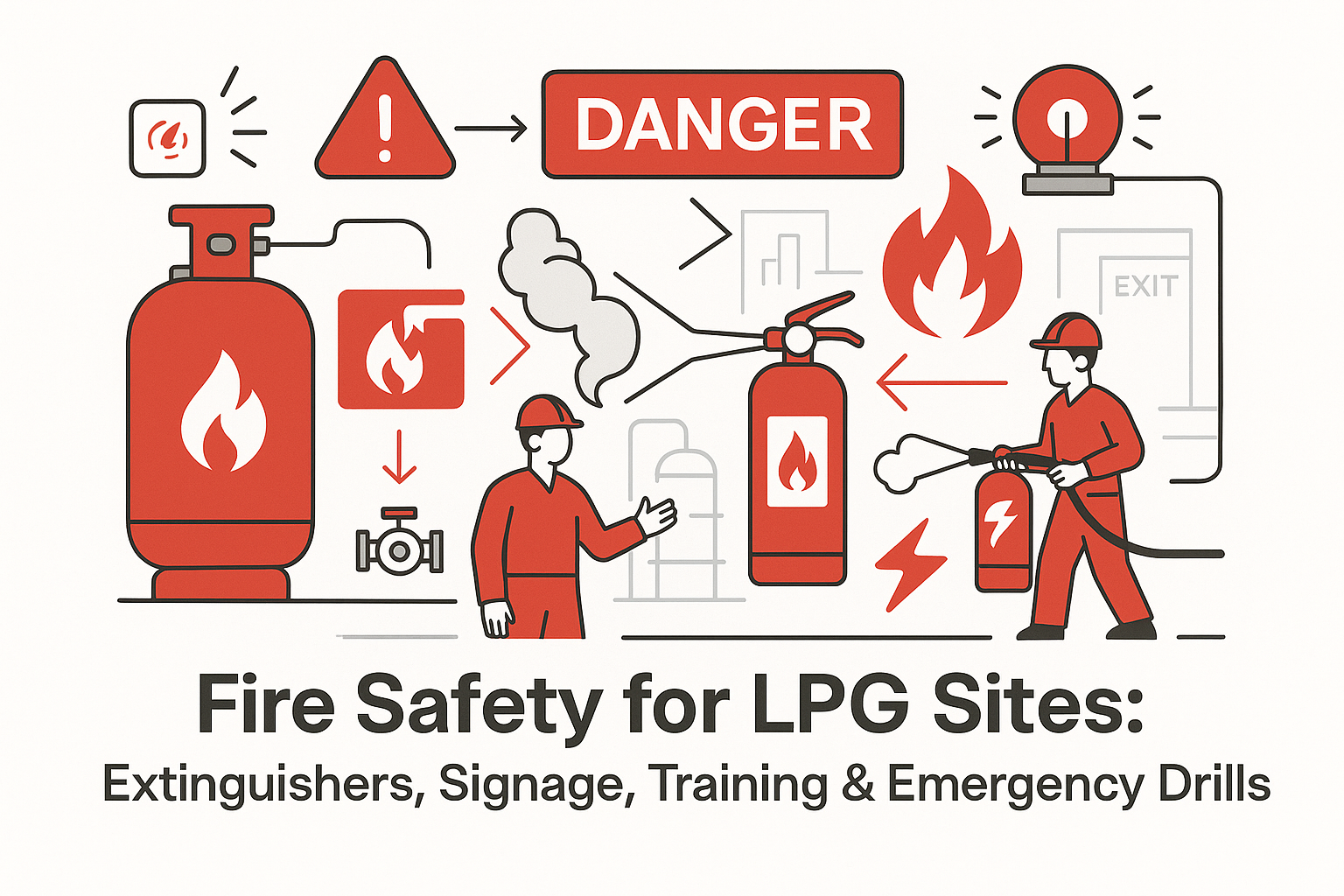
Understanding LPG Fire Risks and Why the Right LPG Fire Safety Equipment Matters
LPG fires don’t give second chances. One spark near a leaking cylinder, a small oversight during refilling, or a faulty regulator inside a cramped storeroom can turn into a life-threatening emergency within seconds. Factories, restaurants, tandoors, hotels, and small workshops across Pakistan rely heavily on LPG, yet many operate with outdated or insufficient safeguards. This gap is exactly where the right LPG fire safety equipment becomes essential—not optional.
LPG is highly flammable, heavier than air, and quick to accumulate in low-lying areas. That means a minor leak can silently travel towards heat sources, electrical panels, or open flames. In Pakistan, many incidents occur in compressor rooms, storage sheds, and commercial kitchens where ventilation is poor and cylinders are placed too close to cooking stations. These are everyday realities that elevate fire risks beyond what traditional protections can handle.
Businesses that depend on LPG—manufacturing units, bakeries, industrial laundries, school canteens, bottling plants—face similar vulnerabilities. These sites store multiple cylinders, operate high-pressure lines, or keep equipment running around the clock. Without proper LPG safety equipment Pakistan industries face unnecessary danger. Even a well-trained staff member cannot control an LPG flash fire without appropriate tools.
Fire authorities and global safety bodies stress the unique behaviour of LPG during fires. The National Fire Protection Association (NFPA) outlines that LPG vapour clouds can ignite instantly, producing intense thermal radiation and rapid flame spread if the leak remains undetected. (Source: https://www.nfpa.org/)
Why LPG Fire Risks Demand Specialised Safety Measures
LPG fires behave differently from standard fuel or electrical fires. Because the gas disperses quickly and ignites with very low energy, the time between leak, ignition, and full-scale fire is extremely short. This is why every industrial, commercial, or residential site using cylinders or vapour systems needs strategically placed LPG fire safety equipment. These devices are designed to suppress flame intensity, interrupt fuel supply, and detect leaks before ignition.
Many local incidents highlight how small oversights become major disasters. In workshops across Lahore and Karachi, fires often start from loose cylinder valves or old hoses. In restaurants, grease, heat, and LPG cylinders are often kept dangerously close. In industrial estates, vapourisers and pipelines may run near electrical motors. This combination makes standard fire extinguishers insufficient. Instead, LPG fire safety devices Pakistan—including leak detectors, DCP extinguishers, flameproof regulators, thermal shut-off valves, and safety alarms—provide specialised layers of protection.
Proper spacing, ventilation, and safety signage are part of the equation too, but they only work when paired with certified equipment built for LPG behaviour. Pakistan’s industries increasingly recognise the need for compliant tools, especially as businesses seek safer and more modern setups.
Key Fire Hazards in Industrial and Residential LPG Use
Across the country, LPG incidents typically share the same root causes. Poorly maintained cylinders, expired accessories, makeshift installations, and untrained staff are among the biggest triggers. In homes, leaks often go unnoticed due to weak ventilation. In factories, cylinders are sometimes stored near boilers or welding areas. Storage sheds frequently lack early-warning systems, leaving people unaware that gas has already accumulated to dangerous levels.
This is why the demand for modern, reliable LPG fire safety equipment Pakistan is growing. For industrial facilities, the need is even greater because high-volume operations rely on vapourisers and pipelines that must be protected with industrial LPG fire suppression system Pakistan solutions. Early detection, immediate suppression, and controlled shutdowns are the essential pillars of a safe LPG environment.
To help businesses strengthen safety standards, Indus 3 offers certified products and expert guidance. For readers exploring equipment options, the LPG safety devices collection is available on the Shop. For broader system planning, visit our industrial LPG solutions page on the Home website.
Without the right tools, LPG sites simply operate on luck. With them, they gain real protection—built on global safety standards and grounded in Pakistan’s on-site realities.
Types of LPG Fire Extinguishers: Which One Do You Need?
Imagine a busy restaurant kitchen during peak hours. Cylinders are stacked near cooking stations, flames are high, and the air is hot. A loose valve, a small leak, or a sudden flash can escalate into a dangerous situation. The same risk exists inside a factory’s cylinder room or an outdoor LPG storage shed where multiple tanks sit close together. In these moments, the difference between a minor incident and a disaster often comes down to whether the right LPG fire safety equipment is available at arm’s reach.
LPG behaves aggressively when ignited, producing intense heat and rapid flame spread. Ordinary extinguishers struggle to suppress these fires effectively. That’s why every industrial and commercial setup must choose the correct extinguishing system—one designed specifically for flammable gas environments.
Pakistan’s industries, from tandoors and hotels to textile factories and workshops, rely on specialised cylinder LPG fire extinguisher Pakistan products that meet global safety standards. These extinguishers are engineered to interrupt gas combustion quickly, buying crucial seconds for evacuation or shutdown.
Dry Chemical Powder (DCP) Extinguishers for LPG Fires
For LPG fires, Dry Chemical Powder extinguishers remain the industry standard. DCP extinguishers work by smothering the flame and interrupting the chemical reaction that fuels combustion. Their effectiveness against Class B and Class C fires makes them the first choice for cylinder areas, vapouriser rooms, and industrial kitchens.
DCP extinguishers are ideal because they work quickly, tolerate wind, and handle sudden bursts of flame. They are also cost-effective, making them accessible for both small and large LPG-dependent businesses.
However, they come with certain limitations. Powder residue may affect machinery, food preparation areas, and electrical components. Cleanup takes time, especially in commercial kitchens. But compared to the risk of uncontrolled LPG fire, the trade-off is minor.
Every space that stores or uses LPG—even a single cylinder—should keep at least one DCP extinguisher nearby. Pairing extinguishers with certified LPG safety equipment Pakistan (regulators, valves, leak detectors) further strengthens on-site protection. Businesses can explore compatible LPG regulators here: https://indus3.pk/product-category/lpg-accessories/lpg-regulator/
CO₂ Extinguishers and Their Limitations
CO₂ extinguishers are another common sight in commercial environments, but they play a limited role in LPG fire suppression. CO₂ works by displacing oxygen and cooling the immediate area. This makes it excellent for electrical fires or equipment overheating.
However, LPG fires can reignite easily once the CO₂ cloud dissipates because the fuel source remains active. LPG is heavier than air, so CO₂’s rapid dispersion often leaves pockets of gas untouched. Outdoors, CO₂ becomes even less reliable because wind disrupts its concentration.
Despite these limitations, CO₂ extinguishers still hold value in LPG sites. They can cool overheated valves, prevent ignition during maintenance, and support DCP units in multi-layered fire suppression plans.
Businesses should never rely solely on CO₂ for LPG protection. Instead, they should combine it with certified LPG fire safety devices Pakistan such as safety shut-off valves, sensors, and alarms. For installation or product recommendations, you can speak to our safety specialists here: https://indus3.pk/contact/
Choosing the Right Cylinder LPG Fire Extinguisher in Pakistan
The correct extinguisher depends on the size of the LPG system, the surrounding environment, and the volume of cylinders stored. For small restaurants or homes with one or two cylinders, a 4–6kg DCP extinguisher is essential. In workshops or stores with multiple cylinders, 6–12kg units are recommended.
Industrial facilities, bottling plants, textile mills, and factories storing large tanks or vapourisers require multiple extinguishers placed at strategic points. Where automated risk exists, suppression systems should be paired with advanced LPG fire safety equipment such as gas leak detectors, emergency shut-off systems, and thermal valves.
According to HSE UK and NFPA fire protection guidelines, sites handling flammable gases must provide “readily accessible” extinguishers within 10–15 metres of the hazard zone. (Source: https://www.hse.gov.uk/)
In Pakistan’s climate—hot, dusty, and often poorly ventilated—fire safety becomes even more important. The right extinguisher doesn’t just put out flames. It protects workers, limits losses, and prevents a small spark from becoming a major emergency.
With the correct tools and proper placement, LPG sites across Pakistan can operate with confidence, knowing they’re equipped to respond instantly when it matters.
Gas Leak Detectors, Safety Alarms & Early Warning Devices for LPG Sites
A sudden LPG leak is one of the most dangerous emergencies a business or home can face. In busy tandoors, cramped restaurant kitchens, small workshops, and residential storerooms, leaks often go unnoticed until someone smells gas—or until it’s already too late. This is why reliable LPG fire safety equipment must include early-warning devices. These systems detect leaks long before flames appear, giving people precious seconds to shut valves, evacuate, or alert emergency teams.
Pakistan’s unique challenges make early detection even more important. Loadshedding disrupts ventilation fans. Older buildings often have worn-out piping. Many restaurants store cylinders indoors due to space constraints. Even a minor leak can accumulate near floors because LPG is heavier than air. Without detection systems, the risk grows silently.
Modern leak detection solutions now come in multiple forms—fixed, portable, wired, wireless, and IoT-enabled—making them accessible for both industrial and residential use.
Fixed Gas Leak Detector Systems for Industrial Sites
In factories, textile units, hotels, and commercial kitchens, fixed gas leak detectors provide continuous monitoring. They are mounted near cylinder banks, vapourisers, pipeline joints, or compressor rooms. These detectors work 24/7, even when staff is away. They sense gas at very low concentration levels, often long before a human can smell it.
Fixed systems usually include sensors, alarms, and relay outputs that can trigger fans or automatic shut-off valves. They are ideal for large cylinder storage sheds and busy industrial environments where leaks may go unnoticed due to noise or heavy activity.
These detectors integrate perfectly with other LPG fire safety devices Pakistan such as thermal valves, flame detectors, and emergency stop systems. Businesses looking to upgrade equipment can browse certified LPG safety devices here: https://indus3.pk/product-category/lpg-accessories/lpg-safety/
The importance of fixed detectors is recognised internationally. According to NFPA 58, LPG storage sites should maintain gas detection systems that alert occupants at the earliest sign of leakage. (Source: https://www.nfpa.org/)
Residential LPG Cylinder Safety Alarms in Pakistan
Homes across Pakistan face a different set of challenges. Ventilation is often poor. Cylinders are placed under kitchen counters. People may be asleep when leaks occur. And because load shedding can affect exhaust fans or ventilation windows, LPG can accumulate without warning.
A residential LPG cylinder safety alarm Pakistan model can prevent these dangerous situations. These compact devices are easy to install. They continuously monitor the air and sound a loud alarm the moment gas levels rise. Some models flash lights or activate phone alerts through mobile apps.
In small flats, hostels, and housing societies—especially older buildings with worn regulators—these alarms are essential. They create a safety buffer even when residents are not actively monitoring the kitchen or storeroom.
Many families now combine alarms with portable extinguishers and regulators to build a basic but effective safety setup. When paired with high-quality regulators and valves, the risk of ignition becomes significantly lower. You can learn more about Indus 3 as a trusted LPG equipment supplier in Pakistan here: https://indus3.pk/about-us/
How Early Detection Prevents Flashovers and Explosions
Early detection doesn’t just warn people—it prevents disaster. LPG needs very little to ignite. A single flame from a tandoor, a pilot light on a stove, or a spark from an electrical switch can ignite accumulated gas instantly.
In many Pakistani restaurants, cylinders sit near hot tandoors or fryers. Gas can escape through loose valves or damaged hoses. In factories, constant movement of cylinders increases the chance of accidental valve damage. In workshops, welding sparks or switches create ignition risks. These hazards magnify during load shedding when power returns unexpectedly and electrical surges occur.
A gas leak detector for LPG cylinder Pakistan instantly catches the first sign of trouble. It provides alerts before concentration reaches explosive levels. This early warning stops flashovers—sudden, widespread ignition seen in poorly ventilated rooms.
IoT-enabled detectors go a step further. These devices connect to mobile apps, allowing owners and supervisors to monitor cylinder areas remotely. Alerts can be sent via SMS, app notifications, or integrated industrial systems. In large facilities, IoT detectors help map risk zones and identify recurring leak points.
Whether for industrial plants or homes, early detection completes the first layer of effective LPG fire safety equipment. It ensures safety even when no one notices a leak, and it offers a vital line of defence against fast-moving LPG fires.
Fire Suppression Systems for Industrial LPG Plants & Cylinder Storage Areas
LPG-related fires move fast, burn hot, and leave very little time to respond. For Pakistan’s industrial sites—CNG workshops, hotels, textile factories, food-processing plants, and LPG bottling yards—manual intervention alone is not enough. These environments demand specialised LPG fire safety equipment supported by automated suppression systems that activate instantly and operate even when staff cannot. A well-designed system dramatically reduces damage, protects workers, and prevents small hazards from escalating into full-blown disasters.
Industrial LPG sites often store multiple cylinders, operate high-pressure lines, or run vapourisers around the clock. Heat, constant movement, and enclosed areas further intensify risk. This is why modern suppression technologies are becoming essential across Pakistan’s industrial landscape.
Automatic Industrial LPG Fire Suppression Systems in Pakistan
Industrial suppression systems are engineered to extinguish fires in seconds. They do not wait for human intervention. Instead, they activate based on temperature, flame, or gas concentration. In Pakistan, these systems are increasingly installed in cylinder stores, gas banks, vapouriser rooms, and filling stations where fire load is high.
One of the most widely used technologies is the dry chemical suppression system. It rapidly disrupts combustion and prevents flame resurgence. It is ideal for outdoor cylinder yards and bottling plants because it works in windy or open environments.
Water spray and mist systems are another layer of protection. They cool cylinders, reduce radiant heat, and prevent BLEVE (Boiling Liquid Expanding Vapour Explosion). In large LPG storage sheds, these systems keep cylinder surfaces cool while emergency teams respond.
Deluge systems provide complete coverage for high-risk facilities. Once triggered, they release large volumes of water or chemical agent across an entire zone. Their fast activation is especially useful in CNG conversion workshops, industrial kitchens, or vapouriser halls where fire spread is rapid.
Businesses upgrading their systems can explore certified industrial LPG safety gear here: https://indus3.pk/shop-page/
International standards emphasise the importance of these systems. According to NFPA 58, LPG installations must have fire suppression and emergency shutdown mechanisms suitable for cylinder volume and site layout. (Source: https://www.nfpa.org/)
How Thermal Valves and Shut-Off Devices Reduce Fire Spread
Suppression systems become significantly more effective when combined with automated shut-off valves. These devices stop the fuel flow during a fire, preventing leaks from feeding the flames.
Thermal valves use fusible links—small metal components that melt at a specific temperature. Once they melt, the valve closes instantly, cutting off gas supply. This simple but highly effective mechanism has saved countless facilities from massive losses.
Flame sensors also play a critical role. Installed near vapourisers, compressor rooms, or cylinder banks, they detect open flames within milliseconds. When triggered, they activate suppression systems, alarms, and emergency shutdown circuits.
In Pakistan’s industrial zones—especially in Lahore, Faisalabad, Karachi, and Gujranwala—many older facilities still rely on manual shut-off methods. These are not fast enough for high-pressure LPG systems. Modern automatic shut-off solutions minimise response time and limit fire spread, particularly in sites handling vapourisers and pipelines. Businesses using vapourisers can review high-quality LPG vaporizers here: https://indus3.pk/product-category/lpg-vaporizer/
The combination of automated valves, flame sensors, and suppression systems creates a resilient multilayered defence, ensuring fires are controlled before they grow.
Designing an Effective Suppression Layout for LPG Yards
Every LPG facility is unique. The layout, cylinder count, ventilation pattern, and vapouriser capacity all influence the suppression design. A well-structured system follows three principles: detect early, act fast, and block fuel supply.
In bottling plants, fire lines surround cylinder areas with DCP points, mist nozzles, and deluge valves. In hotels and commercial kitchens, suppression hoods protect stoves, fryers, and LPG pipeline joints. In CNG and automobile workshops, stations must prioritise cooling systems and dry chemical discharge units.
Factories with indoor cylinder rooms often add heat detectors near ceilings and fixed nozzles near cylinder racks. LPG storage sheds require wide-coverage spray systems to cool multiple cylinders simultaneously.
Lahore’s growing industrial sector is increasingly leaning towards automated LPG fire protection equipment Lahore, recognising the need for local compliance and global safety. Across Pakistan, the shift from manual extinguishers to integrated suppression reflects a maturing safety mindset.
With the right combination of suppression systems, thermal valves, and automatic sensors, LPG sites gain the protection they need to handle fire risks confidently—even in high-pressure environments.
Safety Signage, Floor Markings & Mandatory Labels for LPG Handling Areas
Clear signage saves lives long before an emergency starts. In any facility using LPG—whether a restaurant, factory, hotel boiler room, tandoor shop, or a bottling plant—well-placed signs and hazard labels act as silent protectors. They guide workers, warn visitors, and create order in high-risk spaces. Without visible markers, even the best LPG fire safety equipment loses its effectiveness because people may not know where to go, what to avoid, or how to respond.
Pakistan’s industrial environments face unique challenges. Poor lighting, congested areas, and ageing buildings often make emergency routes unclear. Many cylinder storage areas also lack consistent labelling. To maintain a safe environment, facilities should adopt a structured signage plan aligned with international safety practices and local requirements.
Mandatory LPG Warning Signs Every Site Must Install
Every location that handles LPG must have high-visibility warning signs. These include “Highly Flammable Gas,” “No Smoking,” “No Naked Flame,” “Cylinder Storage Area,” and “Emergency Shut-Off Valve Here.” Signs should be installed at eye level and use clear symbols that remain understandable even if lighting is poor.
For Pakistan, compliance is improving as PSQCA and PESO guidelines become more recognised. These authorities stress the importance of warning signs at cylinder storage racks, gas banks, valve rooms, and vapouriser points.
Facilities that store multiple cylinders should use reflective or photoluminescent signage. This ensures visibility during load shedding—a common challenge across cities like Lahore, Karachi, and Faisalabad. When combined with reliable LPG safety equipment Pakistan, these signs build the first layer of safety in any LPG environment.
International guidance is also helpful. ISO and NFPA offer clear layouts and colour codes that can be adopted easily. (Reference: ISO Safety Signage Standards: https://www.iso.org/)
Floor Markings, Exit Routes and Cylinder Handling Pathways
Floor markings guide staff during both routine work and emergencies. For LPG-dependent businesses, these markings should highlight:
-
Cylinder storage boundaries
-
Safe handling paths
-
Emergency assembly areas
-
Exit routes
-
Zones where LPG use is restricted
-
High-heat or open-flame areas
In many Pakistani restaurants and tandoor shops, cylinders are kept near heat sources due to space issues. Bold floor markings help workers maintain safe distances even in crowded environments. Factories and warehouses benefit from painted pathways that guide forklifts or workers moving multiple cylinders at once.
Emergency exit routes must be unobstructed and clearly highlighted. In Lahore’s industrial belts, inspections often reveal blocked exits due to stored materials. Proper markings minimise confusion during an evacuation and direct workers towards safe zones quickly.
Safety walkthroughs should be conducted weekly. A missing sign or faded floor marking may seem minor, but it can delay evacuation during a fire. For expert setup or guidance, businesses can consult Indus 3—your LPG system design experts: https://indus3.pk/
Placement Rules for Maximum Visibility and Compliance
Signs serve no purpose if placed incorrectly. LPG sites must follow placement rules to ensure visibility from all angles. Signs should be:
-
Mounted at consistent heights
-
Placed at every entry and exit point
-
Repeated along long corridors
-
Marked near valves, regulators, and pipeline joints
-
Installed near vapourisers and heating equipment
-
Positioned so they remain visible even when the area is crowded
Cylinder storage areas must include labels that show cylinder type, maximum capacity, last inspection date, and colour-coded hazard classifications. This helps staff identify faulty or expired cylinders before they become dangerous.
For facilities in Lahore and other large cities, sourcing compliant LPG fire protection equipment Lahore is essential. Proper signage should accompany equipment like vapourisers, regulators, safety valves, and emergency shut-off controls. Pairing labels with this equipment ensures workers know how to operate tools correctly under pressure.
International bodies such as HSE UK offer clear guidance on signage placement and hazard communication. (Reference: HSE Signage Guide: https://www.hse.gov.uk/)
If any facility is unsure about placement standards or compliance, they can get compliance guidance from Indus 3 here: https://indus3.pk/contact/
Effective signage is more than decoration. It serves as a first-response system—one that guides workers and prevents panic when seconds matter.
Employee Fire Safety Training: Skills Every LPG Site Team Must Master
Even the best LPG fire safety equipment cannot protect a site if staff do not know how to use it. In factories, commercial kitchens, workshops, storage areas, and tandoor shops across Pakistan, human error remains one of the most common causes of LPG-related incidents. Proper training transforms workers from passive observers into confident first responders. It reduces panic, improves reaction time, and strengthens overall site resilience.
Training must be practical, hands-on, and tailored to LPG environments. Employees need to understand how LPG behaves, how leaks develop, and how to act quickly during early danger signs. With consistent practice, even complex safety procedures become second nature.
Hands-On Training for Using LPG Fire Safety Devices
Every employee working near LPG cylinders, vapourisers, or pipelines should know how to operate fire extinguishers confidently. This includes identifying the right extinguisher type for LPG fires, checking pressure gauges, pulling safety pins, aiming at the base of the flame, and sweeping effectively.
Practical sessions offer real value. Staff can practise extinguishing controlled training fires using Dry Chemical Powder (DCP) extinguishers—the primary tool for LPG incidents. Demonstrations also cover CO₂ extinguishers and when they can support DCP units safely.
Workers should also be trained in using shutdown tools, safety valves, alarms, and other LPG fire safety devices Pakistan. Modern systems incorporate alarms, detectors, and thermal valves. Understanding how these work boosts worker confidence and speeds up emergency response.
Businesses upgrading or restocking equipment can purchase certified LPG safety tools here: https://indus3.pk/shop-page/
Hands-on sessions can be reinforced with regular refreshers so skills stay sharp and staff remain familiar with any new equipment installed on-site.
Teaching Workers to Identify Leaks, Smells and Early Risks
Most LPG emergencies start small. A faint smell. A soft hissing noise. A slightly loose valve. A worker who recognises these early warning signs can prevent a disaster with a single action.
Training should teach employees to:
-
Recognise the distinctive LPG odour
-
Identify visual clues such as frost lines or oil residues
-
Detect hissing sounds or vibrations
-
Understand how ventilation affects leak movement
-
Shut off cylinders safely
-
Report signs of corrosion or regulator damage
This becomes even more important in Pakistan, where load shedding can stop ventilation fans and allow gas pockets to accumulate. Staff should learn how LPG behaves in different spaces—commercial kitchens, basement storage rooms, open yards, and confined industrial units.
Workers should also be trained to use gas-leak detectors, alarms, and inspection tools. Modern LPG safety equipment Pakistan includes portable and fixed detectors designed to sense gas at extremely low concentrations. Demonstrating these tools in real conditions helps workers build trust in the system and respond faster during emergencies.
To understand Indus 3’s technical competence and safety-focused product philosophy, employees and managers can explore our industrial safety expertise here: https://indus3.pk/about-us/
Why Refresher Courses Are Essential for LPG Sites
Training is not a one-time activity. LPG safety requires repeated practice to keep skills fresh. Staff turnover, equipment updates, and layout changes all impact safety readiness. Regular refresher courses ensure every team member stays aligned with current procedures.
Refresher training should include:
-
Repeating extinguisher drills
-
Re-visiting evacuation routes
-
Conducting full gas-leak simulations
-
Re-teaching emergency shutdown methods
-
Inspecting equipment together as a team
-
Reviewing past incidents and learning from them
Simulation drills can be especially effective. By creating controlled scenarios that mimic cylinder leaks or vapouriser failures, workers get the chance to act out real responses. This lowers anxiety and builds muscle memory.
International organisations like NFPA and FEMA recommend regular fire simulations to maintain a high level of emergency readiness. (Reference: FEMA Fire Training: https://www.fema.gov/)
When employees know exactly how to respond, when to activate extinguishers, and how to shut down valves, the entire site becomes safer. Training empowers people to act swiftly, confidently, and decisively—long before a fire grows out of control.
Emergency Drills: Building a Fast, Coordinated Response for LPG Fire Accidents
Emergency drills turn theory into action. When an LPG leak or fire erupts in a busy environment—whether a restaurant kitchen, tandoor workspace, factory, or cylinder storage shed—people don’t rise to the level of their equipment; they fall to the level of their training. Even with advanced LPG fire safety equipment, untrained staff may panic or make dangerous decisions. Drills create confidence. They build familiarity. And they ensure that when an alarm sounds, every person in the facility knows exactly what to do.
LPG-specific emergency drills differ from generic fire drills because LPG behaves unpredictably and ignites more aggressively. This requires structured steps, dedicated team roles, and rapid coordination.
Creating an LPG-Specific Emergency Response Plan
An effective LPG response drill begins with a clear plan. This plan outlines evacuation routes, hazard zones, equipment locations, and shutdown points. In Pakistan’s commercial kitchens, tandoors, and industrial setups, the plan must consider the common layout problems—tight spaces, poor ventilation, and cylinder placement near heat sources.
Before any drill, the safety officer or facility supervisor gathers the team and outlines the scenario. Examples include:
-
A leaking cylinder behind a restaurant cooking area
-
A hose rupture in a factory line
-
Cylinder overheating in a storage shed
-
Vapour build-up near a boiler or tandoor oven
The drill leader explains potential ignition sources and the behaviour of LPG vapour, which sinks to the lowest part of the room. Staff must learn to avoid switching on lights, fans, or electrical appliances during suspected leaks.
The emergency plan must also identify trained personnel responsible for shutting off cylinders or activating emergency valves. These high-risk tasks must only be performed by designated workers, not by everyone rushing toward the hazard. Facilities upgrading their equipment can source professional LPG safety equipment here: https://indus3.pk/shop-page/
International standards offer valuable guidance. NFPA advises that drills for LPG environments should include shutdown simulations, evacuation rehearsals, and equipment activation practice. (Reference: NFPA Drill Guidelines – https://www.nfpa.org/)
Evacuation Drills for High-Risk Industrial Zones
Evacuation remains the most crucial part of any LPG emergency. In Pakistan’s fast-moving kitchens, bustling factories, and crowded workshops, confusion during evacuation can cause injuries long before fire reaches anyone.
Evacuation drills should:
-
Start with an alarm or verbal alert
-
Direct everyone away from low-lying vapour zones
-
Lead workers to pre-identified assembly points
-
Ensure staff avoid using electrical switches
-
Reinforce that doors must be left open to prevent gas compression
In industrial kitchens, workers must be trained to step away from hot surfaces immediately when a leak is detected. Tandoor operators, for example, often work in deep pits or partially enclosed spaces where LPG can gather unnoticed. Drills must teach them to climb out calmly and move toward safe exits without triggering sparks.
Factories with cylinder banks require broader evacuation strategies. Workers operating machinery must power down equipment without causing ignition. Supervisors should confirm full evacuation before shutting doors or activating mechanical ventilation.
Emergency assembly points should be located far from the cylinder storage zone, ideally upwind, to avoid drifting vapours. These areas must be clearly marked and free of obstacles—an essential requirement for businesses using LPG fire protection equipment Lahore and similar safety assets across Pakistan.
Coordinating Fire Wardens, Supervisors and Safety Staff
Successful drills depend on leadership. Fire wardens, safety officers, and shift supervisors must be trained to lead during chaos. Their responsibilities include:
-
Ensuring alarms are heard
-
Directing staff toward safe routes
-
Checking high-risk zones last
-
Communicating with maintenance teams
-
Reporting missing individuals
-
Overseeing extinguisher activation
-
Coordinating with external responders if necessary
In small restaurants or tandoors, the supervisor often becomes the warden by default. They must know how to shut off cylinders, manage staff movement, and contact emergency services.
Larger factories rely on a team-based response. Fire wardens may be assigned to different zones—boiler rooms, cylinder banks, vapouriser areas, and production floors. Each warden oversees their zone’s evacuation and confirms safety before reporting to the chief warden.
Equipment knowledge is a key part of leadership. Supervisors should know how each extinguisher works, how alarms are triggered, and how suppression systems respond. Facilities that lack proper gear should request a safety assessment through Indus 3: https://indus3.pk/contact/
With regular practice, staff stop reacting out of fear and start acting with precision—even under intense pressure. Routine drills build a culture of preparedness that protects both people and property.
Building a Fully Compliant LPG Fire Safety Framework for Your Site
LPG facilities—whether industrial plants, commercial kitchens, storage sheds, tandoor shops, hotels, or manufacturing units—rely on systems where a single weak link can trigger a catastrophic event. Throughout this guide, we explored how a strong safety framework is built layer by layer. Extinguishers, detectors, signage, training, and emergency drills work together to reduce risk, improve readiness, and protect people as well as property. At the centre of that framework is one constant: your choice of LPG fire safety equipment.
Every environment has unique hazards. In restaurants, open flames mix with cylinders placed near prep stations. In CNG workshops, sparks and welding equipment sit metres away from pipelines. In factories and bottling plants, storage areas hold dozens of cylinders under varying temperatures. These realities demand a structured and proactive approach—one strong enough to prevent emergencies and resilient enough to respond instantly when they occur.
Bringing All LPG Fire Safety Equipment Together
Your safety framework begins with extinguishers. Dry Chemical Powder (DCP) units remain the primary defence against LPG fires, capable of smothering flames in seconds. Larger facilities supplement them with CO₂ or water mist systems, creating layered protection suitable for high-risk areas.
Detectors and alarms add the next layer. Early-warning tools such as fixed gas sensors, portable detectors, and LPG fire safety devices Pakistan give teams the crucial time they need to shut valves, ventilate areas, and isolate hazards. Residential alarms protect homes and apartments in Pakistan’s dense urban areas, where ventilation gaps often make LPG more dangerous.
Signage and floor markings guide workers through every step. Clear “No Smoking” signs, cylinder storage labels, emergency exit routes, and hazard markers prevent confusion in high-pressure situations. Pakistan’s industrial zones—especially in Lahore and Karachi—see daily use of these signs in boiler rooms, kitchens, and manufacturing floors.
Training binds everything together. No tool, even the most advanced LPG safety equipment Pakistan, is effective without well-trained staff who understand how to use it. Regular extinguisher practice, leak recognition exercises, safety demonstrations, and hands-on shutdown training turn workers into confident responders.
Finally, emergency drills ensure that the entire system works in real-time. Drills simulate leaks, overheating cylinders, or flame flashovers, teaching teams to evacuate efficiently and follow established procedures. International standards such as NFPA 58 emphasise the importance of routine LPG emergency drills. (Reference: https://www.nfpa.org/)
When all these components operate together, your site becomes significantly safer, more compliant, and better prepared for emergencies.
Why Pakistan’s Businesses Need a Structured Fire Safety Plan
Pakistan’s climate, infrastructure gaps, and variations in building design create additional LPG vulnerabilities. Load shedding affects ventilation systems. Many facilities have insufficient storage space, forcing cylinders closer to heat sources. Ageing pipelines, outdoor kitchens, and compact restaurant setups further increase risk.
A structured safety plan helps businesses navigate these challenges. It ensures extinguishers are correctly placed, detectors are strategically positioned, drills are conducted regularly, and equipment is inspected on schedule. For high-density cities like Karachi, Lahore, and Rawalpindi, businesses should also consider how foot traffic and customer proximity influence their fire protection strategy.
Whether you aim to secure a new facility, upgrade an existing one, or buy LPG safety equipment Karachi, a formal plan ensures your investment works cohesively and complies with global safety standards.
Work With Indus 3 for Certified LPG Safety Equipment
Indus 3 helps businesses build safe, compliant, and expertly designed LPG systems. We supply certified equipment, offer installation guidance, and support businesses across Pakistan in building multi-layered safety frameworks.
For readers ready to strengthen their sites:
-
Visit our Home Page: https://indus3.pk/
-
Explore our full range on the Shop Page: https://indus3.pk/shop-page/
-
Learn about our team and experience on the About Us page: https://indus3.pk/about-us/
-
Or Contact Page our engineers directly: https://indus3.pk/contact/
Ready to Protect Your LPG Facility?
Indus 3 is your trusted partner for certified LPG fire safety equipment. Whether you need extinguishers, detectors, valves, vapourisers, alarms, or complete suppression setups, our team provides expert guidance and professional installation support. Secure your site and safeguard your workforce—reach out to Indus 3 today and build a safer tomorrow.