
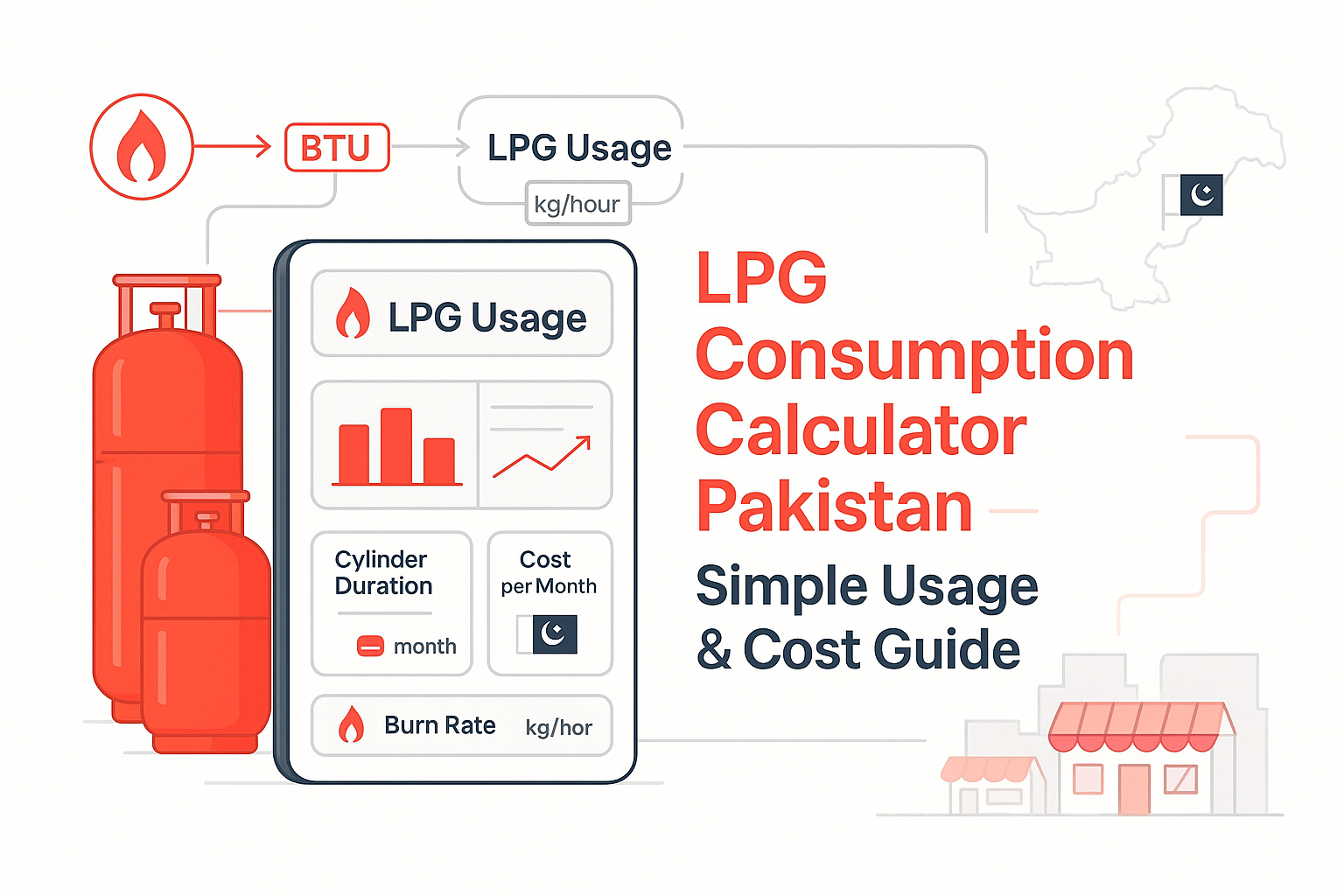
Understanding LPG Usage in Pakistan: Why Accurate Measurement Matters
When your monthly LPG bill keeps rising yet your usage feels the same, it’s a sign something deeper is happening. That’s exactly why an LPG consumption calculator Pakistan has become essential for households, small shops, and local businesses trying to keep energy costs predictable. With more families switching to cylinders due to inconsistent pipeline gas supply, the need for clearer, smarter consumption estimation is higher than ever.
Google Trends data shows a massive rise in searches like “LPG cost per kg in Pakistan” and “LPG usage calculator Pakistan house”, proving how many people are actively trying to understand where their gas is going. Having a simple, reliable way to estimate LPG consumption for home Pakistan helps users avoid surprise expenses and make smarter fuel choices. But to do that, we first need to understand what drives LPG usage in the country.
Rising LPG Dependence in Pakistani Homes and Businesses
Across Pakistan, LPG is no longer limited to rural kitchens or remote areas. Urban families now depend on cylinders for cooking because of low pipeline pressure, especially in winter. Small commercial setups—tandoors, cafés, bakeries, roadside eateries—also rely heavily on cylinder-based systems to stay operational.
Reports from OGRA and SNGPL have highlighted how seasonal shortages lead to major shifts toward LPG cylinders, increasing national consumption year after year. As this trend grows, households need better tools to track usage, compare cylinder sizes, and forecast their monthly needs.
This is where digital and manual methods of how to calculate LPG consumption in Pakistan become genuinely useful.
Why Knowing Your LPG Consumption Saves Money & Energy
Most people in Pakistan estimate their usage based on “how long the last cylinder lasted.” It’s a guess at best, and completely unreliable at scale. Every appliance burns gas differently. A small domestic burner, a commercial tandoor, and an industrial heater consume LPG at dramatically different rates.
When families use an LPG usage calculator Pakistan house, they finally understand how much gas their stove or geyser actually consumes per hour. Knowing the burn rate helps:
-
Plan household budgets
-
Compare cylinder options
-
Prevent mid-month outages
-
Identify excessive or abnormal usage
The World LPG Association often emphasises that transparent consumption tracking reduces waste and makes energy use more predictable for consumers. Pakistan’s energy landscape makes such planning even more important.
Common Challenges in Estimating LPG Needs in Pakistan
The first challenge is that most households don’t know the BTU rating or hourly gas draw of their appliances. Tandoor owners, bakers, tea stalls, and home users often use equipment without documented specifications—making manual calculation difficult.
Another issue is inconsistent flame usage. A stove used for 20 minutes on a high flame consumes more gas than one used for 40 minutes on low. Many people assume usage is purely time-based, not understanding the burn intensity factor.
Also, different LPG brands provide slightly different calorific values. According to PSO LPG specifications, variations do exist—meaning two cylinders of the same weight may still burn at different efficiencies.
Without clear information, families rely on rough ideas rather than data. That’s why tools designed to estimate LPG consumption for home Pakistan are becoming increasingly popular. They simplify the maths and remove the guesswork, making it easier for both households and small businesses to make informed decisions.
For more technical clarity, readers can explore industrial LPG equipment in Pakistan via the
Indus 3 Home,
browse essential components on the Shop Page, or learn more about the brand on the About Us.
How LPG Consumption Works: The Science Behind Gas Usage
If you’ve ever wondered why two households using the same cylinder don’t get the same number of days out of it, the answer lies in how LPG behaves when burned. Understanding the science behind it helps you get accurate results when using an LPG consumption calculator Pakistan, especially when analysing costs for domestic kitchens, tandoors, geysers, and heaters. LPG systems across Pakistan follow the same technical principles, but real-world usage varies because of burn rate, equipment efficiency, and appliance size.
This section breaks down how LPG converts from liquid to flame, how its energy is measured, and why small variations in settings can change your monthly bill. It’s all the background knowledge you need before exploring LPG gas consumption calculation Pakistan for your home or business.
How LPG Burners Convert Liquid Gas into Usable Energy
Inside every LPG cylinder, the gas is stored as a liquid under pressure. When you open the burner valve, the pressure drops, causing the liquid LPG to vaporise instantly. This vapour mixes with air and burns as a blue flame. The stronger the flame, the more vapour is drawn from the cylinder.
In Pakistan, where cylinder quality, ambient temperature, and regulator type vary, the efficiency of this liquid-to-vapour process isn’t always consistent. A high-pressure regulator, for example, will release more vapour than a low-pressure one, which directly impacts how quickly a cylinder empties.
The World LPG Association (WLPGA) explains that LPG burns at a consistent calorific value—around 46 MJ/kg globally—but local factors such as gas purity and cylinder valve condition may influence real-world performance. This is why choosing reliable components like LPG regulators and thermostats helps stabilise consumption.
BTU, kWh, and Cylinder Capacity Explained in Simple Terms
Every LPG flame you see has a measurable heat output. This is expressed in BTUs (British Thermal Units) or kWh (kilowatt-hours). Most Pakistani gas appliances, especially imported ones, list their BTU rating on a sticker or metal plate. If it’s missing—as often happens with local stoves and tandoors—you can still measure consumption manually using tools like an LPG cylinder consumption calculator Pakistan.
Here’s the simple breakdown:
-
1 kg of LPG = roughly 46,000 BTUs
-
Domestic stoves usually consume 6,000–9,000 BTUs per burner per hour
-
Commercial tandoors may exceed 25,000–30,000 BTUs per hour
-
Geysers and heaters draw significantly more depending on flame setting
Cylinder size then determines total available energy. A standard 11.8kg domestic cylinder holds enough LPG to deliver over 500,000 BTUs, but how fast you burn through them depends entirely on your appliance’s demand and your flame usage.
OGRA’s LPG quality guidelines also highlight how temperature affects gas vaporisation—cylinders in colder regions like Murree or Gilgit release vapour slower, often reducing appliance efficiency.
Factors That Increase or Reduce LPG Use in Pakistan
Every flame level, burner type, and appliance model burns gas differently. Even the weather changes how long a cylinder lasts. In winter, burners need more time to heat food, pushing homes to consume more gas per hour. In summer, the difference is noticeable—cylinders tend to last longer because cooking times shorten.
Here are the biggest factors influencing LPG usage in Pakistani homes and shops:
-
Flame intensity: Higher flames release more vapour per second.
-
Burner quality: Clogged or uneven burners waste 10–20% gas.
-
Regulator type: High-pressure regulators burn faster.
-
Appliance size: Commercial tandoors burn far more than domestic stoves.
-
Cylinder placement: Cold environments reduce vapour generation.
-
Gas purity: Lower-quality cylinders may contain moisture or impurities.
For accurate tracking, many users now rely on an LPG consumption calculator Pakistan to understand how these variables affect overall burn rate.
If you’re unsure whether your equipment is optimised, you can seek expert help through the Indus 3 Contact Page or browse reliable components via the Shop Page to improve stability and reduce wastage.
The Standard Formula: How to Calculate LPG Consumption in Pakistan
Most people guess how long a cylinder will last, but once you understand the simple maths behind LPG usage, the picture becomes much clearer. This is exactly why tools like an LPG consumption calculator Pakistan are growing in popularity—they turn guesswork into data. But even without a tool, anyone can calculate LPG consumption using a few easy steps.
This section breaks down the formula used across homes, commercial kitchens, and bakeries in Pakistan, helping you understand both kg per hour and Rupees per hour. Once you learn the basics, checking your usage becomes effortless—whether you’re running a stove, geyser, tandoor, or an industrial oven.
Step-by-Step LPG Consumption Formula (BTU → kg → Rupees)
LPG consumption is calculated using your appliance’s heat output. This is normally shown in BTUs, but if you don’t have the number, you can estimate based on appliance type.
Here’s the simple formula:
1. Convert appliance BTU to LPG (kg/hr)
1 kg LPG ≈ 46,000 BTU (based on PSO LPG specifications)
So:
LPG (kg/hr) = Appliance BTU per hour ÷ 46,000
Example:
A domestic stove burner rated at 8,000 BTU/hr consumes:
8,000 ÷ 46,000 ≈ 0.17 kg/hr
2. Convert kg/hr to Rupees/hr
Use OGRA’s latest LPG rate per kg.
If LPG is Rs. 250 per kg, then:
Cost per hour = 0.17 × 250 ≈ Rs. 42.50
These calculations are the basis of every online calculator, including any Pakistan LPG consumption calculator online.
LPG Consumption per Hour Calculation Pakistan (Domestic & Commercial)
Different appliances burn gas at different rates. Here are some real examples that match typical usage in Pakistan.
Domestic Stove (One Burner)
Average flame: 7,000–9,000 BTU/hour
Consumption formula:
7,000 ÷ 46,000 = 0.15 kg/hr
9,000 ÷ 46,000 = 0.19 kg/hr
So households usually burn 0.15–0.19 kg per hour per burner.
Instant Gas Geyser (Small Size)
Small geysers consume 25,000–30,000 BTU/hr.
30,000 ÷ 46,000 ≈ 0.65 kg/hr
In winter, usage rises sharply, increasing your cylinder turnover.
Commercial Tandoor (Clay Oven)
Commercial tandoors often run 28,000–35,000 BTU/hr.
At 30,000 BTU/hr → 30,000 ÷ 46,000 ≈ 0.65 kg/hr
At 35,000 BTU/hr → 0.76 kg/hr
This explains why many tandoor shops refill cylinders frequently.
Bakery Oven (Industrial)
Larger ovens run at 50,000–80,000 BTU/hr.
80,000 ÷ 46,000 ≈ 1.73 kg/hr
Industrial kitchens can burn through a large cylinder surprisingly fast.
Using an LPG consumption per hour calculation Pakistan helps both home cooks and commercial users manage costs better.
Real-World Examples Using Pakistani Appliance Sizes
Here are practical scenarios showing how long cylinders last with actual local usage.
Example 1: Domestic Cooking Family of Four
Daily stove usage: 2 hours
Burn rate: 0.18 kg/hr
Daily consumption: 0.36 kg
Monthly consumption: 10.8 kg
A standard 11.8kg cylinder will last almost exactly one month.
Example 2: Commercial Tandoor Shop
Running time: 6 hours/day at 0.70 kg/hr
Daily usage: 4.2 kg
A 45kg cylinder will last roughly 10 days.
Example 3: Bakery Oven (8 hours/day)
Consumption: 1.7 kg/hr × 8 hours = 13.6 kg/day
A 50kg cylinder lasts less than 4 days.
Using LPG Accessories to Improve Measurement Accuracy
Flow meters, regulators, and vaporizers play a huge role in stabilising gas pressure—which improves accuracy when using any LPG consumption calculator Pakistan.
You can browse:
Accurate pressure means accurate usage readings.
LPG Cylinder Sizes in Pakistan: How Long Does Each One Last?
Every home, shop, or commercial kitchen in Pakistan relies on the same core question: How long will my cylinder last? While the exact duration depends on your appliance burn rate, understanding different LPG cylinder capacities gives you a clear starting point. Whether you’re using an LPG cylinder consumption calculator Pakistan or estimating manually, knowing the cylinder’s total energy content is essential for planning your monthly gas needs.
In Pakistan, domestic users mostly depend on 11.8kg or 15kg cylinders, while bakeries, tandoors, industries, and commercial kitchens often use 45kg, 50kg, or even 210kg cylinders. Each size offers different usage timelines based on BTU output, appliance type, and operating hours. This section walks you through the most common capacities and how long each one typically lasts.
Domestic Cylinder Timelines: 11.8kg, 15kg, and 45kg
11.8kg Domestic Cylinder
This is the most widely used household cylinder across Pakistan.
-
Total energy content: ~540,000 BTUs
-
Typical stove burn rate: 0.15–0.19 kg/hr
-
Expected duration: 25–35 days for a family of four using one stove for 2–3 hours daily
If you use a small instant geyser, the burn duration decreases significantly. A geyser running at 0.6–0.8 kg/hr can consume an entire cylinder in 15–20 days, depending on winter usage.
15kg Cylinder
A popular choice for homes needing slightly longer duration.
-
Expected duration: 30–40 days (with regular cooking)
-
Ideal for larger families or homes using a single gas heater in winter
45kg Cylinder (Domestic + Light Commercial)
Some larger homes and small bakeries/tandoors prefer this size for convenience.
-
Expected duration (home use): 2–3 months
-
For cooking + geyser usage: 1.5–2 months
Using an LPG bottle usage calculator Pakistan helps compare these capacities based on your specific appliance usage.
Commercial Calculations for 50kg & 210kg Cylinders
Commercial setups often burn LPG far faster than domestic homes.
50kg Cylinder
Used in restaurants, tea shops, and medium-sized bakeries.
-
Burn rate for tandoors: 0.6–0.8 kg/hr
-
Daily consumption (8 hours): ~5–6 kg/day
-
Expected duration: 7–10 days
210kg Cylinder (Commercial Bulk Use)
Large bakeries, industrial ovens, hotels, poultry farms, and factory heating systems rely on this size.
-
Burn rate varies widely: 2–8 kg/hr
-
Expected duration:
-
Light commercial: 15–25 days
-
Heavy industrial: 7–12 days
-
OGRA’s technical data shows that variation in ambient temperature and pressure affects cylinder output, especially for commercial systems where rapid vapour draw is required. According to the World LPG Association, bulk cylinders also experience efficiency changes when used with multiple burners simultaneously.
How Burn Rate Influences Cylinder Duration in Real Use
Cylinder duration isn’t fixed—it changes based on:
-
Flame level (high vs low)
-
Burner size and cleanliness
-
Appliance type (stove, tandoor, geyser, bakery oven)
-
Continuous vs intermittent usage
-
Pressure regulation quality
For example:
-
A bakery oven running at 1.5–1.7 kg/hr will empty a 50kg cylinder in just 3–4 days.
-
A clay tandoor running 6–8 hours daily can finish a 45kg cylinder in 6–10 days.
-
A domestic stove used moderately may stretch an 11.8kg cylinder to a full month.
To stabilise consumption, users often upgrade to proper regulators, vaporizers, and heaters, all available on the Indus 3 Shop Page, which helps keep pressure consistent and burner performance efficient.
For more background on LPG handling and system components, you can learn about Indus 3’s expertise on the About Us page.
Pakistan LPG Consumption Calculator (Interactive Guide & Manual Method)
Most people want to know exactly how long their cylinder will last—but without the right data, it becomes guesswork. The LPG consumption calculator Pakistan solves this by converting your appliance’s heat demand into a clear estimate of gas usage, cylinder duration, and even monthly cost. Whether you’re running a domestic stove, a gas geyser, a tandoor, or a bakery oven, the calculator removes confusion and gives you fast, reliable numbers.
This section explains how the calculator works, what information you should enter, and how it arrives at accurate results. It also helps anyone using an LPG usage calculator Pakistan house understand the logic behind each field, so you can trust the numbers you receive.
How the LPG Consumption Calculator Works
The calculator uses two core pieces of information:
-
Your appliance’s heat output (BTU/hr)
-
Pakistan’s standard LPG calorific value (46,000 BTU per kg)
This standard value is sourced from PSO LPG specifications and aligns with international figures published by the World LPG Association. Once you enter the appliance’s BTU rating, the tool divides it by 46,000 to calculate kg per hour. This same formula was used earlier in the blog, but the calculator performs it instantly.
The tool also uses OGRA’s latest LPG rate per kg—updated monthly—to estimate your hourly or daily cost. This makes it a practical LPG cost calculator Pakistan, especially for homes and businesses planning monthly budgets.
Input Fields You Need: Burner Size, BTU, Hours Used
To get accurate results, the calculator usually asks for three simple inputs:
1. BTU Rating or Appliance Type
If you know the BTU rating, enter it directly.
If you don’t, choose your appliance type—stove, geyser, tandoor, heater, or bakery oven.
The calculator uses typical Pakistani BTU averages for each appliance type.
Examples of standard BTU values:
-
Domestic stove burner: 7,000–9,000 BTU
-
Instant geyser: 25,000–30,000 BTU
-
Tandoor: 28,000–35,000 BTU
-
Bakery oven: 50,000–80,000 BTU
These values are based on local appliance patterns observed in homes and small businesses across Pakistan.
2. Hours of Daily Usage
This field lets the calculator adjust for your real-world consumption.
Someone using a stove for two hours daily burns far less than a shop running a tandoor for eight hours.
3. Cylinder Size
Options typically include:
-
11.8kg
-
15kg
-
45kg
-
50kg
-
210kg
Selecting the correct size allows the calculator to tell you how many days the cylinder will last.
This is especially helpful when trying to estimate LPG consumption for home Pakistan, because families often don’t realise how many hours they actually use the stove or geyser.
Manual Calculation Method for Households Without a Calculator
If you want to verify the results, or if you’re in a place without access to the online tool, you can calculate usage manually.
Step 1: Identify BTU Rating
If not listed, use the standard values provided above.
Step 2: Convert BTU to kg/hr
Use the formula:
kg/hr = BTU ÷ 46,000
Step 3: Multiply by Hours Used
Daily consumption = kg/hr × hours per day
Step 4: Calculate Cylinder Duration
Cylinder duration (days) = cylinder weight ÷ daily consumption
Step 5: Estimate Cost
Cost per day = daily consumption × LPG rate per kg (OGRA rate)
This mirrors the logic behind any Pakistan LPG consumption calculator online, making it easy to understand or confirm your results.
When You Need Accurate Pressure and Better Components
Even the best calculator cannot account for gas loss caused by faulty regulators, weak vapour pressure, or inconsistent flame flow. Using reliable system components ensures your calculations match real-world results.
If you need to upgrade or replace parts, explore the Indus 3 Shop for high-quality LPG regulators, vaporizers, thermostats, and flow meters.
For technical guidance or help verifying your appliance specs, you can reach out through the Indus 3 Contact Page.
LPG Cost Estimation: How Much Will You Pay Per Month?
Rising fuel prices have pushed many families and small businesses to track their LPG spending more closely. Once you know how much gas your appliances burn per hour, calculating your monthly cost becomes straightforward. This is where an LPG cost calculator Pakistan becomes genuinely helpful—it converts your daily usage into a clear monthly budget using OGRA’s official price notifications. Understanding this calculation is essential for anyone learning how to calculate LPG consumption in Pakistan with accuracy.
Monthly planning not only helps control expenses but also ensures you never run out of gas unexpectedly. Whether you’re cooking for a household, running a commercial tandoor, or operating bakery ovens, the same simple cost formula applies everywhere.
Current LPG Prices in Pakistan (Domestic & Commercial)
LPG prices in Pakistan change monthly based on OGRA’s official announcements. OGRA publishes the maximum retail price per kg, which serves as the benchmark across the country. While actual market prices may vary slightly depending on city or supplier, OGRA’s figure remains the most consistent reference.
For example (illustrative figures):
-
If OGRA announces LPG at Rs. 260 per kg, most retailers sell cylinders between Rs. 260–280 per kg depending on transport, distributor margin, and local demand.
PSO’s LPG specifications confirm that Pakistan’s LPG follows a standard calorific value of roughly 46,000 BTU per kg, ensuring consistent burn rates across most regions. These standard values make cost estimation more reliable.
Cost Breakdown Based on kg/hr Usage
Once you know your appliance’s hourly LPG burn rate (kg/hr), the monthly cost becomes easy to calculate.
Here’s the formula:
Monthly LPG Cost = (kg/hr × hours per day × 30 days) × LPG price per kg
Let’s break down a few real examples:
Example 1: Domestic Stove (Family Use)
Burn rate: 0.18 kg/hr
Usage: 2 hours per day
Daily usage: 0.18 × 2 = 0.36 kg/day
Monthly consumption: 0.36 × 30 = 10.8 kg/month
Monthly cost at Rs. 260 per kg → 10.8 × 260 = Rs. 2,808
This matches real usage patterns observed across Pakistani households.
Example 2: Gas Geyser (Winter Use)
Burn rate: 0.65 kg/hr
Usage: 1.5 hours/day
Daily consumption: 0.97 kg/day
Monthly consumption: 0.97 × 30 ≈ 29 kg/month
Monthly cost at Rs. 260 per kg → 29 × 260 = Rs. 7,540
Winter geyser usage significantly increases LPG spending.
Example 3: Commercial Tandoor Shop
Burn rate: 0.70 kg/hr
Usage: 8 hours/day
Daily consumption: 5.6 kg/day
Monthly consumption: 168 kg/month
Monthly cost at Rs. 260 per kg → 168 × 260 = Rs. 43,680
This demonstrates why tandoor owners rely heavily on consistent price forecasting.
Monthly Budget Planning for Houses, Tandoors & Small Shops
Planning a monthly LPG budget becomes easier when you follow these steps:
1. Identify Your Appliance Burn Rate
Use BTU values or default appliance averages discussed earlier.
2. Multiply by Daily Operating Hours
Homes often underestimate stove and geyser usage; track hours for accuracy.
3. Multiply by 30 Days
This gives your monthly consumption in kilograms.
4. Apply OGRA’s Monthly LPG Rate
OGRA’s announcement is the most authoritative pricing source in Pakistan.
5. Adjust for Seasonal Usage
Winter cooking and geyser demands can double consumption.
For better accuracy, the LPG consumption calculator Pakistan automates these steps and ensures your numbers align with real-world burn patterns.
If your current system consumes more gas than expected, inefficient regulators or incorrect pressure levels may be the cause. You can explore solutions like flow meters, vaporizers, and heavy-duty regulators on the Indus 3 Shop Page.
To understand more about LPG efficiency or industrial system upgrades, visit the Indus 3 Home Page for expert insights on advanced industrial LPG equipment.
How to Reduce LPG Consumption in Pakistani Homes and Businesses
For many households and small commercial setups, the monthly gas bill feels heavier every year. Yet a significant portion of LPG waste comes from small inefficiencies—things we often overlook in daily use. With just a few smart adjustments, families and business owners can meaningfully reduce their fuel costs without compromising on comfort or productivity. Using tools like an LPG bottle usage calculator Pakistan also helps track improvements over time, especially when paired with regular checks and good-quality equipment.
The advice below reflects real usage patterns observed across Pakistan’s kitchens, tandoor shops, bakeries, and industrial units, backed by global efficiency guidance from the World LPG Association (WLPGA).
Optimising Burners, Regulators & Flame Settings
A clean burner burns hotter, faster, and with less fuel. In many Pakistani homes, stove burners accumulate soot or food particles that block airflow. Even a 10–15% blockage can increase gas usage. Cleaning the burner holes with a pin or brush once a week ensures proper oxygen flow and a cleaner flame.
Flame strength also matters. A high flame doesn’t always cook faster—it just wastes LPG. Medium flames often provide the same cooking speed but with better efficiency. This small shift alone can reduce fuel consumption by up to 20%.
Regulator quality is another major factor. A low-quality regulator may leak, drop pressure, or release gas inconsistently, leading to uneven consumption. Upgrading to a stable, high-quality regulator helps create more predictable usage patterns. Reliable options are available on the Indus 3 Shop Page, including LPG regulators and pressure-stabilising accessories.
The WLPGA repeatedly emphasises that stable pressure and clean combustion are key contributors to fuel savings in domestic and commercial LPG systems.
Preventing Leaks and Inefficiency Losses
Leaks are one of the most common reasons for unexpected cylinder depletion in Pakistan. Many leaks occur silently—around joints, hoses, regulator valves, or stove connections. A quick soap-water test can detect bubbles around leaking areas. Performing this test monthly can save both money and safety risk.
Hoses should be replaced every 1–2 years, especially in humid kitchens where rubber stiffens quickly. Similarly, loose joints or worn-out washers cause slow leaks that burn away your cylinder without producing any heat. A few minutes of inspection can prevent major losses.
For commercial users, frequent cylinder shifts or heavy-duty connection handling increases leak risk. Investing in industrial-grade joints, safety valves, and reinforced hoses helps maintain system safety and efficiency. You can explore trusted components such as safety valves and vaporizers on the Indus 3 Shop Page.
If you need support understanding which accessories best fit your system, the Indus 3 team provides additional information on the About Us page.
Choosing the Right LPG Accessories for Better Efficiency
Even the best gas-saving habits won’t work well if your LPG system isn’t built with durable, well-calibrated components. Accessories such as vaporizers, gas filters, and thermostats help regulate the burn rate, especially for commercial tandoors, geysers, and ovens.
For example:
-
LPG vaporizers stabilise output pressure for continuous use.
-
Gas filters prevent debris from clogging burners.
-
Thermostats help maintain consistent heat without overfiring.
-
Flow meters let users measure hourly usage instead of guessing.
Businesses operating ovens, heaters, or high-BTU equipment see immediate savings when these components are correctly installed. This stabilisation also ensures more accurate readings when using the LPG gas consumption calculation Pakistan formula or any digital calculator.
Small households benefit too. Replacing a weak regulator or cleaning a clogged burner can extend cylinder duration by several extra days each month.
Final Thoughts: Calculate, Control & Optimise Your LPG Use (Pakistan Guide)
Pakistan’s reliance on LPG continues to grow every year, and with rising prices and shifting availability, households and businesses can no longer depend on guesswork to manage their fuel needs. This is exactly why an LPG consumption calculator Pakistan has become such a valuable tool. It gives users a clear, data-backed view of how much gas they truly consume—hourly, daily, and monthly—allowing them to plan with confidence rather than hope their cylinder lasts “a few more days.”
Throughout this guide, we explored how simple maths, appliance BTU ratings, and standardised calorific values form the foundation of accurate consumption tracking. Whether you’re using a domestic stove, a winter geyser, a clay tandoor, or a heavy bakery oven, the same principles apply. When you understand your burn rate, you gain control over your budget, your cylinder schedule, and your long-term energy planning. Even OGRA’s monthly LPG notifications emphasise the importance of transparent cost monitoring for consumers, reinforcing the value of data-driven usage management.
Why Accurate LPG Planning Matters for Every Pakistani Household
Most families underestimate how much LPG they use each day. Cooking time, flame level, appliance size, and seasonal habits all influence consumption. Without understanding these variables, cylinders tend to run out unexpectedly, leading to frustration—especially in winter when geysers dramatically increase usage.
Efficient planning helps families avoid last-minute refills, unnecessary expense, and disruptions in daily routines. Using tools like a calculator or even simple manual formulas gives you a realistic view of how long each cylinder will last. When paired with good-quality accessories, stable pressure, and proper maintenance, the impact becomes even more noticeable.
Even small savings—an extra 3–4 days per cylinder—add up significantly over the course of a year.
How Smart Equipment Improves Efficiency & Safety
Good planning doesn’t stop at calculation. It extends into the hardware that powers your gas system.
Pakistan’s domestic and commercial LPG setups vary widely, and efficiency often depends on the quality of components such as regulators, vaporizers, safety valves, thermostats, and flow meters. A weak regulator, a clogged burner, or an unstable pressure line can burn through extra kilograms of LPG every week without you ever realising it.
The World LPG Association highlights that pressure stability and clean combustion are key factors in reducing waste and enhancing safety. Reliable equipment gives you predictable output, which means predictable costs—something every Pakistani household, bakery, or tandoor shop needs.
To explore dependable industrial LPG equipment that supports efficiency and safety, visit the
Indus 3 Home or browse equipment on the
Indus 3 Shop Page.
Ready to Upgrade Your LPG System? Here’s Your Next Step
Now that you understand your gas usage, burn rate, and overall cost structure, you’re in the perfect position to optimise your setup. Whether you want to reduce cylinder frequency, stabilise pressure for commercial appliances, or simply run your home more efficiently, having the right tools and components makes all the difference.
If you need expert guidance tailored to your home or business, the Indus 3 team is here to help. You can reach out directly via the
Indus 3 Contact Page for recommendations, installation support, or technical questions.
Bold Move for Your Energy Future
Explore Pakistan’s most reliable LPG regulators, vaporizers, safety systems, and industrial components today—exclusively at Indus 3.
Your efficiency, your safety, and your peace of mind all start with the right equipment and the right calculations.