
What Is an Industrial LPG Regulator and Why It Matters
Industrial LPG systems depend on one function more than any other: accurate pressure control. An industrial LPG regulator is the component that reduces high, unstable storage pressure into a consistent outlet pressure that industrial equipment can safely use. Without correct regulation, even a well-designed LPG system becomes inefficient, unsafe, and prone to failure.
This Industrial LPG regulator guide begins with fundamentals because pressure-related issues are among the most common causes of industrial LPG system breakdowns. Pressure regulation is not an optional accessory. It is a core engineering requirement that directly impacts safety, efficiency, and equipment lifespan.
Role of pressure regulation in LPG systems
Liquefied Petroleum Gas is stored under high pressure, and that pressure varies continuously with temperature, cylinder condition, and withdrawal rate. Industrial burners, boilers, and welding systems require a stable and predictable supply pressure to operate correctly. The regulator sits between storage and consumption, absorbing upstream fluctuations and delivering a controlled downstream output.
This is the basis of LPG pressure regulator operation. Inside the regulator, a pressure-sensing mechanism automatically adjusts gas flow to maintain balance. When demand increases, the regulator opens to allow more gas. When outlet pressure rises beyond the set point, it restricts flow. This constant adjustment explains how industrial LPG regulators work in real operating conditions.
In industrial environments, poor regulation leads to flame instability, incomplete combustion, and unexpected shutdowns. Over time, these problems also damage downstream valves, burners, and control components. For this reason, pressure regulation is not only a safety requirement but also a key factor in long-term operational efficiency.
Where industrial regulators are used
Industrial LPG regulators are used wherever LPG fuels medium- to high-load processes. Typical applications include industrial burners, boilers, furnaces, ovens, and welding equipment. In manufacturing centres such as Lahore, regulators are commonly installed in manifolded cylinder systems that support continuous production operations.
Unlike domestic or light commercial setups, industrial LPG systems experience frequent load variations. Multiple machines may operate simultaneously, and gas demand can fluctuate throughout the day. The regulator must respond instantly while keeping outlet pressure within safe limits. This operational demand is what distinguishes industrial regulators from lower-duty alternatives.
When designing or upgrading such systems, working with a specialist in industrial gas systems in Pakistan becomes critical. Proper regulator selection and system planning reduce downtime, improve combustion stability, and support consistent plant performance.
Indus 3 – Industrial Gas Systems Supplier in Pakistan
Why industrial-grade regulators differ from domestic models
Domestic LPG regulators are designed for low flow rates, short operating periods, and minimal pressure variation. Industrial LPG regulators, by contrast, are engineered for continuous duty, higher pressures, and significantly greater flow volumes. They use reinforced diaphragms, stronger springs, and precision-machined internal components to withstand harsh industrial conditions.
Industrial regulators also offer tighter pressure control and compatibility with safety devices such as relief valves and shut-off mechanisms. These features are essential in environments where pressure instability can damage equipment or compromise operator safety. Using a domestic regulator in an industrial LPG system often results in pressure creep, inconsistent flame quality, and premature regulator failure.
Understanding these differences early helps engineers and contractors avoid costly design mistakes. It also highlights the importance of sourcing equipment from a dedicated industrial LPG equipment supplier with proven experience in industrial applications.
Learn more about Indus 3’s industry experience
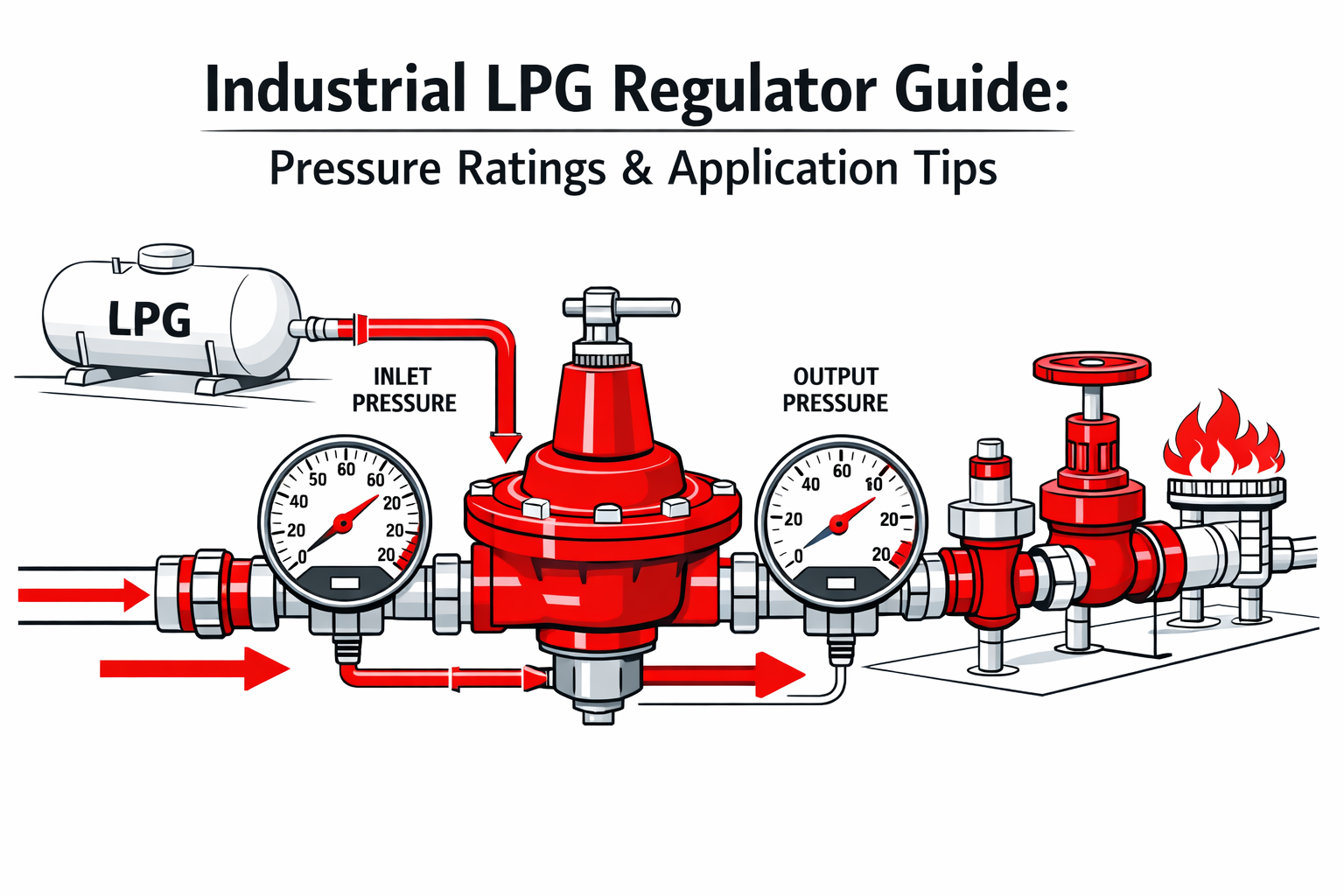
At this stage, a simple pressure-flow schematic can help visualise how inlet pressure is reduced and stabilised before reaching downstream equipment. This foundational understanding sets the stage for selecting the correct regulator type, sizing it accurately, and applying it safely across industrial LPG systems.
Industrial LPG Regulator Types Explained
Selecting the right regulator starts with understanding the different industrial LPG regulator types available and how they behave under load. Many performance issues in industrial LPG systems occur not because a regulator is faulty, but because the wrong type was selected for the application. This section breaks down the main regulator categories and explains where each one fits best.
A clear understanding at this stage helps engineers, contractors, and plant operators avoid instability, safety risks, and unnecessary maintenance.
Single-stage vs two-stage LPG regulators
The comparison between single stage vs two stage LPG regulators is one of the most important decisions in industrial system design. A single-stage regulator reduces cylinder or tank pressure to the required outlet pressure in one step. These regulators are simple, compact, and suitable for applications where demand remains relatively stable.
However, in industrial environments where load fluctuates, single-stage regulators can struggle to maintain consistent outlet pressure. As inlet pressure drops or demand changes, outlet pressure may vary. This variation can affect flame quality and process stability.
Two-stage regulators solve this problem by dividing pressure reduction into two steps. The first stage reduces high inlet pressure to an intermediate level, while the second stage delivers precise outlet pressure to equipment. This design provides better pressure stability across varying loads, making two-stage regulators ideal for continuous industrial operations, multi-burner systems, and applications requiring tight control.
For engineers comparing options, a detailed industrial LPG regulator selection guide should always consider load variation, not just maximum flow.
High-pressure vs low-pressure regulators
Another key distinction lies between high pressure LPG regulator industrial use and low-pressure regulation. High-pressure regulators are typically used upstream in industrial systems, especially where long pipe runs, manifolded cylinders, or specialised equipment require higher intermediate pressures.
Low-pressure regulators are usually installed closer to the point of use, supplying burners, boilers, or ovens with finely controlled pressure. In many industrial installations, both types are used together as part of a staged pressure control system.
Understanding this hierarchy is essential when designing or upgrading LPG systems. Incorrect placement or selection often results in pressure drop issues, uneven gas distribution, or equipment shutdowns. Facilities working with complex LPG layouts benefit from consulting specialists in industrial gas systems in Pakistan, where system design experience plays a critical role.
Indus 3 – Industrial Gas Systems Supplier in Pakistan
Specialised regulators for industrial environments
Beyond basic classification, there are regulators designed for specific industrial conditions. Heavy duty LPG pressure regulators are built for continuous operation, high flow rates, and harsh environments. These regulators use reinforced internal components and robust housings to withstand vibration, heat, and contamination.
Certain applications also require regulators with integrated safety features or compatibility with industrial LPG pressure control valve systems. For example, regulators used with industrial burners or boilers must respond quickly to load changes while maintaining precise outlet pressure. Welding applications, on the other hand, often prioritise stable flow over wide pressure ranges.
Choosing the correct type requires understanding not just the equipment being supplied, but also how the entire system behaves during operation. This is why experienced suppliers focus on application-based guidance rather than generic recommendations.
Explore industrial LPG equipment solutions
At this stage, a simple comparison diagram showing single-stage versus two-stage regulation, along with high- and low-pressure positioning, can greatly improve system understanding.
By recognising how different industrial LPG regulator types function, engineers and contractors can make informed decisions that support safety, efficiency, and long-term reliability. This knowledge also forms the foundation for correct sizing, pressure rating selection, and compliance with industrial safety standards, which are explored in the next section.
Pressure Ratings, Flow Rates, and Regulator Sizing
Correct sizing is the backbone of reliable LPG performance. Even the best regulator type will fail if pressure ratings and flow capacity are mismatched. This section explains how to read ratings correctly, apply a practical LPG regulator sizing guide, and avoid the most common errors seen in industrial installations.
Engineers and contractors often underestimate how quickly demand changes affect pressure stability. Getting sizing right upfront prevents flame issues, shutdowns, and long-term equipment damage.
Understanding inlet and outlet pressure ratings
Every industrial regulator is designed to operate within defined inlet and outlet pressure ranges. Inlet pressure refers to the maximum pressure entering the regulator from cylinders, tanks, or manifolds. Outlet pressure is the controlled pressure delivered to downstream equipment.
Industrial LPG systems typically experience wide inlet pressure variations due to temperature changes and withdrawal rates. The regulator must tolerate these fluctuations without allowing outlet pressure to drift. Selecting a regulator with insufficient inlet pressure tolerance often leads to pressure creep or unstable operation.
Outlet pressure must match the requirements of the appliance being supplied. Industrial burners, boilers, and furnaces are sensitive to overpressure and underpressure alike. This is why pressure ratings should always be confirmed against manufacturer specifications, not estimated on-site.
LPG regulator flow rate calculation basics
Flow rate is equally critical. LPG regulator flow rate calculation is based on maximum gas consumption, not average usage. Many industrial systems fail because regulators are sized for normal operation rather than peak demand.
Flow capacity is usually expressed in kilograms per hour or cubic metres per hour. When multiple appliances operate simultaneously, their combined demand must be considered. Pipe length, bends, and elevation changes also influence effective flow.
A properly sized regulator maintains stable outlet pressure even at peak load. Undersized regulators cause pressure drop, weak flames, and process inefficiencies. Oversized regulators, while less obvious, can lead to poor pressure control and delayed response to demand changes.
Facilities designing complex systems often benefit from consulting specialists in industrial gas flow control equipment, where real-world system behaviour is considered alongside calculations.
Indus 3 – Industrial Gas Systems Supplier in Pakistan
Common sizing errors in industrial installations
One frequent mistake is selecting regulators based solely on pipe size or previous installations. Industrial LPG systems are rarely identical, even within the same facility. Changes in equipment, production scale, or operating hours all affect demand.
Another common error is ignoring future expansion. Regulators sized only for current loads often require replacement when capacity increases. Designing with reasonable headroom improves system longevity and reduces retrofit costs.
Finally, many issues arise from poor coordination between pressure ratings and flow capacity. A regulator may handle the required flow but fail under high inlet pressure conditions. Avoiding this mismatch requires a system-level view rather than component-by-component decisions.
When uncertainty exists, engaging a technical team early helps prevent costly corrections later.
Contact Indus 3 for technical consultation
A clear sizing chart or manufacturer flow diagram is invaluable at this stage, especially for multi-cylinder or manifolded systems.
By understanding pressure ratings, flow requirements, and correct sizing principles, industrial operators can ensure stable combustion, protect equipment, and create a foundation for safe and compliant LPG system design. The next section builds on this by addressing the safety standards and regulatory requirements that govern industrial LPG regulators.
Safety Standards and Compliance for Industrial LPG Regulators
Safety is not a secondary consideration in industrial LPG systems. It is a regulatory, operational, and ethical obligation. Industrial LPG regulators play a central role in system safety by controlling pressure, preventing overloading, and supporting protective devices. Understanding applicable standards and compliance requirements is essential for anyone involved in LPG system design, installation, or operation.
This section explains the key industrial LPG regulator safety standards, with a specific focus on regulatory expectations in Pakistan.
Overpressure protection and safety shut-off mechanisms
One of the primary safety functions of an industrial LPG regulator is preventing overpressure downstream. Excess pressure can damage burners, rupture hoses, or cause uncontrolled combustion. To mitigate this risk, industrial regulators are often paired with overpressure protection devices such as relief valves, slam-shut valves, or integrated safety shut-offs.
LPG regulator overpressure protection works by releasing excess pressure safely or shutting off gas supply entirely when predefined limits are exceeded. In high-demand industrial systems, these mechanisms are not optional. They are essential safeguards against equipment failure and operator injury.
Engineers should always verify whether a regulator supports external safety devices or includes built-in protection. This decision depends on system size, operating pressure, and risk assessment.
Pakistani compliance requirements (OGRA & PESO)
In Pakistan, industrial LPG installations are governed by regulations issued by national authorities. The Oil and Gas Regulatory Authority (OGRA) defines requirements for LPG storage, pressure control, and system safety. Compliance with OGRA guidelines ensures that industrial LPG systems meet legal and operational safety benchmarks.
OGRA – Oil and Gas Regulatory Authority Pakistan
In addition, the Petroleum and Explosives Safety Organisation (PESO) provides safety standards related to pressure vessels, fittings, and hazardous installations. PESO guidance is particularly relevant for high-pressure LPG systems and industrial environments with elevated risk exposure.
PESO – Petroleum and Explosives Safety Organisation
Adhering to these standards is not only a legal requirement but also a critical risk management practice. Non-compliance can result in penalties, forced shutdowns, or serious safety incidents.
Certification and documentation to look for
A certified industrial LPG regulator should be supplied with clear documentation, including pressure ratings, flow capacity, and compliance certifications. These documents confirm that the regulator has been tested for industrial use and meets applicable safety standards.
Engineers and contractors should verify certification before installation, especially in regulated environments such as factories, commercial kitchens, and large-scale manufacturing plants. Documentation also supports inspections, audits, and insurance requirements.
Working with an experienced industrial LPG equipment supplier helps ensure that regulators are selected with compliance in mind rather than retrofitted later to meet safety expectations.
Indus 3 – Industrial Gas Systems Supplier in Pakistan
Learn more about Indus 3’s compliance-focused expertise
At this stage, safety diagrams showing relief valve placement or shut-off mechanisms can help visualise how protection is implemented in real systems.
By understanding safety standards and regulatory requirements, industrial operators can design LPG systems that protect people, equipment, and operations. The next section focuses on best practices for installing industrial LPG regulators correctly to ensure these safety measures function as intended.
Industrial LPG Regulator Installation Best Practices
Correct installation is just as important as selecting the right regulator. Even a properly sized and certified regulator will fail to perform if it is installed incorrectly. In industrial LPG systems, installation errors are a leading cause of leaks, pressure instability, and premature equipment failure. This section outlines practical LPG regulator installation guide principles that support safe and reliable operation.
The goal is not just compliance, but long-term system stability under real operating conditions.
Installation positioning and orientation
Industrial LPG regulators must always be installed in the correct orientation as specified by the manufacturer. Most regulators are designed to operate vertically, allowing internal components such as diaphragms and springs to function accurately. Incorrect positioning can affect pressure sensing and lead to unstable outlet pressure.
Location also matters. Regulators should be installed in well-ventilated areas, protected from excessive heat, vibration, and mechanical damage. In outdoor installations, weather protection is essential, but enclosures must not restrict airflow. Poor ventilation can cause gas accumulation and increase risk during maintenance or pressure relief events.
Upstream and downstream clearances should be maintained to allow safe access for inspection and servicing. In complex installations, proper layout planning plays a critical role in overall system performance.
Speak with Indus 3 for industrial LPG installation support
Common installation mistakes to avoid
One common mistake is installing regulators too close to burners or appliances without adequate downstream protection. Industrial systems benefit from clear separation between pressure control and point-of-use equipment. This separation improves pressure stability and simplifies troubleshooting.
Another frequent error is failing to install isolation valves before and after the regulator. Without isolation points, routine maintenance becomes difficult and unsafe. Additionally, incorrect pipe sizing upstream or downstream can negate the benefits of a correctly selected regulator, causing pressure drop or flow restriction.
Improper sealing methods, unsuitable fittings, and ignoring torque specifications also contribute to leaks and long-term reliability issues. These errors are avoidable when installation follows structured guidelines rather than improvisation.
Commissioning and initial testing
Once installed, industrial LPG regulators must be commissioned carefully. Commissioning includes leak testing, pressure setting, and functional checks under both low and peak demand conditions. Outlet pressure should be adjusted gradually and verified using calibrated gauges.
Testing should confirm that the regulator responds smoothly to load changes without pressure spikes or delays. Safety devices such as relief valves or shut-off mechanisms must also be tested to ensure they activate at the correct thresholds.
Facilities that treat commissioning as a formal process experience fewer operational issues over time. Working with a supplier experienced in industrial LPG equipment helps ensure that installation and testing align with best practices and regulatory expectations.
Explore industrial LPG equipment solutions
A clear installation layout diagram at this stage can help visualise regulator placement, isolation points, and safety device integration, especially in manifolded cylinder systems.
By following proper installation practices, industrial operators protect their investment, improve system reliability, and create a solid foundation for safe operation. The next section focuses on maintenance and troubleshooting, explaining how to keep industrial LPG regulators performing consistently over their service life.
Maintenance and Troubleshooting in Industrial LPG Systems
Industrial LPG regulators are designed for durability, but they are not maintenance-free. Over time, operating conditions such as continuous load, temperature variation, and gas impurities affect performance. A structured approach to industrial LPG regulator maintenance helps prevent unexpected failures and extends equipment life.
This section focuses on practical maintenance routines and clear troubleshooting guidance for industrial environments.
Preventive maintenance schedules
Preventive maintenance is the most effective way to maintain stable pressure control. Industrial regulators should be inspected periodically for external damage, corrosion, and signs of leakage. Seals, diaphragms, and vents must remain clean and unobstructed to ensure accurate pressure sensing.
Pressure settings should be checked at regular intervals using calibrated gauges. Any deviation from the specified outlet pressure may indicate internal wear or contamination. Maintenance frequency depends on system load and operating hours, but high-duty industrial systems benefit from more frequent inspections.
Documenting inspection results supports compliance and helps identify performance trends before they become critical issues. Facilities that integrate regulator checks into routine plant maintenance experience fewer unplanned shutdowns.
Common regulator faults and symptoms
Many operational problems can be traced back to regulator performance. LPG regulator troubleshooting in industrial systems often begins with recognising early warning signs. Common symptoms include fluctuating outlet pressure, unstable flames, or delayed response to demand changes.
Pressure creep, where outlet pressure slowly rises above the set point, usually indicates internal seat wear. Sudden pressure drop may result from blocked filters, undersized regulators, or upstream supply limitations. External leaks often point to damaged seals or improper fittings.
Understanding these symptoms allows technicians to act quickly, reducing the risk of equipment damage or safety incidents. In complex systems, expert input can speed up diagnosis and prevent unnecessary component replacement.
When to repair vs replace
Not all regulator issues require full replacement. Minor faults such as seal wear or contamination can often be resolved through servicing, provided the regulator body and core components remain intact. However, repeated failures, pressure instability, or outdated designs often justify replacement.
Replacement decisions should consider compliance with current safety standards and future system demands. Installing a regulator that no longer meets industrial requirements can compromise both safety and performance.
Working with a supplier experienced in industrial gas maintenance solutions ensures that repair and replacement decisions are based on system needs rather than short-term fixes.
Indus 3 – Industrial Gas Systems Supplier in Pakistan
Contact Indus 3 for technical consultation and support
At this stage, fault-diagnosis charts can be particularly useful, helping maintenance teams link symptoms to likely causes.
By implementing consistent maintenance practices and understanding common troubleshooting scenarios, industrial operators can maintain stable LPG supply, reduce downtime, and protect critical equipment. The next section compares industrial LPG regulators with natural gas regulators, highlighting why correct fuel-specific selection matters.
Industrial LPG vs Natural Gas Regulators: Key Differences
Industrial facilities often operate with both LPG and natural gas systems, which can lead to confusion during equipment selection. While regulators for both fuels serve the same basic purpose—pressure control—their design, materials, and operating characteristics differ significantly. Understanding the difference between LPG and natural gas regulators is essential to avoid misapplication and ensure safe, efficient operation.
This distinction is particularly important in industrial environments where pressure levels, flow rates, and safety requirements are higher.
Pressure characteristics of LPG vs natural gas
The most fundamental difference lies in pressure behaviour. LPG is stored and supplied at much higher pressures than natural gas. Its pressure fluctuates with temperature and withdrawal rate, making accurate regulation critical. Natural gas, by contrast, is usually supplied at lower and more stable pressures through pipelines.
Because of this, industrial LPG regulators must handle wide inlet pressure variations while maintaining a consistent outlet pressure. Natural gas regulators are not designed for these conditions. Using a natural gas regulator in an LPG system can result in unstable pressure control, leakage, or mechanical failure.
Engineers must always account for fuel-specific pressure characteristics during system design, especially in high-load industrial applications.
Material and design differences
Industrial LPG regulators are built with materials compatible with LPG’s chemical properties and pressure levels. Components such as diaphragms, seals, and valve seats are selected to withstand higher stress and prevent degradation over time. Natural gas regulators, while robust in their own context, are optimised for lower pressures and different gas compositions.
Design differences also extend to safety integration. LPG regulators often work alongside overpressure protection devices and shut-off systems to manage higher risk levels. These features are not always present or required in natural gas regulation.
This is why regulators should never be selected based solely on physical size or connection type. Fuel compatibility is a non-negotiable factor in industrial systems.
Application-specific selection considerations
From an operational standpoint, LPG systems are commonly used in facilities where pipeline gas is unavailable or where portability and high energy density are required. Industrial burners, boilers, and welding applications frequently rely on LPG, particularly in regions with expanding industrial activity.
Natural gas systems, on the other hand, are typically fixed installations with steady supply conditions. Each fuel demands a regulator designed for its unique operating environment.
Facilities planning new installations or conversions benefit from working with specialists in industrial gas system design, where fuel type, pressure control, and safety requirements are evaluated together rather than in isolation.
Indus 3 – Industrial Gas Systems Supplier in Pakistan
Understanding these differences also supports better long-term decision-making. Selecting the correct regulator reduces maintenance issues, improves combustion efficiency, and ensures compliance with safety standards.
For engineers and contractors, recognising the limits of interchangeability between LPG and natural gas regulators is a key step toward reliable system performance. This knowledge directly supports proper industrial LPG pressure regulation and prepares the ground for final selection guidance, which is covered in the concluding section.
Choosing the Right Industrial LPG Regulator: Final Guidance
Selecting an industrial LPG regulator is not a single-step decision. It is the result of understanding system demand, pressure behaviour, safety requirements, and long-term operating conditions. This Industrial LPG regulator guide has covered the technical foundations needed to make informed choices without relying on guesswork or trial-and-error.
A well-selected regulator improves combustion stability, protects equipment, and reduces downtime. A poor choice, however, can compromise safety and increase operating costs over time.
Key selection checklist
Before finalising a regulator for any industrial LPG system, several factors must be reviewed together. The first is application demand. Regulators must be sized for peak load, not average usage, and matched to the pressure requirements of downstream equipment.
Next, pressure ratings must align with both inlet supply conditions and outlet requirements. Industrial environments often experience wide pressure fluctuations, making stability under varying loads essential. Regulator type—single-stage or two-stage—should be selected based on how sensitive the application is to pressure variation.
Safety and compliance also play a central role. Regulators should support appropriate overpressure protection and meet relevant regulatory standards. Installation conditions, such as ventilation, accessibility, and environmental exposure, must also be considered during selection rather than after installation.
Finally, future expansion should not be overlooked. Designing with reasonable capacity headroom reduces the need for premature replacement and supports scalable operations.
When to seek expert consultation
Even with a strong technical understanding, complex systems benefit from professional input. Facilities with multiple appliances, long pipe runs, or continuous operation often require system-level analysis rather than component-level decisions.
Consultation is particularly valuable when upgrading existing systems, transitioning between fuels, or addressing recurring pressure-related issues. Experienced engineers can identify root causes that are not immediately visible and recommend solutions aligned with both safety and performance goals.
Working with a trusted partner that understands industrial LPG applications in Pakistan ensures that regulator selection is based on real operating conditions, not generic assumptions.
Explore industrial LPG regulator solutions at Indus 3
For organisations seeking reliable guidance, Indus 3 brings over two decades of experience in industrial gas systems, supporting engineers, contractors, and plant operators across a wide range of applications. From selection and sizing to installation support and long-term maintenance, the focus remains on safe, efficient, and compliant LPG operation.
If you are planning a new installation or reviewing an existing system, speaking with a technical specialist can help you avoid costly mistakes and ensure long-term reliability.
Contact Indus 3 to discuss your industrial LPG requirements
By approaching regulator selection as an engineered decision rather than a procurement task, industrial operators can build LPG systems that perform consistently, meet safety expectations, and support operational growth with confidence.