
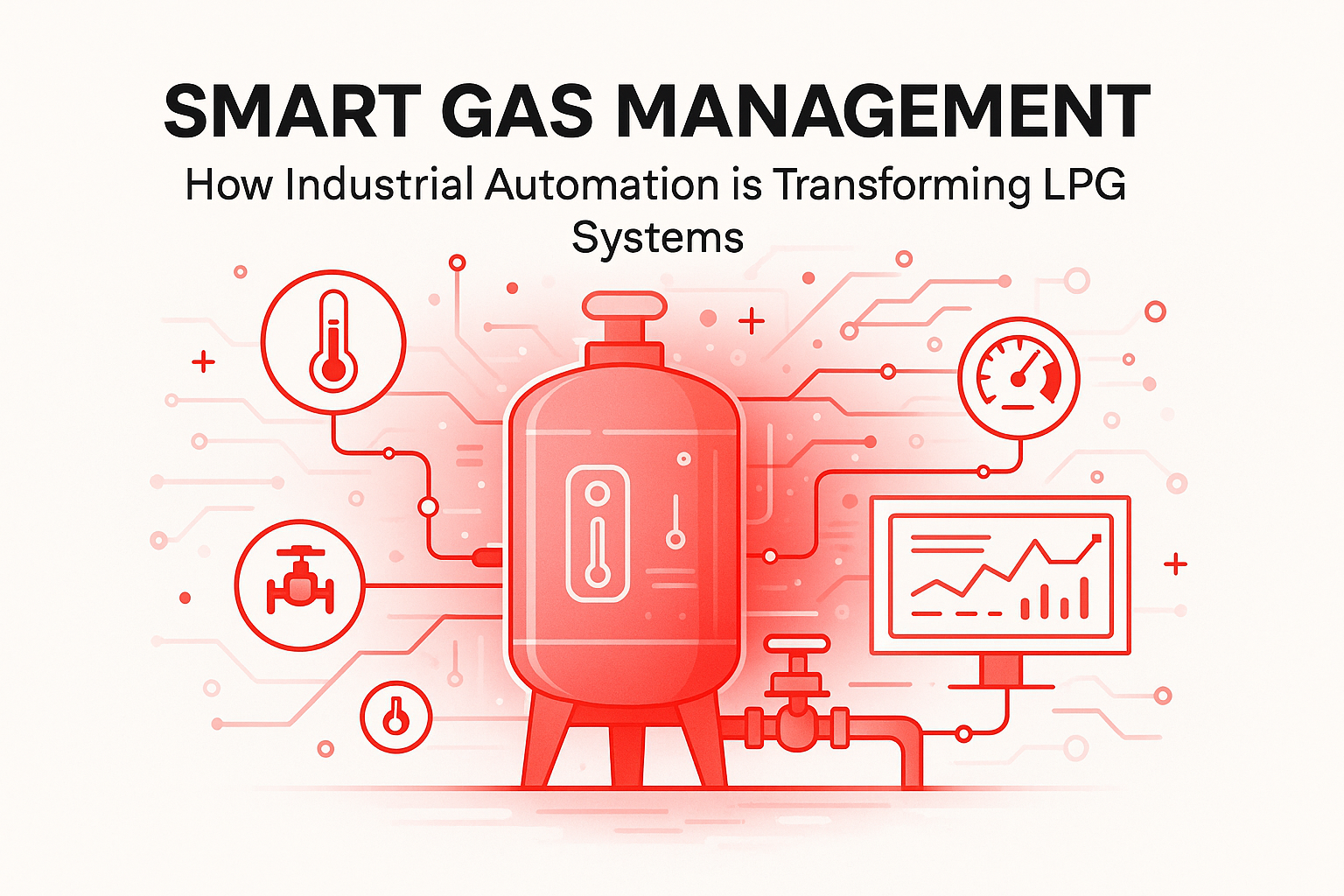
The Rise of Industrial LPG Automation: A New Era of Efficiency
What Is Industrial LPG Automation?
Industrial LPG automation refers to the integration of advanced technologies — such as IoT (Internet of Things), sensors, and digital control systems — into the management and operation of Liquefied Petroleum Gas systems. Instead of relying solely on manual controls and periodic checks, automation allows every aspect of the LPG process — from vaporisation to pressure regulation and distribution — to be continuously monitored and adjusted in real time.
In today’s industrial landscape, where downtime can mean substantial financial losses, automation ensures precise control, enhanced safety, and operational continuity. Through data-driven monitoring and intelligent responses, it transforms how factories, bottling plants, and energy facilities handle their gas systems. This evolution forms the foundation of what is known as smart gas management — a new era of connected, efficient, and sustainable LPG operations.
At Indus 3, we’ve seen firsthand how this transition from manual control to automated systems is reshaping Pakistan’s industrial gas landscape. With a product range that includes automation-ready LPG vaporizers, thermostats, regulators, and safety devices, Indus 3 stands as a reliable partner for industries aiming to future-proof their operations.
Why Automation Matters in the LPG Industry
The LPG industry is inherently complex. Gas systems require accurate temperature and pressure control, continuous safety monitoring, and compliance with industrial standards. Manual systems, while still common in many plants, are vulnerable to human error, inconsistent output, and maintenance delays.
Industrial LPG automation eliminates these inefficiencies by embedding smart sensors and digital controllers that maintain optimum conditions 24/7. For instance, an automated LPG vaporizer can adjust its heating cycle dynamically based on real-time temperature data, improving energy efficiency and reducing gas wastage.
According to the International Energy Agency (IEA), automation in industrial processes can reduce energy consumption by up to 15–25%, depending on system design and load management. The World LPG Association (WLPGA) further highlights automation as a cornerstone of industrial safety, particularly in environments dealing with high-pressure gas systems.
For local manufacturers in Pakistan, the adoption of such systems isn’t just about operational efficiency — it’s also about staying competitive in a rapidly digitalising global market. Companies investing in automation-ready LPG systems not only ensure compliance and reliability but also lower their long-term operational costs.
Global and Local Trends in Industrial Gas Automation
Globally, industrial automation has become a driving force behind safer and more efficient energy systems. From Germany’s automated LPG installations to Japan’s AI-driven gas management networks, industries are increasingly turning to data-centric solutions to boost productivity and sustainability.
In Pakistan, this transformation is now gaining momentum. As industries expand — particularly in textiles, food processing, and power generation — the demand for automation-enabled LPG systems continues to rise. Businesses are actively seeking trusted industrial LPG suppliers who can deliver not just hardware but intelligent, integrated solutions that meet international safety and performance benchmarks.
This is where Indus 3 plays a pivotal role. As one of Pakistan’s leading industrial LPG automation suppliers, Indus 3 offers high-performance equipment such as vaporizers, thermostats, and gas flow meters — all designed to integrate seamlessly with modern control systems. Whether you’re upgrading existing infrastructure or designing a new installation, you can explore Indus 3’s complete automation-ready product range in the Shop or learn more About Us.
IoT and Digital Controls: The Brain Behind Smart LPG Systems
Role of IoT in Industrial LPG Automation
The rise of industrial LPG automation has brought the Internet of Things (IoT) to the forefront of gas management systems. IoT acts as the “nervous system” connecting vaporizers, regulators, flow meters, and thermostats across an industrial network — enabling real-time data collection, communication, and response. Each component equipped with smart sensors can now transmit live operational data such as pressure, temperature, and gas flow rates to a central control unit or cloud platform.
For industries relying on LPG, this connectivity provides a quantum leap in visibility and control. Operators can monitor performance metrics, detect irregularities, and initiate automatic responses long before any safety or efficiency issue escalates. According to Automation.com, IoT-driven automation has been proven to reduce unplanned downtime in industrial plants by over 30%, showcasing the powerful synergy between connected devices and intelligent control.
As one of Pakistan’s leading industrial LPG suppliers, Indus 3 integrates IoT-ready products into its catalogue — ensuring that every gas handling solution aligns with the latest automation standards. This includes vaporizers, thermostats, and regulators designed to seamlessly communicate within modern industrial automation ecosystems.
Remote Monitoring and Predictive Maintenance
One of the most transformative outcomes of industrial automation is the shift from reactive maintenance to predictive maintenance. Through IoT sensors and programmable logic controllers (PLCs), plant managers can track performance trends and identify potential faults before they disrupt operations.
For example, when pressure fluctuations occur in a vaporizer or regulator, the system can instantly trigger alerts, schedule preventive maintenance, or even execute corrective commands remotely. This proactive approach significantly extends equipment life and enhances workplace safety. In a sector where gas leakage or overheating could lead to catastrophic damage, predictive analytics serves as a crucial protective layer.
With automation platforms connected to mobile dashboards or web interfaces, supervisors can monitor LPG systems from anywhere, reducing the need for physical inspections. This remote access is especially valuable for plants located in remote industrial zones across Pakistan.
At Indus 3, we champion the integration of remote monitoring through automation-ready tools like the Rainbow 320F Industrial LPG Thermostat and the Gas Flow Meter G6. These devices enable operators to fine-tune gas temperature and measure flow precisely, optimising both efficiency and energy consumption.
Smart Sensors and Control Panels in Action
The true intelligence of industrial automation controls lies in the seamless coordination between smart sensors and digital control panels. These panels serve as command centres that interpret sensor data and make real-time decisions — such as adjusting valve openings, triggering safety cut-offs, or recalibrating temperature levels.
For instance, when an LPG vaporizer experiences temperature drops below the optimum threshold, the control system automatically signals the heater to activate, ensuring continuous vaporisation. Similarly, if abnormal gas flow is detected by the Gas Flow Meter G6, the automation panel can isolate the affected section to prevent leakage or pressure imbalance.
Beyond operational efficiency, this system ensures compliance with industrial safety standards. Data from these digital panels can also be logged and analysed to optimise performance, reduce energy wastage, and meet sustainability goals.
Indus 3’s catalogue of industrial automation equipment — including smart thermostats, vaporizers, and regulators — offers companies the ability to design fully connected gas infrastructures. Explore automation-ready solutions on the Shop or reach out via the Contact page for tailored system consultations.
Inside an Automated LPG System: From Vaporizers to Valves
Key Components of an Automated LPG Setup
An automated LPG system is a finely tuned network of interconnected components working together to manage gas flow, pressure, and temperature with high precision. At its core, it brings together several industrial automation components—each serving a specific purpose in ensuring smooth, efficient, and safe gas operations.
The foundation of any modern LPG system begins with the vaporizer, which converts liquid gas into vapour suitable for downstream applications. Supporting it are regulators, thermostats, flow meters, and safety valves, all coordinated through a central control system equipped with sensors and digital logic. Together, these devices form what experts on ResearchGate describe as an integrated control loop, capable of self-adjusting to changing environmental and operational conditions.
Automation in this setup allows every unit—from vaporizers to valves—to communicate via IoT-enabled controllers, ensuring that the temperature, pressure, and gas volume are always maintained within safe and optimal limits. This digital synchronisation marks a major step forward in Pakistan’s industrial gas infrastructure, aligning it with international efficiency and safety standards.
For example, Indus 3 offers a complete range of automation-ready LPG components, designed to work seamlessly in both small- and large-scale industrial setups. These include high-performance vaporizers, thermostats, and regulators that deliver consistent reliability under continuous use.
Integrating Vaporizers, Regulators, and Valves
In a well-designed industrial automation system, integration is key. Each element of the LPG network plays a distinct yet complementary role, and automation ensures they operate harmoniously.
Take the LPG Vaporizer 400kg — a vital device responsible for converting liquid LPG into vapour using controlled heat. In traditional systems, temperature fluctuations or uneven gas supply could lead to inefficiencies or even unsafe conditions. However, in automated systems, sensors and thermostats feed continuous data to a central controller that dynamically adjusts heat input for stable vapour output.
From there, the RECO Grey LPG Regulator ½ Inch takes over, ensuring the vapour is delivered at a consistent pressure suitable for industrial use. The regulator works in tandem with automation logic to instantly respond to pressure changes, preventing overpressure scenarios that could compromise system safety.
Finally, the LPG Brass Ball Valve Heavy Duty plays a crucial role in flow management and isolation. Under automated control, these valves can be opened or closed remotely or automatically, based on operational requirements or emergency triggers. This level of control minimises the risk of human error and enhances safety in high-demand industrial environments.
This seamless integration of vaporizers, regulators, and valves demonstrates the power of industrial automation in transforming LPG systems from manually managed setups to smart, responsive infrastructures.
Achieving Balanced Pressure and Flow
Maintaining consistent pressure and flow within an LPG system is critical for both safety and efficiency. In manual setups, achieving this balance requires constant supervision. However, industrial automation systems handle it effortlessly through feedback loops and continuous monitoring.
Using real-time data from sensors installed across the pipeline, automation software adjusts the output of vaporizers, modifies regulator settings, and fine-tunes valve openings — creating a closed-loop control that keeps pressure and flow stable even under fluctuating load conditions.
This capability not only prevents system strain but also optimises fuel consumption and heat transfer. As a result, industries using automation-ready LPG systems experience fewer shutdowns, more consistent product quality, and significantly reduced maintenance costs.
Indus 3 supplies a comprehensive range of these components, making it easier for businesses in Pakistan to transition toward digitally managed LPG infrastructures. Each product — from thermostats to regulators — is engineered for compatibility with automation frameworks, helping industries embrace the future of smart gas management.
Industrial Automation and Control Systems: The Power of Integration
Advanced Control Systems for Gas Regulation
The evolution of industrial automation control systems has completely transformed how LPG operations are managed. In the past, operators relied on manual gauges, levers, and mechanical safety checks — a process prone to human error and limited accuracy. Today, with digital controllers, smart sensors, and PLC-integrated logic, LPG systems can regulate pressure, temperature, and flow with pinpoint precision.
These modern control systems function as the digital guardians of industrial gas plants. They continuously analyse sensor data and respond instantly to changing conditions — such as pressure spikes or sudden flow variations. Automated cut-off systems can immediately halt operations in unsafe conditions, preventing gas leaks or equipment failure.
For example, products like the Madas Gas Filter 2 Inch Mod FM offered by Indus 3 are designed to work efficiently within automation-ready systems, ensuring stable filtration and consistent gas purity throughout the process. These accessories complement high-end regulators, vaporizers, and thermostats to create a seamless flow of safe and clean LPG vapour.
By combining precision hardware with advanced software control, industrial LPG automation achieves the kind of reliability and safety standards previously seen only in large-scale energy facilities. This is not just innovation — it’s operational evolution.
PLC and SCADA Integration
At the heart of every smart LPG system lies two critical technologies — Programmable Logic Controllers (PLC) and Supervisory Control and Data Acquisition (SCADA) systems. Together, they form the backbone of modern industrial automation solutions, creating an intelligent framework capable of monitoring, analysing, and optimising every stage of gas handling.
A PLC is responsible for executing control logic in real-time. It receives signals from field devices such as thermostats, regulators, or vaporizers and sends precise commands to maintain system balance. This micro-level automation allows plants to operate safely even under varying loads or environmental changes.
Meanwhile, SCADA oversees the entire system — providing live visual dashboards that display operational data, system alerts, and performance analytics. According to Automation.com, PLC-SCADA integration not only boosts transparency and traceability but also enables remote supervision and data-driven decision-making, drastically reducing downtime.
For LPG facilities, this integration translates into better visibility across all units. Supervisors can monitor vaporizer performance, regulator output, and safety valve activity from a single control room or even via a mobile dashboard. This real-time connectivity enhances operational continuity while ensuring maximum workplace safety.
Benefits for Industrial LPG Operations
The benefits of industrial automation control systems in LPG plants extend far beyond convenience. They create measurable improvements in energy efficiency, system reliability, and cost-effectiveness. By maintaining precise temperature and pressure levels, automated systems ensure optimal fuel consumption — translating directly into reduced operational costs.
Automated alerts and predictive analytics further reduce maintenance expenses by identifying issues before they escalate. With human error minimised, plants can maintain continuous production while adhering to safety and environmental standards.
Energy efficiency is another major advantage. Automated systems regulate heating elements and vaporizers in real time, optimising power use and reducing waste. The result is not only lower energy bills but also a smaller carbon footprint — a step toward sustainable industrial practices in Pakistan’s growing LPG sector.
Indus 3 provides a comprehensive catalogue of automation-compatible LPG accessories — from regulators and valves to filters and thermostats — designed to integrate seamlessly into PLC-SCADA systems. Each component ensures accurate control and long-term reliability under demanding conditions.
For industries looking to enhance safety, accuracy, and energy performance, industrial LPG automation is not just a technological upgrade — it’s a strategic investment in the future of smart, sustainable energy. To explore customised automation solutions for your facility, visit our Home page or get in touch via the Contact page for expert consultation.
Real-World Applications: Automation in LPG Industries
LPG Automation in Manufacturing and Food Processing
Across the globe, industrial LPG automation is redefining how energy-dependent industries operate. In sectors like manufacturing and food processing, where precision, reliability, and safety are paramount, automation ensures that gas systems perform efficiently under continuous production loads.
In textile mills, for instance, LPG vaporizers are responsible for delivering consistent heat for dyeing and finishing processes. Traditionally, operators had to manually adjust regulators and thermostats to maintain stability — a process prone to human error and energy waste. Now, with IoT-enabled sensors and control systems, automated vaporizers such as the LPG Vaporizer 700kg automatically adjust heating output in response to real-time temperature fluctuations, maintaining perfect operational balance.
In the food and beverage industry, precise heat regulation is essential for baking, sterilisation, and packaging. Here, automation minimises the risk of temperature overshoot and ensures uniform energy distribution. Devices like the Rainbow LPG Thermostat 60°C Auto Stop play a critical role by automatically cutting off heating once the required temperature is reached — improving both safety and efficiency.
Such advancements make LPG not only a cleaner energy alternative but also a smartly managed fuel source capable of meeting modern production demands. Indus 3 has been at the forefront of this transformation, helping manufacturers integrate automation-ready LPG systems that combine sustainability with precision performance.
Smart LPG Management in Energy and Bottling Plants
In the energy sector, particularly in LPG bottling and power generation plants, automation is the key to balancing supply and safety. These high-pressure environments require unwavering precision — something only automated control systems can deliver.
Automation ensures that vapourisation rates match the energy output required at any given moment. Pressure and flow sensors continuously communicate with industrial automation controllers, enabling dynamic adjustments and preventing pressure surges or equipment stress.
For LPG bottling plants, automation also supports batch control and real-time monitoring. Supervisors can view live metrics of filling volumes, temperature, and gas flow from control dashboards — ensuring accuracy and compliance with safety standards. According to the World LPG Association (WLPGA), automation in bottling facilities has reduced gas loss by up to 20% and improved worker safety through advanced leak detection systems.
In Pakistan, where energy reliability is essential for industrial productivity, Indus 3’s range of automation-compatible products — including vaporizers, regulators, and thermostats — helps companies maintain efficiency even under fluctuating power conditions. By connecting smart thermostats, flow meters, and safety valves, industries can operate with greater control, consistency, and confidence.
Industrial Case Studies from Pakistan
Pakistan’s industrial landscape is rapidly adopting automation to keep pace with global standards. In recent years, several sectors — from textiles and food to chemicals — have modernised their LPG infrastructures with automated systems supplied by Indus 3.
For example, a leading textile manufacturer in Faisalabad implemented Indus 3’s LPG Vaporizer 700kg paired with digital thermostats to replace an outdated manual heating setup. The result was a 25% improvement in energy efficiency and a significant reduction in downtime caused by overheating incidents.
Similarly, a Karachi-based bottling plant integrated the Rainbow LPG Thermostat 60°C Auto Stop, enabling automated cut-offs that enhanced worker safety and reduced gas wastage. These real-world successes demonstrate how industrial LPG automation not only drives performance but also ensures compliance with global safety norms.
As a trusted industrial LPG supplier in Pakistan, Indus 3 continues to collaborate with factories, energy producers, and manufacturers to deliver custom automation solutions tailored to each facility’s needs. With decades of expertise in gas equipment and system design, the company is bridging the gap between traditional gas infrastructure and the next generation of automated LPG networks.
The Economic and Environmental Benefits of LPG Automation
Cost Efficiency Through Automation
In today’s competitive market, industrial leaders are constantly searching for ways to cut costs while boosting performance — and industrial LPG automation delivers both. By integrating industrial automation technology into LPG systems, companies gain precise control over temperature, pressure, and flow, which translates directly into reduced operational expenses and greater output efficiency.
According to the International Energy Agency (IEA), industries that employ automation can achieve energy savings of up to 25%, primarily through improved process control and reduced wastage. In the LPG sector, automated vaporizers and thermostats optimise heating cycles, ensuring that gas is used only when needed and in the exact quantities required. This precision eliminates the guesswork associated with manual systems, leading to lower fuel consumption and a substantial reduction in energy bills.
Indus 3 provides a range of automation-compatible LPG vaporizers and thermostats that are designed to maximise cost efficiency without compromising performance. Products such as high-capacity vaporizers and smart thermostats automatically regulate gas flow based on real-time demand — preventing overuse and unnecessary operational strain. For businesses looking to modernise, exploring Indus 3’s Shop is an ideal first step towards implementing smart, cost-effective gas management solutions.
By replacing outdated manual processes with industrial automation equipment, Pakistani industries can maintain steady output while significantly lowering long-term maintenance and operational costs.
Reducing Energy Waste and Emissions
One of the most impactful outcomes of industrial LPG automation is its ability to reduce energy waste and minimise harmful emissions. Traditional gas systems often run continuously, even when the demand fluctuates, leading to excessive fuel consumption and environmental stress. In contrast, automated systems operate based on real-time analytics, automatically adjusting vaporisation and heating processes to match actual energy requirements.
This real-time optimisation means that gas is neither overheated nor over-pressurised — cutting down on carbon emissions while conserving energy. According to studies published by the IEA, automated control systems can decrease industrial CO₂ emissions by 10–15%, contributing significantly to global sustainability goals.
Indus 3’s advanced range of products, such as automation-ready LPG vaporizers and thermostats, helps businesses in Pakistan transition toward greener energy practices. For instance, their smart thermostats, integrated with industrial automation technology, ensure that energy is never wasted due to overheating or system inefficiencies.
Automation also enhances leak detection and pressure control, helping to prevent gas loss — a critical environmental and economic concern. Each litre of LPG saved through automation not only reduces greenhouse gas emissions but also contributes to a more sustainable energy economy for Pakistan.
To learn more about eco-friendly LPG solutions, visit the Home page of Indus 3, where innovation meets responsibility.
Sustainability and Future of the LPG Industry
The global LPG industry is undergoing a major transformation as sustainability becomes a priority across all sectors. As governments and organisations worldwide enforce stricter energy and emission standards, automation stands as the bridge between industrial growth and environmental responsibility.
In Pakistan, where industries such as textiles, food processing, and energy are rapidly expanding, adopting industrial automation systems offers a dual benefit: improving production efficiency while meeting sustainability commitments. Automated LPG systems not only conserve resources but also align with global trends in low-carbon manufacturing.
By investing in industrial automation equipment, companies future-proof their operations — reducing dependence on manual oversight and embracing data-driven decision-making. Indus 3’s automation-ready LPG components, including vaporizers, regulators, and thermostats, enable businesses to achieve cleaner, smarter, and more sustainable operations.
The integration of industrial automation technology with LPG infrastructure marks the next stage in Pakistan’s energy evolution — one where profitability and environmental stewardship coexist. As industries continue to modernise, automation will remain central to achieving a balanced, efficient, and eco-conscious LPG ecosystem.
Overcoming Challenges in Industrial LPG Automation
Common Barriers to Automation in LPG Plants
While industrial LPG automation offers remarkable advantages in efficiency, safety, and sustainability, many industries — particularly in developing markets like Pakistan — still face significant challenges in adopting these systems. The most common barriers include outdated infrastructure, limited technical expertise, and the initial cost of automation equipment.
Many LPG plants and industrial facilities still rely on manual operations that lack data connectivity and precision control. Such systems, though inexpensive to maintain in the short term, are prone to inefficiencies, energy waste, and safety risks. According to research published on ResearchGate, nearly 40% of industrial accidents in gas-based plants stem from human error or insufficient system monitoring — challenges that automation could virtually eliminate.
Another key obstacle is the high upfront cost of modern automation technology. While the long-term savings outweigh the investment, smaller manufacturers often hesitate to commit capital without a clear understanding of the return on investment. Moreover, fragmented industrial ecosystems and the lack of standardised integration across legacy systems can complicate the automation process.
These issues underscore the importance of having reliable industrial LPG suppliers and automation experts who can deliver not only products but also practical, end-to-end implementation guidance.
Training and Technology Adoption
Adopting advanced industrial automation solutions requires more than just installing hardware — it demands a shift in knowledge, culture, and operational mindset. One of the primary bottlenecks in Pakistan’s LPG sector is the skills gap in handling automation tools such as PLCs, SCADA systems, and IoT-based controllers.
According to Automation.com, ongoing industrial automation training is crucial to ensure that engineers, technicians, and plant operators can fully leverage the capabilities of automation systems. Without adequate training, even the most advanced systems may operate below their full potential, reducing efficiency and increasing maintenance costs.
This is where Indus 3 plays a transformative role. As one of Pakistan’s most trusted industrial automation supply hubs, Indus 3 not only provides automation-ready LPG equipment but also assists industries in understanding how to integrate and maintain these systems effectively. The company’s expertise ensures smooth transitions from manual control to intelligent automation, reducing the risk of errors and downtime during implementation.
By offering advisory and technical support, Indus 3 helps clients develop internal capability — empowering them to take full control of their systems while enhancing long-term reliability and safety.
How Indus 3 Supports Industrial Transformation
At Indus 3, automation isn’t treated as a product — it’s a partnership. Recognising the challenges faced by industrial operators, the company provides comprehensive solutions that combine cutting-edge products, integration guidance, and local support. Whether a facility needs a simple regulator upgrade or a complete smart vaporiser system, Indus 3’s team ensures that each component fits seamlessly into the broader automation framework.
By leveraging global insights and local expertise, Indus 3 bridges the technology gap in Pakistan’s LPG industry. The company’s automation-ready equipment — including vaporizers, thermostats, valves, and regulators — is designed to meet international safety standards while remaining accessible for local industries.
Moreover, Indus 3 actively collaborates with engineers and plant managers to develop customised automation blueprints that balance performance with budget considerations. This approach makes automation achievable even for small and mid-sized enterprises that once viewed it as unattainable.
For businesses looking to begin their automation journey or upgrade existing systems, Indus 3’s consultation services offer a clear roadmap to success. To discuss your plant’s automation potential, visit the Contact page and connect directly with the company’s experts.
The Future of Smart Gas Management: Why Indus 3 Leads the Way
The Next Phase of Industrial LPG Automation
As industries worldwide continue to embrace digital transformation, industrial LPG automation stands at the heart of this evolution — merging precision, efficiency, and intelligence into one cohesive system. The next phase of smart gas management will be defined by deeper integration of IoT, AI, and real-time data analytics, creating gas infrastructures that can self-regulate, predict maintenance needs, and optimise performance without manual input.
Globally, the LPG industry is shifting towards predictive control systems that adapt dynamically to changing demand and environmental conditions. In Pakistan, this transformation has already begun — with forward-thinking businesses investing in automation-ready vaporizers, thermostats, and regulators that ensure reliability and safety at scale.
According to the World LPG Association (WLPGA), automation will play a pivotal role in achieving cleaner and more sustainable gas operations over the next decade. For industrial players, this means greater cost savings, enhanced safety compliance, and reduced carbon footprints — all while meeting the growing energy demands of modern production facilities.
By integrating smart components such as temperature sensors, flow controllers, and pressure regulators, industries can create closed-loop gas systems that optimise every drop of energy. This shift from reactive to proactive gas management marks a turning point for Pakistan’s industrial sector — and Indus 3 is leading the charge.
Why Choose Indus 3 for Automation-Ready LPG Solutions
In Pakistan’s rapidly evolving industrial landscape, Indus 3 has emerged as a trusted name in industrial LPG supply and automation-ready technology. With years of experience and a product catalogue designed for precision, safety, and efficiency, Indus 3 has positioned itself as a cornerstone in the country’s journey toward digitalised energy infrastructure.
What sets Indus 3 apart is its commitment to providing complete automation ecosystems, not just standalone products. The company’s inventory includes high-performance vaporizers, regulators, thermostats, and valves — each engineered to integrate seamlessly into modern industrial automation systems.
Among their best-selling automation-compatible products are:
-
The LPG Vaporizer 500kg — ideal for stable, high-volume gas flow with intelligent heat regulation.
-
The Madas FRG2MTE Regulator 1 Inch — known for maintaining precise pressure balance under varying load conditions.
-
The Industrial LPG Vaporizer ½ Inch — a compact yet powerful solution for smaller-scale or decentralised industrial systems.
Every component supplied by Indus 3 adheres to international safety and performance standards, making them compatible with automation systems powered by PLC and SCADA technology. These products not only enhance efficiency but also ensure that industries remain compliant with evolving safety regulations and sustainability goals.
Partner with Indus 3 for Smarter Gas Management
The road to intelligent gas infrastructure begins with choosing the right partner — one that understands the intersection of technology, safety, and performance. Indus 3 stands at this intersection, combining decades of technical expertise with a deep understanding of industrial needs across Pakistan.
Whether you operate in manufacturing, bottling, textiles, or energy production, Indus 3 provides end-to-end industrial automation solutions tailored to your operations. From consultation and system design to delivery and after-sales support, the company ensures that every stage of your automation journey is seamless and future-ready.
Ready to modernise your LPG systems with automation-ready solutions?
Visit Indus 3, explore the Shop, or Contact Us today to get expert guidance and high-performance industrial gas products that empower your business for the future.
As Pakistan moves toward a digitally driven industrial economy, automation will define competitiveness, safety, and sustainability in every sector. With its cutting-edge products, trusted expertise, and commitment to innovation, Indus 3 is not just keeping pace with this future — it’s shaping it.
One Reply to “Smart Gas Management: How Industrial Automation is Transforming LPG Systems”