
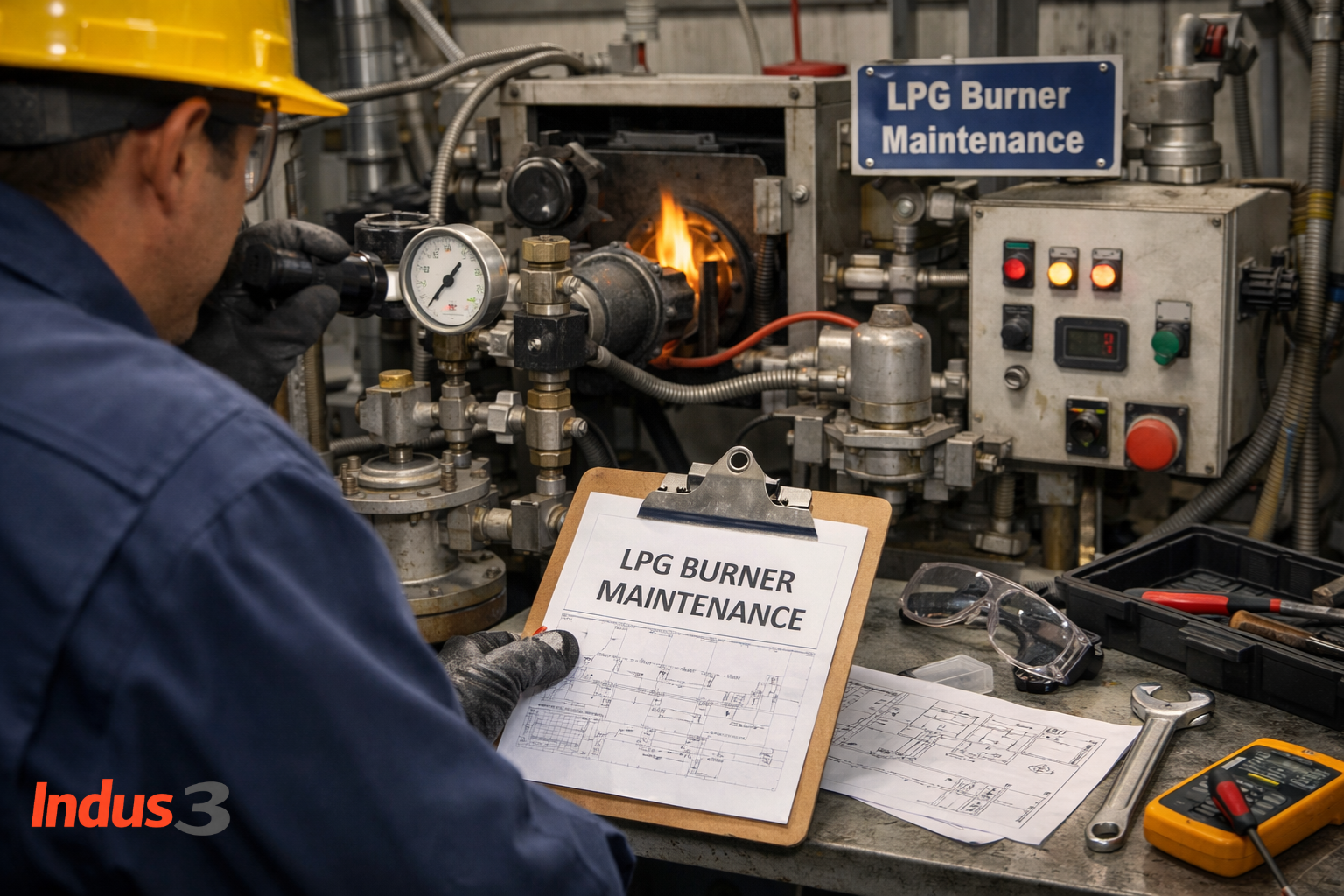
The Role of LPG Burner Maintenance in Industrial Energy Reliability
In industrial operations, LPG burners are not just combustion devices. They function as load-bearing elements of the entire energy system. When burner performance declines, the impact rarely stays localised. It surfaces as unstable flames, inefficient fuel use, uneven heating, and eventually production losses.
This is why LPG burner maintenance best practices should be viewed as a reliability discipline rather than routine housekeeping.
Across South Asian industrial facilities, LPG systems often operate under demanding conditions. High dust levels, variable fuel quality, extended operating hours, and limited shutdown windows place continuous stress on burners. Without a structured maintenance approach, even a correctly designed burner slowly drifts away from its optimal operating range.
Industrial burners are precision assemblies. Gas flow rate, air to fuel ratio, and ignition stability must remain within defined tolerances. When maintenance is inconsistent, small deviations accumulate over time. A partially blocked jet or early-stage corrosion on the burner head may appear minor, but it increases fuel consumption, destabilises combustion, and accelerates wear on connected components.
From an energy efficiency perspective, regular LPG burner maintenance directly influences system output. Clean burners deliver stable flame geometry, consistent heat transfer, and reduced unburnt gas losses. In continuous-duty applications such as boilers, furnaces, bakeries, and process heaters, these improvements translate into measurable operating cost reductions.
Reliability is another critical factor that is often underestimated. Poor burner condition disrupts gas draw characteristics, placing irregular loads on regulators, hoses, and vaporizers. This can contribute to pressure fluctuations, regulator freezing, and intermittent flame failure. Many of these secondary issues are addressed within a broader LPG system service schedule, but the burner itself remains one of the most frequent starting points for system instability.
Maintenance best practice begins with recognising the burner as part of an integrated gas system rather than a standalone component. Effective gas burner maintenance aligns burner inspection cycles with vaporizer performance, regulator health, and actual fuel demand. A solid understanding of phase change behaviour, as explained in how LPG vaporizers work, helps maintenance teams diagnose burner-related issues with greater accuracy.
Workforce practices also play a major role. In many plants, burner maintenance is reduced to surface cleaning performed during breakdowns. This reactive approach restores operation temporarily but often masks underlying efficiency losses. Proper maintenance focuses on repeatable procedures, condition-based inspection, and basic performance checks rather than improvised fixes.
Safety considerations further reinforce the importance of disciplined burner upkeep. Poorly maintained burners are more prone to delayed ignition, flame lift-off, and localised gas accumulation near combustion zones. These conditions are well-documented contributors to near-miss incidents in industrial LPG installations. Maintaining burner integrity therefore supports both operational uptime and risk control.
In energy-intensive operations, the burner is the point where fuel value is either realised or wasted. A structured maintenance approach protects that value by ensuring predictable heat output, stable combustion, and controllable energy costs throughout the life of the system.
Establishing this context is essential. Once the role of burner maintenance is clearly understood, it becomes easier to identify why neglected burners lead to specific performance problems and how those problems can be prevented through systematic maintenance practices.
Common Industrial LPG Burner Problems Caused by Poor Maintenance
Most industrial LPG burner failures do not occur suddenly. They develop gradually as a result of skipped inspections, inconsistent cleaning, or delayed component replacement. By the time a burner shows visible malfunction, the underlying issue has often been present for weeks or months.
One of the most common outcomes of poor maintenance is unstable flame behaviour. Operators frequently report yellow or lifting flames, delayed ignition, or flames that fluctuate under constant load. These LPG burner flame issues are typically linked to partially clogged gas jets, carbon deposits on burner ports, or incorrect air to fuel ratios caused by dirt ingress. Without routine cleaning, even minor contamination can disturb combustion stability.
Clogging is another widespread problem in industrial environments. Dust, oil vapours, and airborne particles gradually restrict gas passages. When steps are not taken to prevent gas burner clogging, burners begin to draw gas unevenly. This leads to incomplete combustion, higher fuel consumption, and increased thermal stress on burner components. Over time, clogging also affects upstream equipment by creating irregular gas demand.
Maintenance neglect also contributes directly to LPG burner performance issues such as reduced heat output and longer warm-up times. These symptoms are often misattributed to fuel quality or regulator faults. In reality, worn burner heads, damaged mixing tubes, or blocked jets are frequently responsible. Proper diagnosis requires understanding burner condition before adjusting pressure or flow settings.
Another recurring issue is ignition failure. Burners that are not cleaned or inspected regularly are more prone to delayed ignition, which increases the risk of local gas accumulation. This is particularly dangerous in enclosed industrial settings. Regular inspection routines help identify early warning signs such as fouled igniters or restricted pilot passages before they escalate into safety hazards.
Leak-related problems also surface more often when maintenance is inconsistent. Cracked seals, hardened hoses, or loose fittings near the burner assembly can go unnoticed during daily operation. These issues not only reduce system efficiency but also raise safety concerns. Broader system-level risks associated with leaks are covered in detail within LPG fault analysis resources such as LPG vaporizer issues and diagnosis, but burner-level leaks remain a frequent root cause.
Troubleshooting becomes significantly more complex when routine maintenance is ignored. Operators may attempt repeated adjustments to pressure regulators or air shutters without addressing the actual fault. This trial-and-error approach often worsens the situation, masking the original problem and accelerating component wear. Effective LPG stove troubleshooting at an industrial level depends on clean, well-maintained burners as a baseline condition.
Spare part degradation is another overlooked consequence. Burner nozzles, caps, and mixing components are designed with specific tolerances. When cleaning is skipped or incorrect tools are used, parts deform or corrode prematurely. This leads to unplanned LPG burner parts replacement, increased downtime, and higher lifecycle costs. Access to correct components, such as those outlined in burner spare parts in Pakistan, becomes critical once damage has occurred.
In many cases, these problems appear simultaneously. A poorly maintained burner may exhibit flame instability, reduced output, and ignition delays at the same time. Treating these symptoms individually without addressing maintenance gaps leads to recurring failures.
Understanding how poor maintenance translates into specific burner problems is essential. It allows maintenance teams to move away from reactive fixes and towards systematic prevention, which is the foundation of reliable and efficient industrial LPG burner operation.
Operational Constraints in Industrial Burner Maintenance Environments
Even when the importance of maintenance is well understood, industrial LPG burner upkeep is rarely straightforward. Real-world operating conditions introduce constraints that shape how maintenance is planned, executed, and sometimes deferred. Recognising these constraints is essential for building realistic and effective routines rather than idealised checklists that never get followed.
One of the most common constraints is limited downtime. Many industrial plants operate on tight production schedules where shutting down a burner, even briefly, has cost implications. As a result, routine LPG burner inspection is often postponed until a visible fault appears. This reactive pattern increases the likelihood of compounded issues because early warning signs are missed during normal operation.
Workforce capability is another factor. In many facilities, burner maintenance is handled by general technicians rather than gas specialists. While this approach may keep systems running in the short term, it often leads to inconsistent inspection depth and improper cleaning methods. Without access to the best LPG stove maintenance tools or clear procedures, technicians may rely on visual checks alone, leaving internal components unassessed.
Environmental conditions further complicate maintenance. Industrial sites in South Asia frequently expose burners to dust, humidity, and temperature fluctuations. These factors accelerate corrosion and contamination. Without proactive gas burner corrosion prevention, burner components degrade faster than expected, shortening service intervals and increasing replacement frequency. Environmental exposure also affects hoses and fittings near the burner assembly, making regular LPG hose check tips an essential part of any inspection routine.
Fuel quality variability adds another layer of complexity. Inconsistent LPG composition can lead to residue build-up and altered combustion behaviour. When maintenance teams are unaware of these fuel-related influences, they may misinterpret symptoms as mechanical faults rather than environmental or supply-driven effects. This often results in unnecessary adjustments or component changes.
Access constraints also play a role. Burners installed in compact or enclosed plant layouts are harder to inspect thoroughly. Components may be partially hidden or difficult to remove without disturbing adjacent equipment. In such cases, maintenance tasks are often simplified or skipped altogether. Over time, this creates uneven maintenance coverage across the system.
Documentation gaps are a less visible but equally important constraint. Many plants lack formal records of burner inspections, cleaning intervals, or part replacements. Without historical data, maintenance decisions rely heavily on memory or assumptions. Structured documentation frameworks, such as those encouraged within an LPG hose and fitting guide, help standardise inspection practices and reduce reliance on individual judgement.
Finally, budget prioritisation influences maintenance quality. Burner upkeep is often viewed as a low-cost activity compared to larger equipment servicing. This perception leads to deferred part replacement and improvised repairs. Over time, these shortcuts increase total cost of ownership through higher fuel use, unplanned downtime, and premature equipment failure.
Understanding these operational constraints allows maintenance planners to design realistic inspection routines that fit actual site conditions. By aligning maintenance frequency, tooling, and documentation with environmental and operational realities, plants can maintain burner performance without disrupting production. This practical alignment is a necessary step before addressing the safety and compliance risks that emerge when constraints are ignored.
Safety Risks and Compliance Gaps in LPG Burner Systems
Safety risks in industrial LPG burner systems rarely stem from a single failure. They emerge when routine maintenance, inspection discipline, and compliance checks gradually fall out of alignment. Over time, small oversights create conditions where minor faults escalate into serious incidents.
One of the most significant risks is gas leakage at or near the burner assembly. Worn seals, loose fittings, and degraded hoses are common in high-temperature zones. Without a structured LPG burner safety checklist, these issues often go unnoticed during daily operation. Even minor leaks reduce combustion efficiency and increase the risk of gas accumulation in confined spaces.
Ignition-related hazards are another concern. Poorly maintained burners are more prone to delayed ignition or flame instability. When gas is released without immediate ignition, it can accumulate briefly before lighting, creating a flashback risk. Regular inspection routines help identify early warning signs such as fouled igniters, restricted pilot lines, or inconsistent flame sensing before they become safety-critical.
Hose integrity is frequently overlooked in burner-focused maintenance. Hoses exposed to radiant heat, vibration, or chemical contaminants degrade faster than expected. Without consistent LPG hose check tips integrated into inspection routines, cracks and hardening may only be detected after failure. These risks extend beyond the burner itself and can compromise the entire gas supply line.
Corrosion presents a slower but equally dangerous threat. Moisture, chemical vapours, and temperature cycling accelerate metal degradation in burner components and nearby fittings. Effective gas burner corrosion prevention requires both environmental awareness and regular physical inspection. Corroded parts may still function temporarily, but their structural integrity is compromised, increasing the likelihood of sudden failure under load.
Compliance gaps often arise from documentation rather than equipment condition alone. Many industrial sites operate LPG systems that are mechanically sound but poorly documented. Missing inspection records, undocumented part replacements, and informal maintenance practices make it difficult to demonstrate compliance during audits. This becomes particularly important in jurisdictions where regulatory oversight is increasing and incident reporting requirements are tightening.
Leak detection practices also vary widely between facilities. Some rely solely on manual checks, while others integrate detection equipment at critical points. Understanding modern approaches to LPG stove leak detection, as outlined in resources on LPG leak detection technologies, helps close the gap between traditional inspection and current safety expectations.
Fire risk management is another area where maintenance discipline plays a decisive role. Burners operating with unstable flames or incomplete combustion increase local heat stress and raise ignition risks in surrounding materials. Integrating burner maintenance with broader safety measures, including appropriate fire protection equipment such as those covered in LPG fire safety equipment, strengthens overall risk control.
Ultimately, safety and compliance are not separate from maintenance. They are outcomes of consistent inspection, timely intervention, and clear procedures. When burner maintenance is treated as a technical routine rather than a safety-critical process, compliance gaps widen and risks multiply. Addressing these gaps requires structured maintenance strategies that balance operational demands with safety obligations, which sets the stage for more efficient and reliable system performance.
Structured Maintenance Strategies for LPG Burner Efficiency
Improving LPG burner efficiency in industrial settings is rarely achieved through isolated actions. It requires a structured maintenance strategy that aligns inspection routines, cleaning practices, and component replacement with actual operating conditions. Without structure, maintenance becomes reactive, and efficiency gains remain inconsistent.
The foundation of any effective strategy is preventive maintenance. Rather than waiting for visible faults, preventive routines focus on maintaining baseline burner condition. This includes scheduled cleaning, inspection of flame quality, and verification of air to fuel ratios. These practices directly support LPG burner efficiency tips by ensuring combustion remains stable and predictable over time.
A common mistake is treating all burners the same. Industrial applications vary widely in duty cycle, thermal load, and environmental exposure. A burner operating continuously in a bakery environment faces different stresses than one used intermittently in a batch process. Maintenance strategies should reflect these differences by adjusting inspection frequency and cleaning intensity accordingly.
Cleaning strategy plays a central role. Effective LPG burner cleaning tips go beyond surface-level debris removal. Burner ports, jets, and mixing zones must be kept free from carbon deposits and dust buildup. Cleaning intervals should be defined based on observed residue patterns rather than fixed calendar dates. This approach prevents over-cleaning while still maintaining combustion efficiency.
Another key element is inspection sequencing. Visual inspection alone is not sufficient for industrial burners. Structured routines should include checks for flame colour, flame stability, ignition response time, and unusual noise. These indicators provide early insight into efficiency loss before fuel consumption rises noticeably. Linking burner checks with broader system inspections, as outlined in an LPG system service schedule, helps ensure consistency across the gas network.
Documentation is often overlooked but has a direct impact on efficiency. Recording inspection findings, cleaning actions, and minor adjustments creates a performance history for each burner. Over time, patterns emerge that highlight recurring issues or gradual degradation. This data-driven approach supports informed decisions about adjustments and part replacement rather than guesswork.
Maintenance strategies should also account for operator interaction. Simple practices such as keeping burner areas clean, avoiding unauthorised adjustments, and reporting abnormal flame behaviour contribute to easy gas stove maintenance at an industrial level. When operators understand how daily actions affect burner efficiency, maintenance teams face fewer avoidable issues.
Alignment with system-level performance is another strategic consideration. Burner efficiency is influenced by upstream factors such as vaporizer output and regulator stability. Understanding how these elements interact, as discussed in resources on LPG vaporizer applications, helps maintenance planners avoid focusing narrowly on the burner while ignoring system-wide inefficiencies.
Ultimately, structured maintenance strategies convert routine tasks into measurable efficiency improvements. By standardising inspection logic, tailoring cleaning intervals, and integrating documentation, industrial facilities can maintain consistent burner performance. This structured approach lays the groundwork for applying practical maintenance frameworks and tools, which turn strategy into repeatable action.
Practical Maintenance Frameworks Used in Industrial Gas Systems
Translating maintenance strategy into consistent action requires clear frameworks. In industrial LPG systems, maintenance frameworks provide structure to inspections, define responsibility, and reduce variability in how burners are assessed across shifts and sites. Without such frameworks, even well-intentioned maintenance plans tend to erode over time.
A widely used approach is checklist-based maintenance. A structured gas burner maintenance guide typically breaks inspections into visual, functional, and condition-based checks. Visual checks cover flame appearance, soot accumulation, and obvious physical damage. Functional checks focus on ignition response, flame stability, and shutdown behaviour. Condition-based checks assess wear on burner components, seals, and fittings. This layered approach ensures that issues are identified before they affect efficiency or safety.
Inspection frequency is another key element of effective frameworks. Rather than fixed schedules, many industrial facilities adopt tiered inspection intervals. High-duty burners are inspected more frequently, while low-utilisation units follow extended cycles. This risk-based prioritisation helps maintenance teams allocate time and resources efficiently without compromising performance.
Parts lifecycle management is central to these frameworks. Burner components such as nozzles, caps, and mixing tubes are subject to thermal stress and gradual wear. Defining clear criteria for LPG burner parts replacement prevents overuse of degraded components and avoids unnecessary downtime. Access to standardised components, such as those outlined in burner spare parts in Pakistan, supports predictable maintenance planning and inventory control.
Tool standardisation also plays a role. Using inappropriate tools can damage delicate burner parts and alter tolerances. Maintenance frameworks typically specify approved cleaning tools, torque limits, and inspection instruments. Having access to the best LPG stove maintenance tools ensures that cleaning and adjustment tasks are repeatable and do not introduce new faults during servicing.
Safety integration is another defining feature of effective frameworks. Maintenance checklists often incorporate elements of an LPG burner safety checklist, ensuring that leak checks, hose condition, and isolation procedures are verified during routine inspections. This integration reduces the risk of safety steps being skipped under time pressure.
Frameworks also emphasise documentation and traceability. Recording inspection outcomes, component changes, and observed anomalies creates a maintenance history for each burner. Over time, this data helps identify patterns such as recurring clogging, premature corrosion, or performance drift. Documentation also supports compliance requirements and simplifies handovers between maintenance teams.
Some facilities extend these frameworks by aligning burner maintenance with valve and control inspections. Coordinating burner checks with components such as safety valves and control valves, as covered in LPG safety valves in Pakistan, improves system-wide reliability and reduces isolated maintenance efforts.
Ultimately, practical maintenance frameworks bring discipline to daily operations. They reduce dependence on individual experience, improve consistency across teams, and create a shared understanding of what “good condition” looks like. By establishing these frameworks, industrial plants create a foundation that allows execution-level best practices to be applied effectively and safely.
Execution-Level Best Practices: Cleaning, Inspection, and Replacement
At the execution level, LPG burner maintenance becomes a matter of discipline, consistency, and correct technique. Even well-designed maintenance frameworks fail if day to day practices are rushed or improvised. Execution-level best practices focus on doing the right tasks, in the right order, using the right methods.
Cleaning is usually the first and most visible maintenance activity. Effective LPG burner cleaning tips start with isolating the gas supply and allowing components to cool fully before any work begins. Cleaning should target burner ports, gas jets, and mixing areas where dust, oil vapour, and carbon deposits accumulate. Compressed air and soft brushes are preferred tools, as hard objects can alter port geometry and disrupt flame patterns.
Understanding how to clean gas jets correctly is particularly important. Jets should be removed carefully, cleaned without enlarging the orifice, and reinstalled using correct torque. Over-cleaning or using sharp tools often causes more damage than neglect, leading to long-term efficiency loss and unstable combustion.
Inspection should always follow cleaning. Visual checks confirm that burner ports are clear and that no cracks or deformation are present. Functional checks then assess ignition response, flame colour, and flame stability under load. Consistent blue flames with well-defined edges indicate proper air to fuel mixing. Yellow or noisy flames signal incomplete combustion or airflow imbalance and should be addressed before returning the burner to service.
Hygiene around the burner area also affects performance. Simple LPG stove hygiene tips such as keeping burner surroundings free from dust buildup, oil residue, and packaging debris reduce the rate of recontamination after cleaning. In industrial kitchens and processing environments, hygiene directly influences maintenance frequency and burner lifespan.
Replacement decisions require careful judgement. Components should be replaced based on condition rather than failure alone. Excessive corrosion, distorted burner heads, or repeated clogging are signs that LPG burner parts replacement is necessary. Delaying replacement often leads to repeated shutdowns and higher overall costs. Using correct components from reliable sources, such as those outlined in burner spare parts in Pakistan, ensures compatibility and predictable performance.
Hoses and fittings near the burner should be inspected during every service. Heat exposure and vibration accelerate hose degradation, making regular checks essential. Replacing hoses at the first sign of cracking or hardening prevents leaks and improves overall system stability. Guidance from structured resources like the LPG hose and fitting guide helps standardise inspection criteria.
Troubleshooting should follow a logical sequence. When performance issues arise, cleaning and inspection should be completed before adjusting pressure or airflow settings. Many cases of LPG stove troubleshooting are resolved simply by restoring the burner to a clean, unobstructed condition. Adjustments made on dirty burners often mask the real problem and create new ones.
Execution-level best practices turn maintenance plans into reliable outcomes. By applying consistent cleaning methods, thorough inspections, and timely replacement decisions, industrial facilities can maintain burner efficiency and stability. These practices reduce unplanned downtime and create a strong foundation for long-term performance management and professional servicing considerations.
Long-Term Performance, Professional Servicing, and Future Outlook
Sustaining LPG burner performance over the long term requires more than routine cleaning and inspection. It depends on how maintenance practices evolve as operating conditions change, equipment ages, and regulatory expectations increase. Industrial facilities that view burner upkeep as a static task often struggle with recurring inefficiencies and unplanned downtime.
Over time, even well-maintained burners experience gradual performance drift. Metal fatigue, repeated thermal cycling, and environmental exposure slowly alter combustion characteristics. This is why routine LPG burner inspection must be complemented by periodic performance reviews rather than relying solely on visual condition. Tracking flame stability, fuel consumption trends, and ignition reliability over months provides insight into when deeper intervention is required.
Professional servicing plays a critical role at this stage. While in-house teams handle day-to-day maintenance effectively, specialised inspections help identify issues that are not immediately visible. These include subtle air-fuel imbalances, early-stage component deformation, and compatibility problems between burners and upstream equipment. Engaging professional LPG burner servicing at defined intervals supports objective assessment and prevents maintenance blind spots from developing.
Long-term efficiency also depends on alignment with system upgrades. Changes in production load, fuel supply arrangements, or vaporizer capacity directly influence burner performance. Maintenance strategies should be reviewed whenever system modifications occur to ensure burners are still operating within their intended design parameters. Broader system considerations, such as component sourcing and configuration, are often supported through structured supply and service ecosystems available via industrial platforms like the Indus 3 shop page.
Another important aspect is lifecycle planning. Burners are often kept in service until failure, even when efficiency losses make continued operation uneconomical. Planned replacement based on condition and performance data reduces long-term costs and improves operational predictability. Access to technical guidance and component availability through experienced suppliers simplifies these decisions and reduces procurement delays.
Regulatory and safety expectations are also evolving. Documentation, traceability, and demonstrable maintenance practices are becoming more important during audits and inspections. Facilities that integrate burner maintenance records into broader compliance systems are better positioned to adapt to these changes without disruption.
Looking ahead, industrial LPG systems are moving toward greater monitoring and automation. While manual maintenance remains essential, data-driven insights will increasingly inform inspection frequency and servicing scope. Burners that are maintained within a structured framework today are easier to integrate into these future systems tomorrow.
For industrial operators, the goal is not just to keep burners running, but to keep them running efficiently, safely, and predictably over their entire service life. Reviewing maintenance practices periodically and seeking expert input when performance plateaus helps maintain this balance.
For organisations looking to assess their current burner maintenance approach or explore professional servicing options, engaging with experienced LPG system specialists through Indus 3 or initiating a technical discussion via the contact page can provide clarity on next steps without disrupting ongoing operations.