
Understanding LPG Vaporiser Sizing for Industrial Applications
Correct LPG vaporiser sizing is the foundation of a safe, efficient, and reliable industrial gas system. In factories, boiler rooms, and process plants, the vaporiser is not an accessory or optional add-on. It is the component that determines whether liquid LPG is converted into stable vapour at the correct pressure and flow rate for your equipment. This LPG vaporizer sizing guide is written to help engineers, contractors, and plant managers make sizing decisions based on real operating conditions rather than assumptions.
Across Pakistan’s industrial sector, many LPG installations are still designed using rough estimates. These systems may appear to operate normally during low demand, but problems surface when production increases. Pressure drops, unstable flames, icing at the vaporiser outlet, and frequent burner shutdowns are common outcomes. In almost every case, the root cause is incorrect vaporiser sizing rather than faulty equipment.
What an LPG Vaporiser Does in an Industrial System
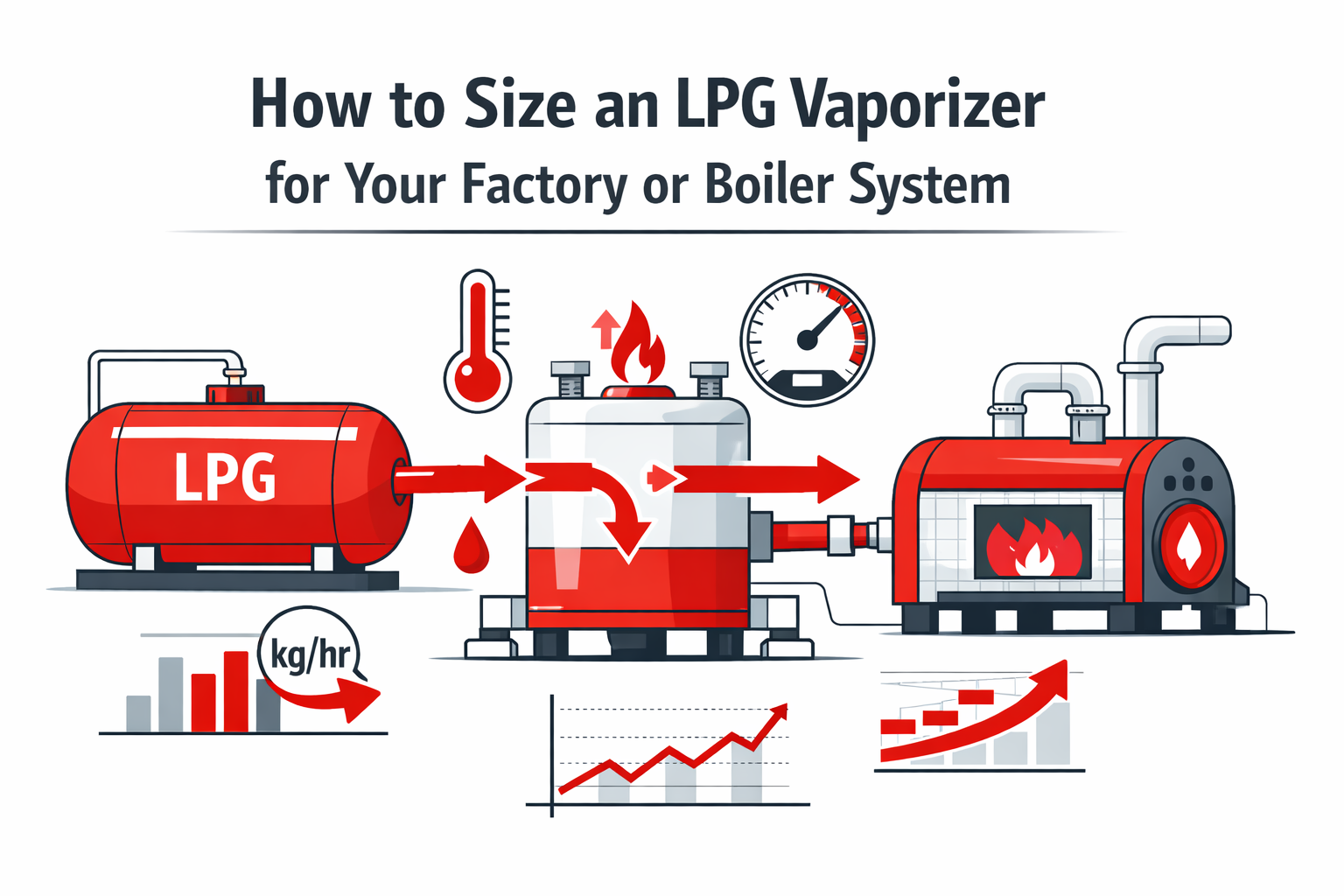
An LPG vaporiser converts liquid LPG from bulk storage tanks into vapour before it reaches boilers, furnaces, ovens, or other combustion equipment. This conversion requires controlled heat input and sufficient capacity to maintain vapour flow under changing demand.
Industrial facilities rarely operate at a constant load. Start-ups, batch processing, and simultaneous equipment operation create sudden increases in LPG consumption. A correctly sized vaporiser absorbs these changes without allowing liquid carryover or pressure instability. This is why experienced teams treat vaporiser sizing as a system-level decision rather than a simple product selection.
Facilities that work with industrial LPG system specialists understand that vaporiser performance is directly linked to the overall LPG system design. Proper sizing supports consistent combustion, improved fuel efficiency, and reduced wear on downstream components.
Why Incorrect Sizing Causes Operational Problems
Undersized vaporizers struggle to meet peak demand. When vaporisation capacity is exceeded, LPG flashes too quickly, drawing heat from the surroundings. This leads to icing, reduced heat transfer, falling outlet pressure, and burner flame instability. Production interruptions often follow.
Oversizing is not a safe alternative. Larger vaporizers increase capital cost, electrical or heat input requirements, and installation complexity. They may also operate inefficiently at partial loads, creating control challenges without delivering additional reliability.
Plants that do not follow a structured LPG vaporizer sizing guide for factories often experience repeated maintenance issues and unplanned downtime. This is why organisations rely on teams with 24+ years of LPG engineering experience to review demand, operating conditions, and safety margins before selecting capacity.
Why Pakistani Factories Face Unique Sizing Challenges
LPG vaporiser sizing in Pakistan must account for local operating realities. Seasonal temperature variation has a direct impact on vaporisation efficiency, particularly during colder mornings in Lahore and other industrial zones of Punjab. Vaporizers sized for average conditions may perform well in summer and struggle in winter.
Industrial load patterns also vary widely. Many facilities operate multiple burners or boilers across different shifts, creating fluctuating demand throughout the day. LPG quality, storage configuration, and supply pressure further influence system behaviour.
From a regulatory perspective, stable vapour supply is a safety expectation. Oversight from bodies such as the Oil and Gas Regulatory Authority of Pakistan reinforces the importance of safe and consistent gas delivery. Pressure equipment safety principles referenced by the Petroleum and Explosives Safety Organization also highlight the link between correct sizing and operational safety.
Facilities that design systems around complete LPG system solutions benefit from better alignment between storage, vaporisation, and downstream equipment. When sizing is done correctly at the design stage, approvals are smoother, commissioning is faster, and long-term performance is more predictable.
How to Calculate LPG Demand Before Selecting a Vaporiser
Before choosing any LPG vaporiser, calculating actual LPG demand is the most critical step. Skipping this stage or relying on rough estimates is the main reason industrial vaporizers fail to perform as expected. A proper demand calculation ensures the vaporiser can support operations safely, efficiently, and without pressure instability. This step sits at the core of any reliable LPG vaporizer sizing guide.
In industrial environments, LPG demand is rarely constant. Boilers, furnaces, dryers, and ovens behave differently depending on process conditions, shift schedules, and start-up cycles. Understanding how much LPG your system consumes, and when it consumes it, allows engineers to size vaporizers based on real operating behaviour rather than nameplate assumptions.
Understanding LPG Consumption in kg per Hour
Industrial LPG demand is always calculated in kilograms per hour. Most boilers and burners specify fuel input in kilowatts or BTU. These values must be converted into LPG mass flow to determine vaporiser capacity requirements.
For example, a boiler rated for a certain heat input will consume a predictable amount of LPG at full load. However, industrial systems rarely operate at full load continuously. This is why engineers do not size vaporizers based on maximum ratings alone.
A structured approach to how to size an LPG vaporizer starts by converting each appliance’s rated input into kg per hour and then evaluating how those loads behave during real operation. This prevents common mistakes such as undersizing for peak demand or oversizing based on theoretical maximums.
Boiler Load, Burner Ratings, and Diversity Factors
Most industrial facilities operate more than one LPG-consuming appliance. Boilers may cycle on and off, while furnaces ramp up during production peaks. Some equipment may operate continuously, while others run intermittently.
This is where diversity factors become important in LPG vaporizer capacity calculation. Diversity reflects the reality that not all equipment operates at maximum output at the same time. Simply adding all maximum ratings together often results in unnecessary oversizing.
For example, two boilers may each be capable of full output, but operational data may show that they rarely peak simultaneously. Engineers evaluate operating schedules, production patterns, and historical usage to apply realistic diversity assumptions.
Facilities that involve industrial LPG system specialists early benefit from demand calculations that reflect actual usage rather than worst-case assumptions that inflate system cost.
Continuous Demand Versus Peak Demand
Another critical distinction is between continuous demand and peak demand. Continuous demand represents average LPG consumption during normal operation. Peak demand represents short-term spikes such as cold starts, burner ignition, or batch processing.
Vaporizers must handle peak demand without pressure collapse, but they do not need to operate at peak capacity continuously. Effective LPG vaporizer flow rate sizing balances these two conditions by allowing sufficient headroom for spikes while maintaining efficient operation during normal loads.
In Pakistan’s industrial sector, particularly in manufacturing zones around Lahore, peak demand events often occur during shift changes or morning start-ups. Systems that ignore these spikes experience burner instability at the worst possible times.
From a safety and compliance perspective, stable gas supply under peak conditions is essential. Guidance from the Oil and Gas Regulatory Authority of Pakistan and pressure safety principles promoted by the Petroleum and Explosives Safety Organization both emphasise adequate capacity and controlled operation in industrial LPG systems.
Once demand has been clearly defined in kg per hour, engineers can begin reviewing vaporiser options with confidence. Many facilities compare calculated demand against available equipment within industrial LPG equipment ranges to understand realistic capacity options before final selection.
LPG Vaporiser Flow Rate and Capacity Explained
Once LPG demand has been calculated accurately, the next step is understanding how vaporiser flow rate and capacity ratings translate into real industrial performance. Many sizing errors happen at this stage, not because demand calculations were wrong, but because capacity figures were misunderstood. A practical LPG vaporizer sizing guide must explain what these ratings actually represent under operating conditions found in factories and boiler systems.
Manufacturers publish flow rate and capacity data to guide selection, but these values are often based on specific assumptions. If those assumptions do not match site conditions, the vaporiser may underperform even though it appears correctly sized on paper.
What LPG Vaporiser Flow Rate Actually Represents
LPG vaporiser flow rate refers to the amount of vapour the unit can deliver over time, typically expressed in kilograms per hour. This figure represents vapour output, not the volume of liquid LPG entering the vaporiser. Confusing liquid flow with vapour flow is a common and costly mistake.
In an industrial system, vapour flow must remain stable even when demand changes suddenly. If the vaporiser cannot supply vapour at the required rate, pressure drops occur downstream. Burners respond poorly to this instability, leading to flame fluctuations, inefficient combustion, or shutdowns.
This is why engineers focus on LPG vaporizer flow rate guide principles that match vapour output to peak system demand rather than average consumption. Facilities that consult industrial LPG system specialists early often avoid flow-related issues because sizing decisions are tied to actual operating behaviour.
How to Read an LPG Vaporiser Capacity Chart
Capacity charts are essential tools, but only when interpreted correctly. Most LPG vaporizer capacity charts assume specific conditions such as ambient temperature, inlet pressure, and available heat input. These conditions are rarely identical to those found on-site.
For example, a vaporiser rated for a certain kg per hour output may only achieve that capacity at a defined temperature. During colder conditions, output can drop significantly if heat transfer is limited. This is particularly relevant for industrial facilities operating in Lahore and surrounding regions during winter months.
Engineers following vaporizer sizing for LPG systems best practices treat capacity charts as guidance rather than absolute limits. Safety margins are applied to ensure the vaporiser performs reliably across seasonal temperature changes and fluctuating loads.
Why Nameplate Capacity Alone Is Not Enough
Nameplate capacity often reflects maximum theoretical output under ideal conditions. Relying solely on this value can lead to undersized systems that struggle during peak demand or cold weather operation.
Two vaporizers with identical nameplate capacities may perform very differently depending on heat source design, control accuracy, and installation quality. This is why capacity selection must consider the entire system rather than a single specification.
From a safety perspective, operating a vaporiser continuously near its maximum limit increases stress on downstream regulators, valves, and burners. Pressure stability is a key concern in LPG system design, and inadequate flow capacity can compromise it.
Regulatory guidance reinforces this approach. Principles supported by the Oil and Gas Regulatory Authority of Pakistan and pressure safety frameworks promoted by the Petroleum and Explosives Safety Organization both highlight the importance of stable gas delivery and controlled operation.
Facilities often review calculated demand against available equipment within industrial LPG equipment options to confirm that selected vaporizers can sustain required output with appropriate headroom. Engineers may also validate selections by referencing a structured LPG vaporizer sizing guide for factories before procurement.
Understanding flow rate and capacity correctly ensures vaporisers are selected for real-world performance rather than catalogue values. In the next section, the guide explains how heat input and ambient temperature directly affect vaporiser output, and why these factors must be considered alongside flow rate when finalising capacity.
Heat Input and Temperature Factors in LPG Vaporiser Sizing
Even when LPG demand and flow rate are calculated correctly, vaporiser performance can still fall short if heat input and temperature conditions are ignored. Vaporisation is a heat-driven process. Without sufficient and consistent heat transfer, liquid LPG cannot convert into vapour at the required rate. This is why heat input and ambient temperature are critical components of any accurate LPG vaporizer sizing guide.
In industrial environments, especially across Pakistan, temperature-related performance issues are one of the most common causes of vaporiser underperformance.
Understanding LPG Vaporiser Heat Capacity
Every LPG vaporiser relies on an external heat source to convert liquid LPG into gas. Depending on the vaporiser type, this heat may come from electricity, steam, hot water, or ambient air. The amount of heat available directly limits how much LPG can be vaporised in a given time.
This relationship is often described as LPG vaporizer heat capacity sizing. Even if a vaporiser appears large enough based on flow rate alone, insufficient heat input will restrict vapour output. In practical terms, this means the vaporiser becomes the bottleneck in the system.
Industrial designers therefore treat heat input as a core sizing parameter. Heat availability must match peak vaporisation demand, not just average operation. Facilities that plan systems holistically often review heat requirements alongside complete LPG system solutions to ensure compatibility between vaporizers, power supply, and process utilities.
Impact of Ambient Temperature on Vaporisation
Ambient temperature plays a major role in vaporiser performance. As temperature drops, more energy is required to vaporise LPG. Vaporizers sized without considering seasonal conditions may perform adequately during warm months and fail during colder periods.
In Lahore and other industrial regions of Punjab, early winter mornings frequently expose marginally sized systems. Vaporizers struggle to maintain output during start-up, leading to pressure drops and delayed burner ignition.
Engineers following a structured LPG vaporizer sizing formula account for worst-case ambient conditions rather than average temperatures. This approach ensures reliable vapour supply throughout the year and avoids seasonal operational issues.
Facilities that consult industrial LPG system specialists early typically factor ambient temperature into sizing calculations, preventing cold-weather failures that disrupt production.
Why Cold Conditions Cause Icing and Pressure Drop
When LPG vaporises rapidly without enough heat input, it absorbs heat from its surroundings. This rapid heat loss lowers surface temperature and causes moisture in the air to freeze on the vaporiser. This phenomenon, known as icing, reduces heat transfer efficiency even further.
As icing builds up, vapour output drops, outlet pressure falls, and burners become unstable. Operators often misinterpret this as a supply or equipment fault, when the real issue is insufficient heat capacity for the operating conditions.
Correct sizing prevents this chain reaction. Vaporizers selected using a comprehensive LPG vaporizer capacity selection guide maintain enough thermal margin to avoid icing, even during peak demand or cold starts.
Safety and Regulatory Implications
From a safety standpoint, unstable vapour supply increases stress on downstream regulators, control valves, and burners. This can trigger nuisance shutdowns or create unsafe combustion conditions.
Regulatory oversight reinforces the importance of thermal adequacy. Guidance issued by the Oil and Gas Regulatory Authority of Pakistan emphasises stable and safe LPG supply in industrial installations. Pressure equipment safety principles promoted by the Petroleum and Explosives Safety Organization also highlight the link between controlled vaporisation and system safety.
Facilities that design systems with proper heat input margins not only improve reliability but also reduce compliance risk during inspections.
Understanding how heat input and temperature affect vaporiser performance is essential before final capacity selection. In the next section, the guide focuses on safety, compliance, and regulatory considerations in Pakistan, and explains how correct vaporiser sizing supports both operational safety and regulatory approval.
Safety, Compliance, and Regulatory Considerations in Pakistan
LPG vaporiser sizing is not only a technical decision. It is a safety and compliance requirement for industrial facilities operating in Pakistan. A vaporiser that cannot supply stable vapour under all operating conditions introduces risk at every downstream component, including regulators, valves, burners, and boilers. For this reason, safety authorities and inspectors consistently link system reliability back to correct sizing. Any serious LPG vaporizer sizing guide must address regulatory expectations alongside engineering performance.
Incorrect sizing often becomes visible during inspections or after incidents. Pressure instability, repeated burner shutdowns, and icing are not viewed as normal operational issues. They are treated as indicators of poor system design.
OGRA Guidelines and LPG System Responsibility
In Pakistan, industrial LPG installations fall under the oversight of the Oil and Gas Regulatory Authority of Pakistan. While OGRA does not approve individual vaporiser models, it sets the regulatory framework that requires safe, stable, and controlled gas supply in industrial environments.
From a compliance perspective, vaporiser sizing supports several core expectations. The system must be capable of meeting peak demand without pressure collapse. It must operate within the limits of connected equipment. It must also avoid operating conditions that increase the likelihood of icing, flame instability, or emergency shutdowns.
Facilities that follow a documented LPG vaporizer sizing guide for factories are far better positioned during audits and site reviews. Clear demand calculations, capacity justification, and safety margins demonstrate that sizing decisions were made responsibly rather than by approximation.
Pressure Equipment Safety and PESO Principles
Pressure stability is central to LPG system safety. Principles promoted by the Petroleum and Explosives Safety Organization emphasise controlled pressure, predictable operation, and equipment used within defined limits. Although PESO guidelines are often associated with pressure vessels and hazardous materials, the same principles apply to LPG vaporisation systems.
Undersized vaporizers are frequently forced to operate at or beyond their effective limits during peak demand. This places unnecessary stress on regulators and safety valves and increases the likelihood of nuisance trips or unsafe conditions.
Correct vaporizer sizing for LPG systems ensures that pressure control devices function as intended. Stable vapour supply reduces system cycling, improves burner safety, and lowers the risk of abnormal operating events.
Why Proper Sizing Supports Inspection and Approval
During inspections, authorities focus less on brand selection and more on system behaviour. Inspectors assess whether the LPG system can support connected loads safely under all expected conditions. Vaporiser sizing plays a direct role in this assessment.
Facilities that involve experienced engineers early often prepare sizing documentation that includes demand calculations, safety margins, and operating assumptions. This documentation simplifies inspections and reduces the likelihood of corrective actions after installation.
Plants that work with a trusted LPG compliance partner typically experience fewer delays because system design decisions align with both operational needs and regulatory expectations.
Operational Safety Beyond Compliance
Safety is not limited to passing inspections. Stable vaporiser performance reduces operator intervention, limits emergency shutdowns, and improves overall plant reliability. Poorly sized systems force operators to compensate manually, increasing human error risk.
Facilities that design LPG systems as part of complete LPG system solutions benefit from better coordination between storage, vaporisation, and downstream equipment. This integrated approach improves both safety and efficiency.
When safety and compliance are considered from the beginning, vaporiser sizing becomes a protective measure rather than a regulatory hurdle. Correct sizing reduces risk exposure, improves plant confidence, and supports long-term operational stability.
With regulatory and safety considerations clearly defined, the next section focuses on practical decision-making. It explains how to translate demand calculations and safety margins into selecting the right LPG vaporiser capacity for your specific facility.
Choosing the Right LPG Vaporiser Capacity for Your Facility
Once LPG demand, flow rate behaviour, heat input, and safety requirements are clearly understood, the next step is selecting the correct vaporiser capacity. This is where calculations are translated into a practical, reliable system design. A disciplined approach to LPG vaporizer capacity selection ensures your facility operates smoothly under both normal and peak conditions, without unnecessary cost or risk.
The goal is not to choose the largest unit available, but to select a vaporiser that matches real operational needs with appropriate engineering margin.
Matching Vaporiser Capacity to Actual Operating Load
Capacity selection should always start with the calculated peak LPG demand expressed in kilograms per hour. From there, a sensible safety margin is applied. This margin accounts for temperature variation, control response time, and short-term demand spikes.
Engineers using an LPG vaporizer sizing chart kg per hour approach typically select a vaporiser that can comfortably meet peak demand without operating continuously at its upper limit. This allows the system to respond smoothly during boiler start-ups, load changes, or simultaneous equipment operation.
Operating a vaporiser too close to its maximum capacity increases wear, reduces thermal efficiency, and raises the likelihood of pressure instability. Facilities that consult industrial LPG system specialists early often avoid these issues by selecting capacity based on how the plant actually runs, not how it might run in a theoretical worst case.
Allowing for Future Expansion Without Oversizing
Industrial facilities rarely remain static. Additional burners, upgraded boilers, or increased production output are common over the life of a plant. Ignoring future growth often results in early system limitations and costly upgrades.
However, planning for expansion does not mean doubling capacity without justification. Experienced engineers typically allow a controlled expansion margin aligned with realistic growth plans. This provides flexibility while keeping current operation efficient.
When reviewing capacity options, many facilities compare calculated demand against available equipment within industrial LPG equipment ranges. This helps identify vaporizers that support both present requirements and foreseeable expansion without excessive oversizing.
Common Capacity Selection Mistakes to Avoid
One of the most common mistakes is selecting capacity based purely on catalogue ratings. Nameplate values often assume ideal conditions that may not exist on-site, especially during colder periods.
Another frequent error is choosing the smallest possible unit to reduce upfront cost. While this may lower initial expenditure, it often leads to higher operating costs, increased maintenance, and production downtime caused by pressure instability and icing.
Oversizing as a safety measure is equally problematic. Larger vaporizers require more power or heat input and may operate inefficiently at partial loads. Control systems can become less responsive, and compliance complexity may increase.
A structured how to size LPG vaporizer methodology balances performance, efficiency, and safety rather than optimising for a single factor.
Capacity Selection and Safety Margins
From a safety perspective, vaporisers should always operate within comfortable thermal and flow limits. Adequate capacity margin reduces stress on downstream regulators, valves, and burners, improving overall system reliability.
Regulatory expectations reinforce this approach. Guidance from the Oil and Gas Regulatory Authority of Pakistan places responsibility on operators to ensure stable and safe gas supply under all expected conditions. Pressure safety principles referenced by the Petroleum and Explosives Safety Organization also support operating equipment well within defined limits.
Facilities that align capacity selection with these principles experience fewer compliance issues and smoother inspections.
Validating Capacity Before Final Selection
Before procurement, it is good practice to review capacity assumptions with experienced engineers. Small adjustments at this stage can prevent significant operational issues later.
Many facilities choose to validate their selection by reviewing system layouts or discussing demand profiles with teams that have hands-on installation experience. Working with a partner that offers complete LPG system solutions ensures vaporiser capacity aligns with storage, piping, and downstream equipment.
Selecting the right LPG vaporiser capacity is where engineering judgement has the greatest impact. When done correctly, it delivers stable operation, predictable performance, and long-term cost control.
LPG Vaporiser Sizing for an Industrial Boiler System
Understanding concepts is important, but seeing how LPG vaporiser sizing works in a real industrial scenario makes the process far clearer. This example demonstrates how engineers apply a structured LPG vaporizer sizing guide to a typical boiler system found in manufacturing facilities across Pakistan. The focus is on decision-making rather than complex calculations.
System Overview and Operating Conditions
Consider a medium-sized factory using LPG-fired steam boilers for process heating. The facility operates two shifts per day, with higher steam demand during morning start-up and peak production hours. LPG is supplied from a bulk storage tank to a dedicated vaporiser that feeds a boiler burner through pressure regulation and safety controls.
The system must deliver stable vapour flow during cold starts, continuous operation, and short-term load spikes. Seasonal temperature variation is also a factor, particularly during winter mornings in Lahore when vaporisation efficiency drops.
Before sizing begins, engineers review boiler input ratings, daily operating hours, start-up behaviour, and any planned future expansion. Facilities that work with industrial LPG system specialists typically start at this stage to ensure assumptions reflect real operating conditions rather than idealised data.
Demand Estimation and Capacity Planning
Using the boiler’s rated heat input, engineers convert energy demand into LPG consumption expressed in kilograms per hour. This establishes the base demand under full load. Next, they examine how often the boiler operates at maximum output and identify short-term peak conditions such as ignition and warm-up cycles.
Rather than selecting a vaporiser equal to the calculated maximum demand, a safety margin is applied. This margin accounts for ambient temperature variation, heat transfer efficiency, and control response time. The resulting figure represents the minimum vapour output the system must sustain without pressure drop.
At this stage, engineers reference vaporizer sizing for LPG systems to confirm that selected capacity supports both continuous operation and peak demand events. Capacity charts are reviewed, but selections are made conservatively to avoid running the vaporiser near its operational limits.
Many facilities also compare calculated requirements against available options within industrial LPG equipment ranges to identify vaporizers suitable for the application without excessive oversizing.
Heat Input and Environmental Considerations
Heat input is reviewed alongside capacity selection. Engineers ensure that the chosen vaporiser has sufficient heat source capability to maintain vapour output during colder conditions. This is particularly important for facilities that operate early mornings or in cooler regions.
If heat input is marginal, even a correctly sized vaporiser may struggle under peak demand. This step prevents common issues such as icing, delayed ignition, and pressure instability that often appear after commissioning.
Safety and Compliance Validation
Before finalising the design, engineers validate that the selected vaporiser operates within safe limits under all expected conditions. Stable pressure delivery protects downstream regulators, valves, and burners from unnecessary stress.
From a regulatory perspective, this approach aligns with expectations set by the Oil and Gas Regulatory Authority of Pakistan, which emphasises safe and consistent gas supply in industrial installations. Pressure equipment safety principles promoted by the Petroleum and Explosives Safety Organization also support operating equipment with adequate capacity margins.
Facilities that document demand calculations, capacity selection logic, and safety margins generally experience smoother inspections and fewer post-installation modifications.
Key Lessons from the Example
This example highlights several important lessons. First, accurate demand assessment prevents undersizing. Second, applying sensible safety margins avoids pressure instability during peak operation. Third, environmental conditions must always be factored into vaporiser selection.
Most importantly, vaporiser sizing works best when treated as part of a complete system design rather than an isolated purchase decision. Facilities that engage experienced engineers early benefit from reliable operation, safer systems, and lower long-term costs.
Getting LPG Vaporiser Sizing Right from Day One
Correct LPG vaporiser sizing is one of the most important design decisions in any industrial LPG system. When done properly, it ensures stable combustion, safer operation, and long-term cost control. When done poorly, it leads to recurring shutdowns, compliance challenges, and avoidable maintenance issues. This LPG vaporizer sizing guide has shown that sizing is not about selecting a product quickly, but about understanding how your system truly operates.
From factories and boiler rooms to large process plants, the same principle applies. Vapour supply must consistently match real demand under real operating conditions.
Key Takeaways for Engineers and Plant Managers
Accurate demand calculation is the starting point. Understanding LPG consumption in kilograms per hour, identifying peak demand events, and applying realistic diversity factors prevents both undersizing and unnecessary oversizing.
Flow rate ratings and capacity charts must be interpreted carefully. Nameplate capacity alone does not guarantee performance. Ambient temperature, heat input availability, and control response all influence how much vapour a system can actually deliver.
Heat input is equally critical. Vaporizers depend on sufficient thermal energy to convert liquid LPG into gas. Systems that ignore seasonal temperature variation, particularly during colder mornings, often experience icing and pressure instability even when capacity appears adequate.
Safety and compliance are inseparable from sizing decisions. Stable vapour supply protects burners, regulators, and valves while reducing operational risk. Facilities that follow a structured how to size LPG vaporizer methodology experience smoother commissioning and fewer long-term issues.
Why Expert Review Makes a Difference
Even with correct calculations, engineering judgement plays a decisive role. Every facility has unique operating patterns, expansion plans, and environmental conditions. These factors cannot be fully captured by formulas alone.
Experienced engineers recognise potential risks early, such as marginal heat input, unrealistic diversity assumptions, or future load increases. Addressing these issues at the design stage is far more effective than correcting them after installation.
In Pakistan, regulatory expectations place responsibility on operators to ensure LPG systems are designed and operated safely. Guidance from the Oil and Gas Regulatory Authority of Pakistan reinforces the importance of stable gas supply and responsible system design. Pressure safety principles referenced by the Petroleum and Explosives Safety Organization further support operating vaporisation equipment within comfortable limits.
Facilities that involve knowledgeable partners early reduce compliance risk and improve overall system reliability.
Positioning Indus 3 as a Trusted Engineering Partner
With over two decades of industry experience, Indus 3 supports industrial clients across Pakistan with practical LPG system design and equipment selection. The focus is not just on supplying components, but on ensuring each system operates safely, efficiently, and in line with real production needs.
Whether you are planning a new installation, upgrading an existing boiler system, or experiencing performance issues with your current vaporiser, working with industrial LPG system specialists helps identify the root cause rather than treating symptoms.
Facilities that explore complete LPG system solutions benefit from better alignment between storage, vaporisation, piping, and downstream equipment. This integrated approach reduces mismatches and improves long-term performance.
Take the Next Step with Confidence
If you are unsure whether your current vaporiser is correctly sized, or if you are designing a new LPG system, a professional review can prevent costly mistakes. Early consultation often reveals simple adjustments that significantly improve safety and reliability.
You can request a vaporiser sizing consultation to discuss your system requirements, operating conditions, and future plans. To learn more about the experience behind this guidance, visit the team with 24+ years of LPG engineering experience.
2 Replies to “LPG Vaporizer Sizing Guide for Industrial Systems | Indus 3”