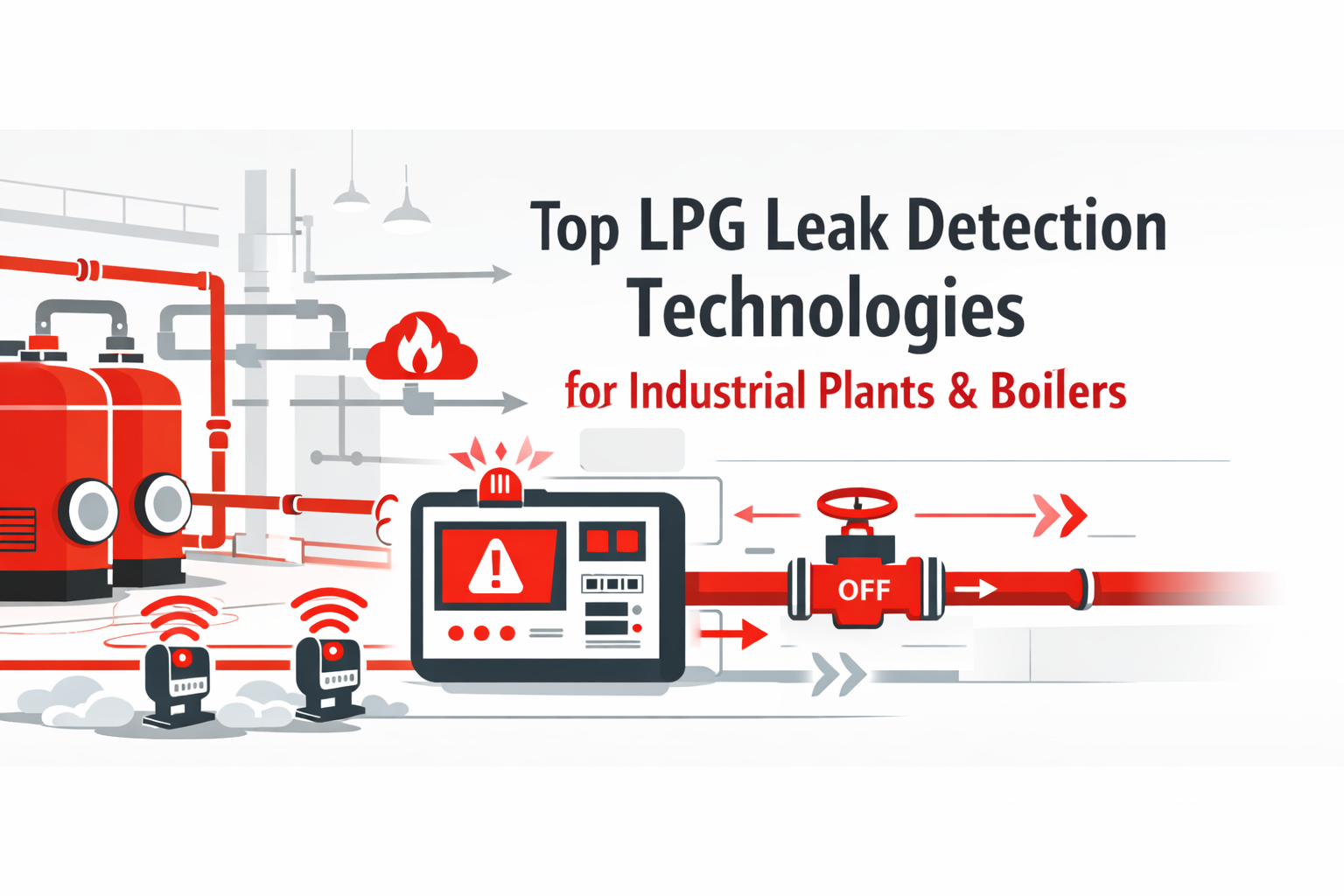
Understanding LPG Leak Detection Technologies in Industrial Environments
LPG leak detection technologies are a fundamental safety layer in modern industrial plants, particularly where boilers, burners, and bulk gas storage are in constant operation. For engineers and plant operators, these systems are not optional add-ons; they are engineered safeguards designed to prevent fires, explosions, production shutdowns, and costly asset damage. In high-throughput industrial settings, even a minor undetected LPG release can escalate into a major operational incident within minutes.
An effective lpg gas leak detection system continuously monitors the presence of gas and provides early warnings before concentrations reach flammable limits. In many cases, these systems are integrated with alarms, automatic shut-off valves, and control panels to isolate gas flow immediately. This proactive approach significantly reduces downtime, protects personnel, and helps facilities maintain compliance with industrial safety requirements across Pakistan.
A critical factor in LPG safety is its physical behaviour. LPG is heavier than air, which means it does not disperse upward like natural gas. Instead, it settles and accumulates near ground level. This makes lpg gas heavier than air leak detection especially important in basements, boiler rooms, service trenches, and enclosed plant areas where ventilation may be limited. In industrial facilities across Lahore and other manufacturing hubs, these low-lying spaces are common and often house pipelines, vaporizers, and pressure regulation equipment.
From an engineering perspective, lpg gas heavier than air leak safety depends heavily on correct sensor placement and system design. Detectors positioned too high may fail to identify gas pooling at floor level, allowing a hazardous concentration to build unnoticed. Diagrams that illustrate LPG accumulation near the ground can be particularly useful for visualising this risk during system planning and safety briefings, especially for multi-level boiler installations.
Industrial LPG leaks most commonly originate from mechanical interfaces rather than storage vessels themselves. Pipelines carrying LPG under pressure, isolation valves, flanged joints, vaporizers, and cylinder manifolds are all potential leak points. Over time, vibration, thermal expansion, corrosion, or improper maintenance can compromise seals and fittings. An industrial lpg gas leak detector is designed to monitor these areas continuously, offering a level of protection that manual inspections alone cannot achieve.
Beyond immediate safety benefits, reliable leak detection also supports operational continuity. Unplanned shutdowns caused by gas incidents can halt production, damage equipment, and disrupt supply commitments. Early detection allows maintenance teams to intervene in a controlled manner, often before a full shutdown is required. This makes leak detection technologies a practical risk-management investment, not just a regulatory requirement.
In Pakistan, industrial gas handling is governed by safety frameworks issued by the Oil and Gas Regulatory Authority. Facilities handling LPG are expected to implement appropriate detection and control measures in line with Oil and Gas Regulatory Authority guidelines for industrial gas systems. Aligning detection strategies with these regulations helps plants demonstrate due diligence during audits and inspections while maintaining a safer working environment.
For organisations seeking industrial LPG safety solutions in Pakistan, it is essential to work with suppliers who understand local operating conditions, regulatory expectations, and real-world plant layouts. Indus 3’s experience in industrial gas systems reflects over two decades of practical involvement in LPG equipment and safety engineering. To learn more about their background, visit https://indus3.pk/about-us/, or explore their broader capabilities at https://indus3.pk/ as part of a structured approach to industrial LPG safety.
Fixed LPG Gas Leak Detection Systems for Industrial Plants
A fixed LPG gas leak detection system is designed to provide continuous, automated monitoring in areas where LPG is stored, processed, or consumed. Unlike portable detectors, these systems operate permanently in the background, forming an integral part of industrial safety infrastructure. For engineers managing boiler rooms, LPG storage yards, and vaporizer skids, understanding the lpg gas leak detector working principle is essential for correct system design and reliable operation.
At the core of any fixed system are gas sensors installed at strategic locations. These sensors are calibrated to detect LPG at very low concentration levels, well before the gas reaches its lower explosive limit. Because LPG is heavier than air, sensors are typically mounted close to floor level, near pipelines, valves, vaporizers, and cylinder manifolds. In boiler rooms and enclosed plant spaces common in Pakistani factories, this positioning is critical to ensure early detection of gas accumulation that might otherwise remain unnoticed.
When LPG is present, the sensor converts the detected gas concentration into an electrical signal. This signal is transmitted to a central control panel, which acts as the system’s decision-making unit. The control panel continuously analyses incoming data from all connected sensors and compares it against pre-set alarm thresholds. This centralised approach allows multiple risk zones—such as an LPG storage yard and an adjacent vaporizer skid—to be monitored simultaneously through a single interface.
Once gas levels exceed the defined safe limit, the control panel initiates a series of automated responses. Audible and visual alarms are activated to alert plant personnel immediately. These alarms are typically installed both locally, near the leak source, and centrally in control rooms to ensure rapid awareness across the facility. In parallel, the system can trigger automatic shut-off valves installed on LPG supply lines. These valves close the gas flow within seconds, isolating the affected section and preventing further release. This automated isolation is a key advantage of an industrial lpg gas leak detector, as it reduces reliance on manual intervention during high-risk situations.
In industrial applications, fixed detection systems are often integrated with broader safety and control architectures. For example, a boiler room detection system may be linked to burner management systems, ventilation controls, or emergency shutdown protocols. In LPG storage yards, detectors may be connected to perimeter alarms and remotely operated valves, providing layered protection across open and enclosed areas. Vaporizer skids, which handle phase change and pressure regulation, are particularly sensitive zones where continuous detection is considered best practice due to the concentration of fittings and thermal stresses involved.
From a compliance and installation perspective, correct system design extends beyond equipment selection. Sensor spacing, mounting height, cable routing, and power redundancy all influence system reliability. Installation and commissioning should follow recognised safety standards issued by authoritative bodies such as Petroleum and Explosives Safety Organisation, whose engineering guidance is widely referenced across South Asia for gas detection and hazardous area practices. Adhering to such standards helps ensure that systems perform as intended under real operating conditions.
For clarity during planning and training, schematic-style system layout illustrations are often valuable. These diagrams typically show sensor locations, signal flow to the control panel, alarm points, and automatic shut-off valves within a boiler room or LPG yard. While not decorative, they support accurate installation and long-term maintenance.
Facilities looking to source industrial gas safety equipment can explore suitable components via https://indus3.pk/shop-page/, while those requiring tailored layouts or technical validation are encouraged to seek a consultation for LPG detection system design through https://indus3.pk/contact/. This approach ensures that fixed LPG detection systems are engineered as coherent safety solutions, rather than isolated devices, supporting both operational continuity and regulatory confidence.
Portable and Handheld LPG Gas Leak Detectors for Industrial Maintenance
For maintenance engineers and safety officers, portable gas detection plays a supporting but highly practical role alongside fixed safety systems. While fixed detectors provide continuous monitoring in defined zones, a lpg gas leak detector in portable or handheld form allows targeted checks during activities where system conditions change. Inspections, shutdowns, maintenance work, and commissioning phases all introduce temporary risks that fixed systems alone cannot fully cover.
During routine inspections, portable detectors are used to verify the integrity of pipelines, valves, flanged joints, and flexible connections. These are the areas most likely to develop minor leaks over time due to vibration, thermal cycling, or mechanical wear. A handheld detector allows the engineer to move systematically along gas lines and equipment, confirming that no LPG is escaping at connection points. This approach is especially valuable when investigating suspected issues such as the leaking of LPG cylinder connections in cylinder manifolds or changeover systems used as backup supply in industrial plants.
Portable detectors are also essential during planned shutdowns and maintenance activities. When sections of a boiler system or vaporizer skid are isolated and later brought back online, temporary joints may be disturbed, and seals may not seat correctly on the first attempt. Using a handheld detector during re-pressurisation provides immediate feedback, allowing maintenance teams to correct issues before full operation resumes. In commissioning scenarios, portable detection supports verification that newly installed equipment meets safety expectations before fixed systems are relied upon for long-term monitoring.
In commissioning and fault-finding work, portable detectors offer flexibility that fixed systems cannot. Engineers can approach confined or awkward locations, such as behind boilers, beneath pipe racks, or inside service trenches, where fixed sensors may not be installed. This makes portable detection an important tool for confirming safe conditions before work permits are issued or hot work begins.
However, it is important to recognise the limitations of handheld detection and use it appropriately. Unlike fixed systems, portable detectors do not provide continuous monitoring. They only detect gas at the moment and location where they are used. This means that leaks developing outside inspection periods may go unnoticed until the next check. Their effectiveness also depends on operator skill. Incorrect probe positioning, rushed inspections, or misunderstanding of detector readings can reduce reliability. Proper training and disciplined inspection routines are therefore essential to ensure consistent results.
Calibration is another critical factor. Portable detectors must be calibrated at defined intervals to maintain accuracy. Many manufacturers publish clear calibration and bump-test procedures within their technical documentation, which should be followed strictly. Referencing manufacturer guidance or recognised engineering safety documentation ensures that handheld devices perform as expected and that readings can be trusted during safety-critical decisions.
Handheld detector usage diagrams can be particularly helpful during training and toolbox talks. These diagrams typically illustrate correct sweeping techniques, probe distances, and inspection paths around common leak sources. While not a substitute for experience, they help standardise inspection practices across maintenance teams.
For facilities sourcing industrial inspection and safety tools, suitable portable detection equipment can be explored via https://indus3.pk/shop-page/. Equally important is access to reliable after-sales guidance and application support. Details on the technical support provided by Indus 3 are available at https://indus3.pk/about-us/, reinforcing the role of portable gas detection as part of a broader, well-managed industrial LPG safety strategy rather than a standalone solution.
Infrared and Semiconductor LPG Leak Detection Technologies
Infrared and semiconductor sensors are widely used within modern LPG leak detection technologies, particularly where higher accuracy, durability, or specific environmental resistance is required. In industrial boilers, processing plants, and LPG handling areas, these sensor types offer different strengths that engineers must understand to apply them correctly.
Infrared gas detection works on a straightforward physical principle. LPG molecules absorb infrared light at specific wavelengths. An infrared sensor emits a controlled beam of light across a measurement chamber and continuously monitors how much of that light is absorbed. When LPG enters the chamber, absorption increases, and the sensor converts this change into a gas concentration signal. Because this method is based on optical absorption rather than chemical reaction, infrared sensors tend to deliver stable, repeatable readings over long periods.
From an operational standpoint, infrared sensors offer strong resistance to environmental influences. They are largely unaffected by humidity, temperature fluctuations, or the presence of other non-reactive gases. This makes them well suited for boiler rooms and industrial plants where heat, steam, and variable airflow are common. In open or semi-open areas such as LPG storage yards, infrared detection also performs reliably, as wind and dust have minimal impact on optical measurement when systems are correctly enclosed and maintained.
Semiconductor sensors operate differently. These devices use a sensing element whose electrical resistance changes when exposed to LPG. As gas molecules interact with the sensor surface, resistance shifts, and this change is interpreted as a gas concentration. Semiconductor sensors are compact and respond quickly, which makes them suitable for detecting sudden releases in enclosed industrial spaces. Within LPG leak detection technologies, they are often applied in boiler rooms, burner enclosures, or service corridors where rapid response is valuable.
However, semiconductor sensors are more sensitive to environmental conditions than infrared systems. High humidity, airborne contaminants, or temperature extremes can influence readings if sensors are not properly specified or maintained. In industrial plants, this means careful consideration of mounting location, ventilation patterns, and routine calibration. When these factors are managed correctly, semiconductor detection remains an effective solution for many fixed installations.
When comparing the two technologies, accuracy and long-term stability are key differentiators. Infrared detection generally offers superior accuracy over time with lower drift, making it attractive for critical process areas and high-risk zones. Semiconductor sensors, while accurate in controlled environments, may require more frequent calibration and inspection to maintain consistent performance. This does not make one technology universally better than the other; rather, suitability depends on the specific application, environmental exposure, and maintenance strategy of the plant.
In industrial boilers and processing facilities, detection reliability directly affects safety and uptime. A well-designed system may even combine different sensor technologies to address varied risk zones within the same site. This application-driven approach reinforces the role of LPG leak detection technologies as engineered systems rather than standalone devices.
Technical guidance on sensor behaviour and performance is supported by international engineering documentation, including standards and application notes referenced by bodies such as the International Electrotechnical Commission, which outlines best practices for gas detection in hazardous industrial environments.
Facilities planning advanced industrial LPG systems can explore broader system concepts at https://indus3.pk/, while those requiring site-specific advice are encouraged to seek technical guidance on LPG detection technology via https://indus3.pk/contact/. This ensures sensor selection is aligned with real operating conditions, regulatory expectations, and long-term plant safety objectives.
LPG Gas Heavier Than Air: Detection Challenges and Safety Design
Understanding lpg gas heavier than air leak detection is central to safe industrial LPG system design. Unlike natural gas, LPG does not rise and disperse quickly when released. Instead, it settles at low levels and spreads horizontally along floors. In industrial environments, this behaviour directly shapes how leaks develop, where hazards form, and how detection systems must be engineered to respond effectively.
In many factories across Lahore and other industrial zones in Pakistan, LPG is used in boiler rooms, burner enclosures, and service areas that include pits, trenches, cable ducts, and partially enclosed rooms. These low-lying or confined spaces create natural collection points for LPG. A small release from a valve, flange, or regulator can migrate into these areas and remain undetected if sensors are positioned incorrectly. Over time, gas can accumulate to flammable concentrations even when the source leak appears minor.
This is why lpg gas heavier than air leak safety depends less on detection sensitivity alone and more on intelligent system layout. Sensors installed at ceiling height may never encounter the gas, while accumulation continues below. For effective detection, sensors must be positioned close to the floor, typically near likely leak sources such as boiler connections, vaporizer outlets, cylinder manifolds, and pipeline low points. In trenches or pits, additional sensors may be required where gas can collect outside the main equipment footprint.
Ventilation design works alongside detection to manage risk. In enclosed boiler rooms, mechanical ventilation helps dilute any released gas, reducing the likelihood of dangerous build-up. However, ventilation should never be treated as a substitute for detection. Airflow patterns can be unpredictable, especially in older industrial buildings or during equipment operation. A properly designed detection system ensures that gas is identified regardless of how it moves within the space.
From a practical engineering perspective, diagrams that illustrate LPG pooling near ground level are often helpful during design reviews and safety briefings. These visuals support better understanding of why sensor height and spacing matter, particularly for maintenance teams who may otherwise assume gas behaves like lighter fuels. Clear layout planning also simplifies future system expansion or modification when equipment is relocated or upgraded.
Safety design expectations in Pakistan are shaped by regulatory guidance on industrial gas handling. The Oil and Gas Regulatory Authority outlines requirements and best practices for LPG installations, including expectations around leak detection, ventilation, and hazard control. Aligning detection system design with these guidelines helps facilities demonstrate compliance while creating a safer working environment for operators and maintenance staff.
A safety-first approach treats LPG behaviour as a design input rather than an afterthought. Indus 3’s safety-first engineering approach reflects this principle by focusing on system layout, sensor positioning, and real-world operating conditions rather than generic configurations. More information on this approach is available at https://indus3.pk/about-us/.
For facilities assessing existing installations or planning new LPG systems, professional evaluation can identify areas where heavier-than-air gas behaviour has not been fully addressed. A structured site assessment for LPG safety compliance can be arranged via https://indus3.pk/contact/, supporting informed decisions that balance regulatory alignment, operational practicality, and long-term industrial safety.